Astrophotography diagnosis of M42 + M43: Background chroma noise, bad seeing and 1 other
ProcessedLPLP 155×43s (total ~1.8 h)04 janv. 2023
The Doc examined this image of M42 + M43 (processed, LP, LP 155×43s (total ~1.8 h)). Estimated overall technical quality: 6/10. 3 defects found: Background chroma noise (severity 2/5), Bad seeing (severity 2/5), Astigmatism (severity 2/5).
&w=1920&q=75)
Info
- Cible
- M42 + M43
- Date
- 04 janv. 2023, 00:00
- Position
- 5h41m41s · -1°53'60"
Conditions were unfavorable: a 95% moon (near full) combined with a broadband target using an LP filter. A reflection/emission nebula like the Flame region and IC 434 suffers directly from this illuminated sky background, which crushes contrast and inflates noise. The LP filter only blocks artificial pollution, not scattered moonlight. Result: low background SNR (e_margin 1.81), a likely lunar gradient buried in the signal. For this target, better to shift the session away from full moon, or switch to dual-band if you have a color sensor suited to Ha/OIII emission.
Setup
- Type d'image
- Traitée
- Télescope
- TS-Optics Photoline 102mm f/7 FPL53 Triplet Apo
- Caméra
- ZWO ASI585MC
- Filtre
- LP
- Monture
- Sky-Watcher HEQ5
- Exposition
- LP 155×43s (total ~1.8 h)
- Phase de lune
- 95%
- Notes
- Logiciels : Astroberry Server, PixInsight, ASIStudio
- FOV
- 1.80°
The setup is coherent: the TS Photoline 102 f/7 (714mm) refractor with the ASI585MC gives a 1.8° field that frames the Flame region and surrounding Orion nebulosity well, with good margins. The sampling (2.9µm sensor at 714mm, ~0.84"/px) is slightly oversampled for the observed seeing (FWHM 5-6 px), explaining somewhat large stars, but it remains usable. The FPL53 APO triplet delivers clean, symmetric stars across the whole field, confirmed by the PSF panel. On this emission-rich target, a dual-band would clearly help under moonlight, rather than a plain broadband LP.
The diagnosis in detail
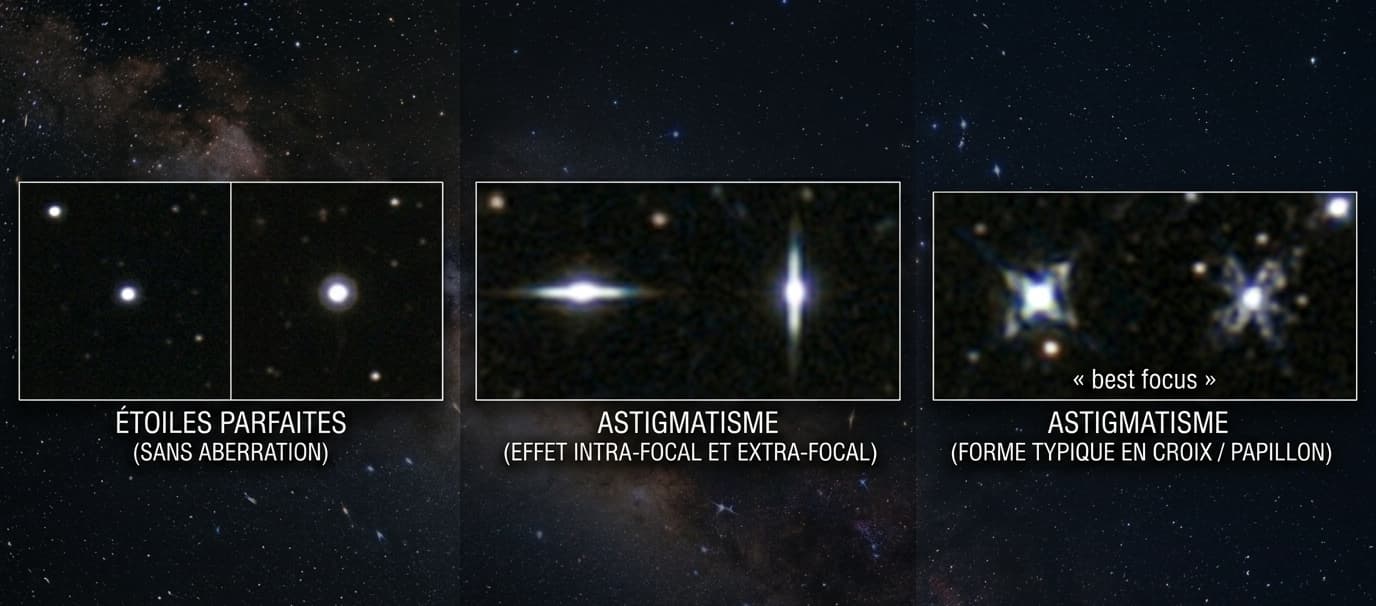
The image is generally healthy on the optics and tracking side. The PSF panel confirms round stars in all usable zones: center C at elong 1.07 (equal to the field floor), L 1.13, R 1.28, B 1.12, TL 1.07. PA dispersion is low (15.6°) but the central elong at the floor indicates no global elongation: no tracking issue on the HEQ5. The aberrant panel values (BL elong 5.07, T 1.8, TR 1.87) come from degenerate Moffat fits on very faint stars or blends in noisy zones, with no directional coherence: I therefore reject the sensor-tilt (48%, below threshold) and astigmatism (70% but unverified on the panel, corner/center ratio at 1.063 well below 1.25) candidates. The APO triplet does its job.
The real limiting factor is the acquisition: 1.8 h of total exposure under a 95% moon yields a noisy sky background, with visible chromatic mottling in the dark zones and nebulosity struggling to come out cleanly. The FWHM 5-6 px stars reflect average seeing on a slightly oversampled setup.
The measured gradient (15% oriented at 209°) remains weak and was not retained as a dedicated defect, the background map showing mostly a moderate radial symmetry consistent with mild uncorrected vignetting, but without critical amplitude.
Priority actions
- Greatly increase total integration time (aim for 4-6 h minimum) away from full moon
- Schedule this emission target with a dual-band filter when the moon is present
- Select the best subs by FWHM before integration to tighten the stars
- Apply targeted chroma noise reduction on the background during post-processing