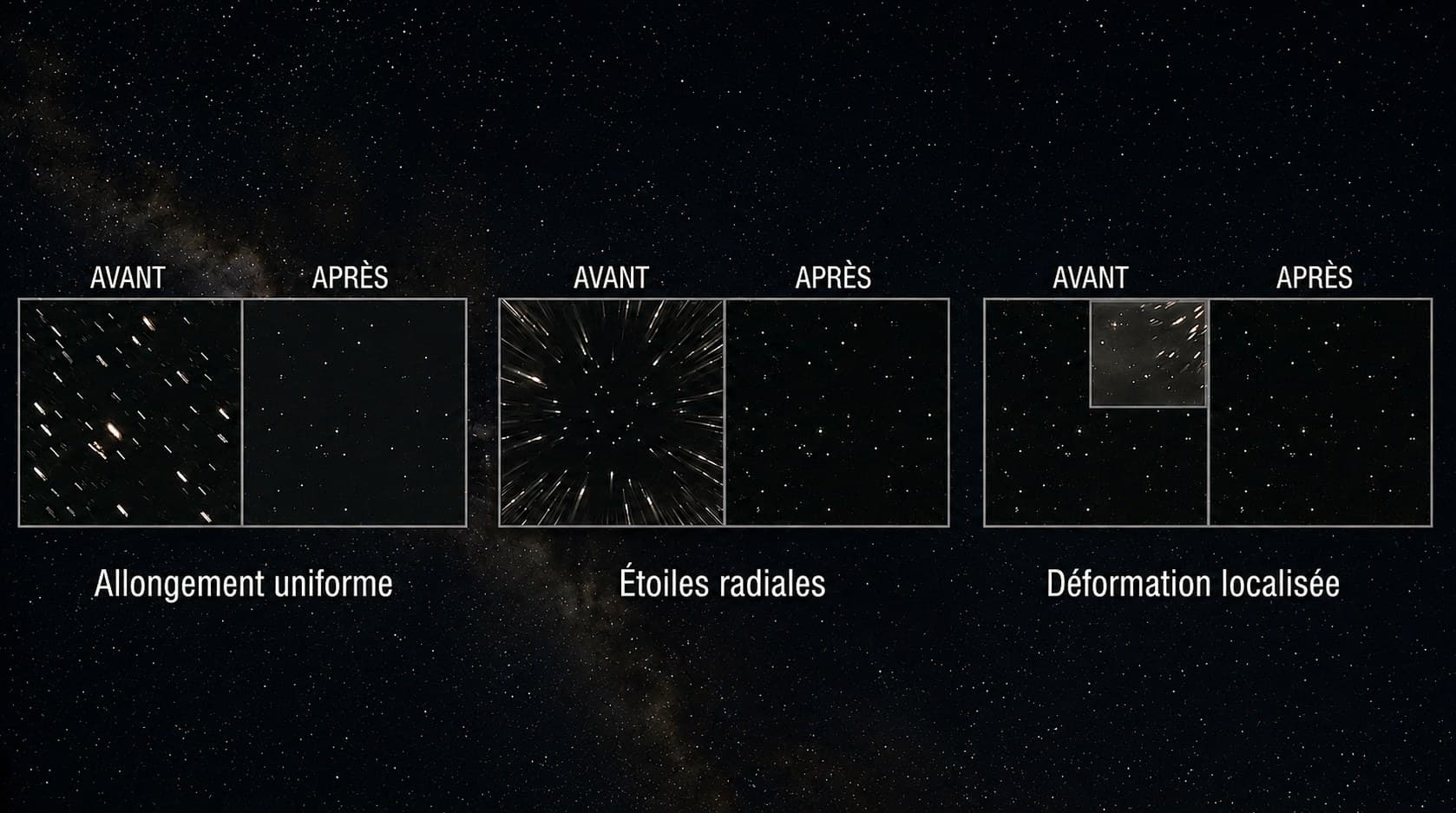
You come back from a night session, open your raw frames... and every star looks like a comma or a rod. Frustrating, right? Elongated stars in astrophotography are the number one problem for beginners, but also for many experienced imagers. The good news: every type of distortion has a precise cause, and therefore a concrete solution.
Key takeaways |
|---|
The star distortions in astrophotography fall into two broad families: exposure mechanics (tracking, guiding, polar alignment, wind, flexure) and optics (coma, tilt, backfocus, collimation). |
The primary criterion for diagnosing distorted stars: uniform elongation across the entire field points to exposure mechanics, while distortion that varies with position (corners) points to optics. |
Good autoguiding combined with an accurate polar alignment solves the majority of problems. |
Why do stars appear elongated in astrophotography?
Stretched stars occur either when the light source drifts across the sensor during the exposure, or when the optics fail to form a sharp image across the full field. The drift may come from the actual movement of the sky, a mechanical defect, or an optical defect. Identifying the origin changes everything, and you can compare your images to our visual diagnostics gallery to recognize each signature.
Shooting on a fixed tripod: the 500 Rule
Without a motorized mount, on a fixed photographic tripod, Earth's rotation creates star trails very quickly. The 500 Rule gives a first estimate: divide 500 by the lens focal length (in mm) to get the maximum exposure time before trailing. For example, with a 24 mm lens, 500/24 = roughly 20 seconds.
Keep in mind this is a rough approximation: it ignores the declination of the target (a star near the celestial equator trails faster than one near the pole) and the pixel density of modern sensors, which often trail at the pixel level. On an APS-C sensor, stick to one method: apply the 500 Rule to the equivalent focal length (500 / (focal length x 1.5)), without combining it with the 300 Rule. For a pixel-accurate result, use the NPF Rule (built into PhotoPills).
Mount tracking error and periodic error
A motorized equatorial mount (HEQ5, EQ6, etc.) compensates for Earth's rotation on the RA axis. But unguided periodic error in the gear mechanism causes regular micro-drifts. The result: stars shaped like short streaks, all in the same direction across the entire field, the typical signature of a tracking drift on the RA axis.
Optical causes of elongated stars
Incorrect telescope collimation
On a Newtonian telescope, poor collimation produces comet-shaped stars, even at the center of the field. That is precisely what distinguishes it from field coma: miscollimation shows up even on the central star, whereas field coma leaves the center sharp. Check collimation regularly (defocused-star test) and recollimate as soon as you notice any degradation. The frequency depends on the instrument and how it is transported: a Newtonian handled with care often holds alignment across several sessions, but a tube that has been shaken may lose it quickly.
Absent or misadjusted field flattener
Residual optical coma and field curvature distort stars at the edges in a radial, symmetric pattern across all four corners, with the center remaining sharp. A field flattener or coma corrector fixes this, provided the backfocus distance is correct. Incorrect backfocus also distorts all four corners radially (stars shaped like mustaches or seagull wings): it is this symmetric distortion across all 4 corners that distinguishes it from tilt, which affects only one corner.
Sensor tilt: when stars elongate in a single corner
Sensor tilt is deceptive: it elongates stars in one corner or one side only of the image. The non-orthogonality of the sensor relative to the focal plane creates uneven focus across the field. Tilt correction requires an adjustable adapter or a dedicated tilt ring.
Optical astigmatism
Astigmatism distorts stars differently: they shift from an oval oriented one way to an oval oriented perpendicularly on either side of focus. If the defect persists near the center and changes orientation around the focal point, that is the path to follow (misadjusted optics or a sensor constrained in its housing).
Polar alignment: declination drift
On an equatorial mount, a poor polar alignment does not produce field rotation within a single exposure: it produces a slow drift in declination. Stars elongate into rods, all in the same direction across the entire field, and the effect worsens with exposure duration and changes depending on the region of sky being imaged. The residual field rotation from a poorly aligned equatorial mount only becomes visible after stacking many frames, at the edges of the image.
How to recognize a bad polar alignment
Signature: a regular drift, identical across the entire field, growing with exposure time. An accurate polar alignment with a polar scope camera (iPolar, PoleMaster) or a drift alignment routine fixes this in a few minutes. Declination autoguiding can mask part of the drift, but the real solution remains polar alignment.
Field rotation: the case of alt-azimuth mounts
Field rotation is the signature of alt-azimuth mounts (motorized Dobsonians, mounts used in azimuth mode): even with perfect tracking, the field rotates around the target star. Stars then trace circular arcs centered on the frame center, the effect being more pronounced farther from that center. The solution: an equatorial mount, or a field derotator.
Autoguiding: the key solution against elongated stars on long exposures
Autoguiding uses a guide camera and software (PHD2) to correct mount drifts in real time. It is essential once you exceed 60 seconds per exposure at long focal lengths. Watch out for guiding oscillations caused by overly aggressive PHD2 settings, which themselves produce distorted stars. On the declination axis, backlash (gear play) creates back-and-forth elongation after each direction reversal: compensate for backlash and reduce aggression in PHD2 rather than increasing gain.
Differential flexure: the trap of perfect guiding
Differential flexure is the most puzzling cause. The guide tube and the main instrument flex independently, so PHD2 shows perfect guiding (RMS in the green) while stars are trailing on the final image. Signature: a slow, progressive drift from one frame to the next, with no error visible on the guiding side. The solution is mechanical: stiffen the optical train, guide off-axis (OAG) rather than with a guide scope, and pay attention to balance and cable routing (a single cable pulling on the train is enough to cause drift).
Reading the signature: uniform or localized?
The position and direction of the distortion are usually sufficient to identify the cause:
Visual signature | Probable cause | Solution |
|---|---|---|
Uniform elongation, same direction across the entire field | Exposure mechanics: tracking drift, periodic error, polar alignment, wind, flexure | Autoguiding, careful polar alignment, mechanical rigidity |
Double stars or stars with a bounce (not a continuous streak) | Vibration, jolt, wind gust | Stabilize the mount, shelter from wind, use soft release |
Distortion in a single corner or side | Sensor tilt | Adjustable tilt ring |
Radial, symmetric stars on all 4 corners, center sharp | Field coma (missing corrector) or incorrect backfocus | Coma corrector, adjust backfocus distance |
Comet shapes even at the center | Miscollimation | Collimate the instrument |
Circular arcs centered on the frame center | Field rotation (alt-azimuth mount) | Equatorial mount or field derotator |
To refine a tracking drift, the PHD2 graph separates the RA and Dec axes: periodic error and motor drift mainly appear in right ascension (RA), while backlash and polar-alignment drift appear in declination (Dec).
Not sure how to read yours? Let the Doc analyze your image: submit your photo and get a targeted diagnosis.
Quick diagnosis: identifying the cause by analyzing your images
Here is the 4-step method to analyze elongated stars in your images:
Check whether the elongation is everywhere (uniform) or localized in the corners.
Identify the shape: circular arcs centered on the frame (field rotation, alt-azimuth mount) or linear streaks all in the same direction (tracking drift).
Verify focus: accurate focus eliminates global blur.
Compare several frames: a progressive drift with guiding shown as perfect points to differential flexure or a mechanical defect; doubled stars point to a vibration or jolt.
Correcting elongated stars in post-processing with PixInsight or Siril
Astrophotography post-processing cannot fix a poor acquisition, but it can reduce certain residual defects.
Star deconvolution and reduction tools
In PixInsight, BlurXTerminator reconstructs the PSF (this is not a simple deconvolution) and can tighten slightly elongated stars; Siril also offers star reduction tools. Use with caution: this is a cosmetic last resort, not a solution. Pushed too far, BXT can invent detail, and correcting elongation after the fact masks the real problem without restoring the lost resolution or SNR. These tools only work on slightly distorted stars, never on clear trails.
FAQ: elongated stars in astrophotography
Why are my stars elongated even with a motorized mount?
Motorization compensates for Earth's rotation, but not for an imperfect polar alignment: this results in a slow declination drift that sidereal tracking alone cannot correct. Add a careful polar alignment and, for long exposures, autoguiding.
What is the difference between coma and tilt?
Field coma distorts stars radially and symmetrically across all four corners, leaving the center sharp. Sensor tilt only elongates stars in one corner or on one side. Comet shapes present even at the center point more toward miscollimation.
Is the 500 Rule still valid?
It is an approximation for full-frame 24x36 mm sensors that ignores the declination of the target and pixel density. On APS-C, apply it to the equivalent focal length (500 / (focal length x 1.5)) without combining it with the 300 Rule. For a pixel-accurate result, use the NPF Rule (PhotoPills).
Is autoguiding enough to eliminate all elongated stars?
No. Autoguiding corrects tracking drifts, but not sensor tilt, coma, incorrect backfocus, or differential flexure between the guide tube and the main instrument (stars trail while PHD2 stays green).
How do I check whether my backfocus is correct?
Take an image of a star field and examine all four corners. Stars shaped like mustaches or seagull wings, radial and symmetric across all 4 corners, indicate incorrect backfocus distance. Adjust the spacing in 0.5 mm steps until stars are round across the full field. If only one corner is affected, look at tilt instead.
Conclusion
Elongated stars in astrophotography always have a logical explanation. With a good polar alignment, active autoguiding, careful collimation, and a correctly adjusted field flattener, you get round stars across the full field. Always start by reading the location and direction of the distortion: it is the fastest and most reliable diagnostic. Need a personalized assessment? Submit your image to the Doc to identify the exact cause.