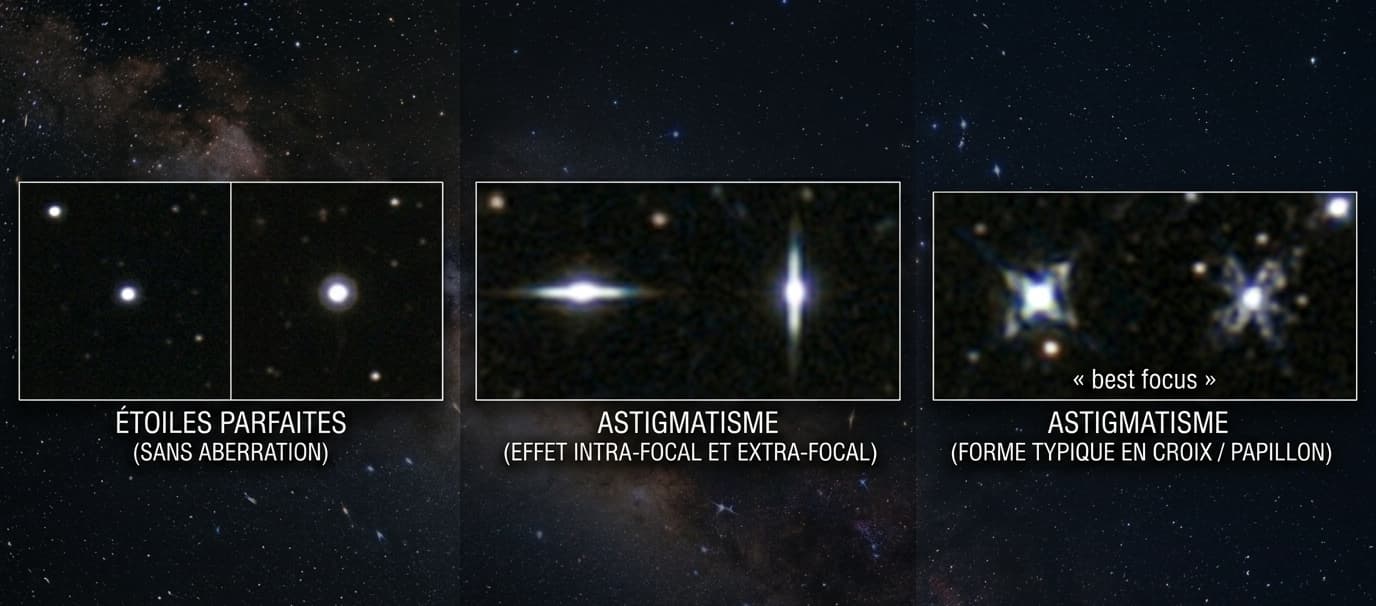
Hey, it's the Doc! If you have been shooting astrophotos for a while, you have definitely seen this before: distorted stars stretched in one direction on your raw frames, even though you set everything up carefully... or almost. Astigmatism in astrophotography is one of the most common and most frustrating optical aberrations. The good news: in the vast majority of cases, it can be diagnosed and corrected. Let's break it all down together.
What is astigmatism in astrophotography?
Optical astigmatism and visual astigmatism: two distinct phenomena
Be careful not to confuse two very different things. The astigmatism discussed here is an optical aberration of your instrument: telescope, refractor, or camera lens, not a defect in your own eyesight. If you have astigmatism in your eyes, it does not affect your photos, only visual observation at the eyepiece. Astronomical photographic astigmatism, on the other hand, originates from a defect in the optical path of your setup.
Technically, this aberration occurs when light rays passing through two perpendicular planes (sagittal and tangential) do not converge at the same focal point. The result: the perfectly round Airy disk transforms into an elliptical spot. And in an astronomical image, this shows up immediately on the stars.
How astigmatism manifests in your images
On your raw frames, stars distorted by astigmatism take on a characteristic shape: they stretch in a specific direction, often different depending on their position in the field. Near the center, you may have correct round stars, but toward the edges they become elongated, sometimes even cross-shaped. This differs from coma, which produces comet-shaped stars with a tail pointing outward from the field. A spot diagram in optical simulation software illustrates this phenomenon very clearly.
The PSF (Point Spread Function) is no longer symmetric: if you zoom in on a bright star in PixInsight or another astronomical processing application, you will clearly see the ellipticity. That is your first image diagnostic tool.
Identifying the cause: step-by-step diagnosis of distorted stars
Collimation issues
On a Newtonian or Cassegrain telescope, poor collimation is the primary cause of degraded stars. When the primary mirror is not perfectly aligned with the secondary mirror and the focuser, optical aberrations explode, especially astigmatism and coma. First and foremost, collimate your instrument properly, ideally using an artificial star during the day or a real star at night with a Cheshire eyepiece and a dedicated collimation tool.
A simple test: if your distorted stars all point in the same direction across the entire field, this is often a collimation or tilt problem. If the orientation changes depending on position in the field, this points more toward an intrinsic aberration of the optics or a backfocus issue.
Sensor tilt and incorrect backfocus
Sensor tilt is the non-orthogonality of your CMOS sensor (APS-C or full-frame) relative to the optical axis. Even a few tenths of a degree is enough to produce asymmetrically distorted stars: on one side of the field the stars are round, on the other they stretch. On a large full-frame sensor, the problem is even more visible.
The optical backfocus distance between your field flattener and the sensor is also critical. Insufficient or excessive backfocus generates field curvature and astigmatism toward the edges. Every field flattener has a precise nominal backfocus distance (often 55 mm): measure it carefully, counting the distance between the last lens of the flattener and the focal plane of your sensor. A few millimeters off is enough to ruin everything.
Coma and other associated aberrations
Optical coma is often confused with astigmatism, but comet-shaped stars have an asymmetric appearance with a "tail" directed toward the edge of the field. Both aberrations can coexist, especially on a fast Newtonian at a short focal ratio (f/4 or f/5). A good field corrector designed for your focal ratio is then essential. Chromatic aberration is another aberration that can compound the problem on a non-apochromatic refractor.
Hardware solutions for correcting telescope astigmatism
Recollimating your Newtonian and adjusting backfocus
For a Newtonian reflector, collimation is non-negotiable. Use an artificial star during the day or a defocused real star at night. The goal: obtain perfectly concentric diffraction rings around the Airy disk. Remember that precise focus and polar alignment (including autoguiding) must be performed after collimation, not before.
Then, set your corrector-to-sensor backfocus distance to the nearest millimeter. Use graduated extension rings and run tests on stars at the edge of the field. Nicely symmetric diffraction spikes around bright stars (caused by the secondary mirror spider vanes) are also an indicator of good collimation on a Newtonian.
Using a tilt adjuster for large sensors
If after correct collimation and backfocus you still have asymmetrically distorted stars, invest in a tilt adjuster. This accessory allows you to slightly tilt the sensor plane to bring it perfectly perpendicular to the optical axis. It is nearly indispensable on a full-frame sensor paired with an f/4 Newtonian or a short-focal-length refractor. Some models even integrate autoguiding in the same unit.
Correcting astigmatism in post-processing with PixInsight
Stellar deconvolution and PSF modeling
Even after a well-configured setup, a slight residual deformation often remains. This is where post-processing comes in. In PixInsight, the stellar deconvolution module is your best ally. The principle: by modeling the PSF of your image (its actual shape, elliptical or otherwise), the deconvolution algorithm mathematically "cancels out" the degradation to restore round, sharp stars.
To create your PSF in PixInsight, use the DynamicPSF process: select about twenty non-saturated stars from your raw or stacked images, let the tool fit the model, then inject this PSF into the Deconvolution module. Combine this with a well-defined star mask to avoid amplifying noise in the dark areas. Deconvolution has its limits: it cannot salvage a heavily degraded image, but on slight residual aberrations the results are impressive.
Summary: diagnostic table for distorted stars in astrophotography
Symptom | Probable cause | Solution |
|---|---|---|
Stars stretched uniformly in the same direction across the field | Poor collimation (Newtonian) | Recollimate the primary mirror |
Asymmetrically distorted stars (one side of the field) | Sensor tilt | Tilt adjuster, check all fittings for play |
Stars stretched at the edges of the field only | Incorrect field flattener backfocus | Adjust backfocus to the nearest mm |
Comet-shaped stars toward the edges | Optical coma (short focal ratio) | Appropriate coma/field corrector |
Slightly elliptical stars across the entire field | Residual astigmatism / degraded PSF | Deconvolution in PixInsight |
Colored halo around bright stars | Chromatic aberration (refractor) | UV/IR cut filter, apochromatic refractor |
Astrophotography astigmatism FAQ: frequently asked questions
Is astrophotography astigmatism always caused by the instrument?
Not necessarily. It can come from the primary mirror itself (mechanical stress on the mirror cell), an ill-matched field corrector, or an incorrect backfocus distance. In rare cases, a low-quality eyepiece or Barlow lens can also introduce astigmatism during visual observation.
Can astigmatism be corrected entirely in post-processing?
Partially. Stellar deconvolution in PixInsight can correct mild, field-uniform astigmatism. But if your stars are severely distorted, no amount of astronomical post-processing will substitute for correct mechanical adjustment at the source. You can also explore our gallery of distorted-star diagnostics to compare your image against documented cases.
Does focal ratio affect astigmatism?
Yes, directly. A short focal ratio (f/4, f/5) is far more sensitive to all optical aberrations, including astigmatism and coma. This is why fast Newtonians absolutely require a quality field corrector and precise collimation.
How do I tell tilt from collimation?
Rotate your camera 90 degrees in the focuser. If the distorted-star pattern rotates with the camera, it is sensor tilt. If it stays fixed, the problem lies in collimation or the instrument optics.
Can autoguiding cause astigmatism?
No, autoguiding (and polar alignment) does not introduce astigmatism as such. Guiding errors produce stars elongated into trails, not the characteristic distortions of an optical aberration. Make sure you have a good polar alignment before suspecting an aberration.