Astrophotography diagnosis of ngc281: Astigmatism, background chroma noise and 1 other
ProcessedL-pro23x300
The Doc examined this image of ngc281 (processed, L-pro, 23x300). Estimated overall technical quality: 6/10. 3 defects found: Astigmatism (severity 2/5), Background chroma noise (severity 2/5), Clipped stars (severity 1/5).

Info
- Cible
- ngc281
A 5% crescent is negligible, you were effectively at new moon: no lunar pollution expected, and the background measurement indeed shows nothing instrumental to fix on that side. The weak point is not the sky but the signal budget: the measured background to black point margin is 1.74, well below the sky-limited threshold of 5 to 10, with a Bowley skew of 0.38. In other words your 300 s subs remain read-noise dominated rather than sky dominated, which makes sense behind an L-Pro at f/6.3. In that moonless window, the right strategy was to stack many more hours rather than lengthen each sub.
Setup
- Type d'image
- Traitée
- Télescope
- C8 réducteur 6,3
- Caméra
- ZWO ASI294MC Pro
- Filtre
- L-pro
- Monture
- AM3
- Exposition
- 23x300
- Phase de lune
- Premier croissant (5 %)
The C8 with the 6.3 reducer and the ASI294MC Pro give roughly 1.15 arcsec/px, a comfortable sampling well matched to typical seeing: the measured FWHM of 2.8 to 3.6 px, about 3.2 to 4 arcsec, reflect average seeing more than a focus problem. The watch point is the reducer: it requires a strict 57 mm backfocus, and it is very likely the source of the edge astigmatism measured on a 4/3 sensor. The L-Pro is a reasonable OSC choice on an emission region, but on a target this Ha-rich a dual-band such as an L-eXtreme would give much better contrast if your sky is light polluted. Finally, 23x300s is short for this focal ratio.
The diagnosis in detail
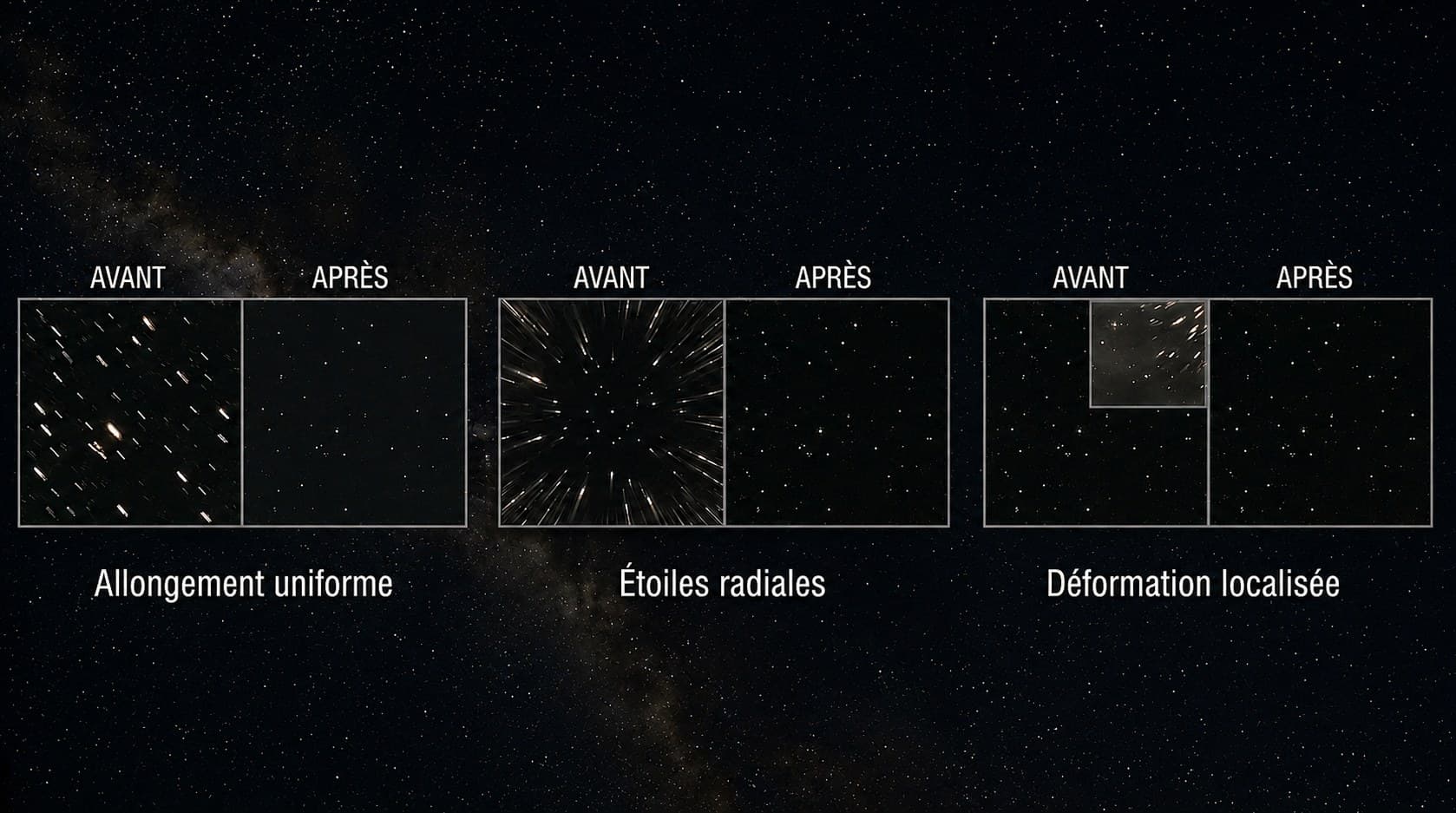
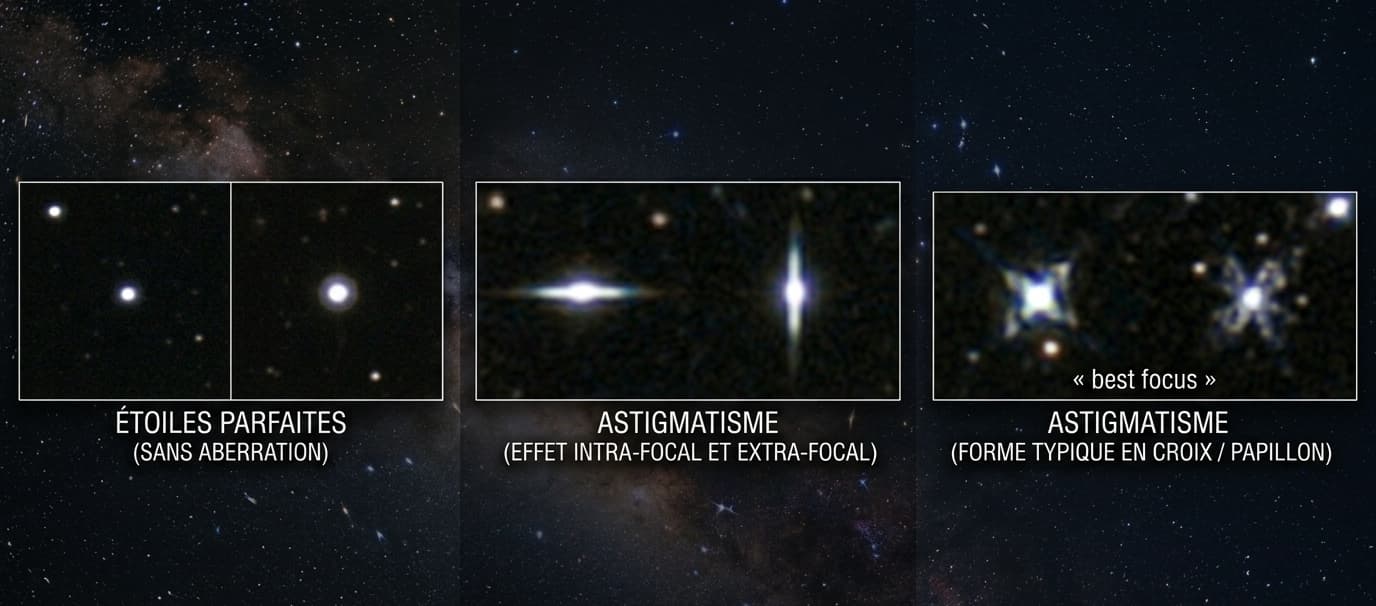
The structuring defect is optical and it is measured, not assumed. The field center is nearly clean (elong 1.17 against a 1.04 floor), but elongation climbs to 1.52 in the bottom-left corner and stays around 1.23 to 1.27 on the side edges, while the corner/center FWHM ratio barely moves (1.156). That dissociation is the characteristic signature of astigmatism: stars stretch without really growing. The top and bottom edges stay round at 1.04 and 1.05, which points to optical train geometry rather than a tracking issue, confirmed by the AM3 holding the center well.
The second layer of problems is budgetary. With 1 h 55 of integration behind an L-Pro at f/6.3, the nebula signal is only just enough to support the stretch applied, and the background pays the price as patchy chroma mottling. This is not strictly a processing fault, it is a photon shortage made visible by the stretch. A few bright star cores are also clipped, the logical consequence of 300 s subs at this focal ratio.
The sequence is therefore simple: setting the backfocus cleans up star shape across the whole field, and doubling or tripling integration time will on its own solve most of the background noise, without aggressive denoising.
Priority actions
- Set the 6.3 reducer backfocus accurately to 57 mm and re-shoot a field test to check the bottom-left corner elongation drops
- Increase total integration toward 5 to 8 h to pull the background out of the noisy regime instead of compensating with denoising
- Add a series of short 30 to 60 s subs to rebuild bright star cores in HDR
- Treat the background chroma noise with targeted chrominance-only noise reduction, using a mask protecting faint areas
- Consider a dual-band filter if your sky is light polluted, to gain contrast on this emission region