Astrophotography diagnosis of ngc281: Astigmatism
ProcessedL-pro23x300s
The Doc examined this image of ngc281 (processed, L-pro, 23x300s). Estimated overall technical quality: 7/10. 1 defect found: Astigmatism (severity 2/5).

Info
- Cible
- ngc281
- Position
- 0h53m10s · +56°37'23"
Moon at 0 percent, so no lunar contribution to the background: these conditions are ideal for an emission nebula like NGC 281 and no moon gradient is expected or observed. The histogram confirms a background barely lifted off the black point (e_margin 0.98, Bowley skew 0.72), which means a dark sky and 300 s subs with the L-pro that stay well short of the sky-limited regime: you have room to lengthen exposures, and above all to stack far more of them. No dark clipping, offset is fine.
Setup
- Type d'image
- Traitée
- Télescope
- C8 réducteur 6,3
- Caméra
- ZWO ASI294MC Pro
- Filtre
- L-pro
- Monture
- AM3
- Exposition
- 23x300s
- Phase de lune
- 0%
- FOV
- 50.6'
Coherent combination: the C8 with the 6.3 reducer gives 0.84 degrees of field, which frames NGC 281 (about 35 arcmin) comfortably with margin around it, and the measured FWHM of 2.2 to 3 px shows the ASI294MC sampling keeps up without penalising oversampling. The AM3 holds tracking well: no directional elongation at the centre, scattered PA, guiding is not at fault. The weak point of the optical train is the reducer spacing, sensitive to the millimetre, and that is consistent with the measured field astigmatism. On an emission target like this one, a dual-band would add contrast, the L-pro remaining a defensible choice under a dark sky.
The diagnosis in detail
Verdict: a successful image at its core, limited by two separate things, the optical train and integration time.
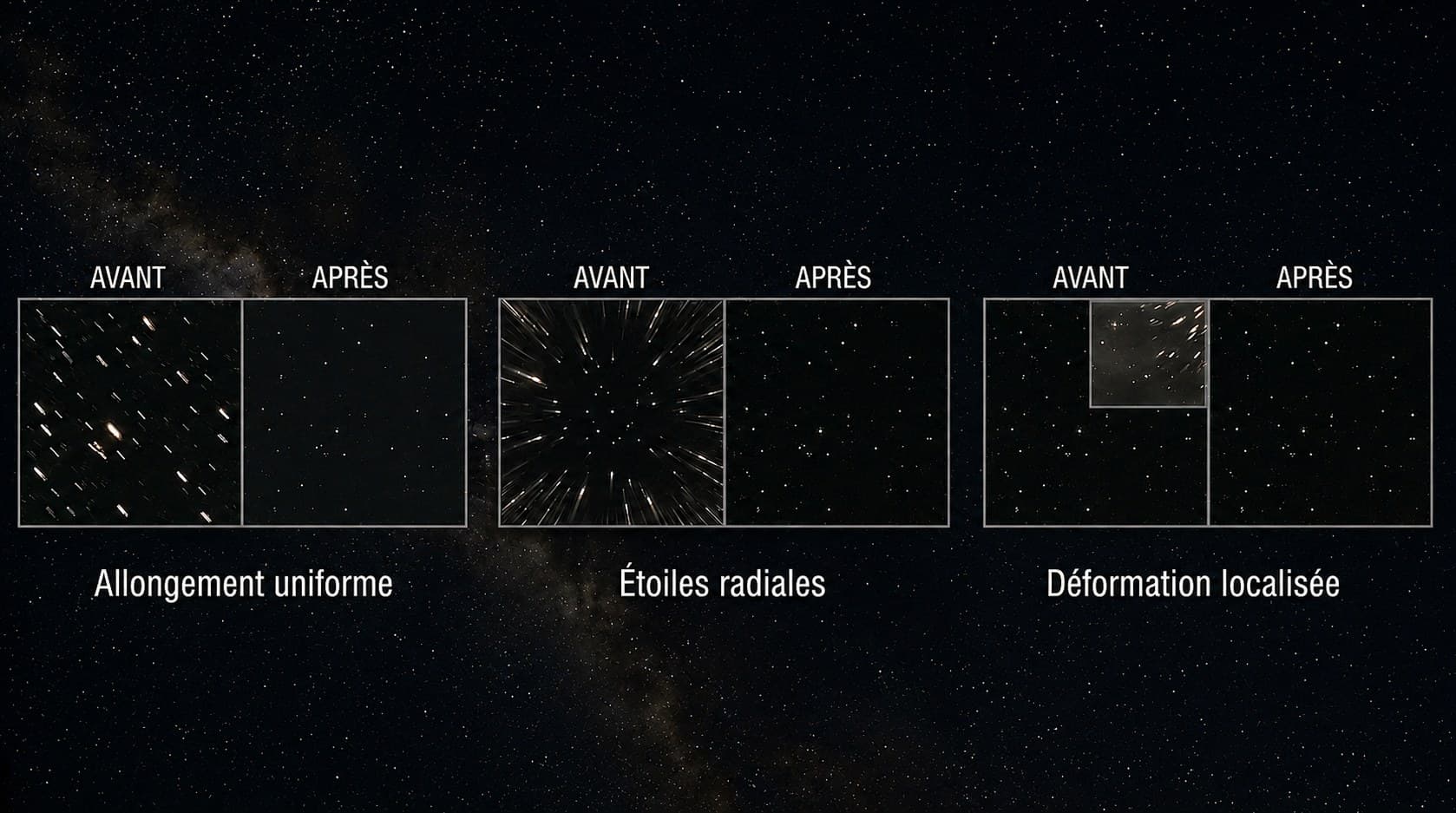
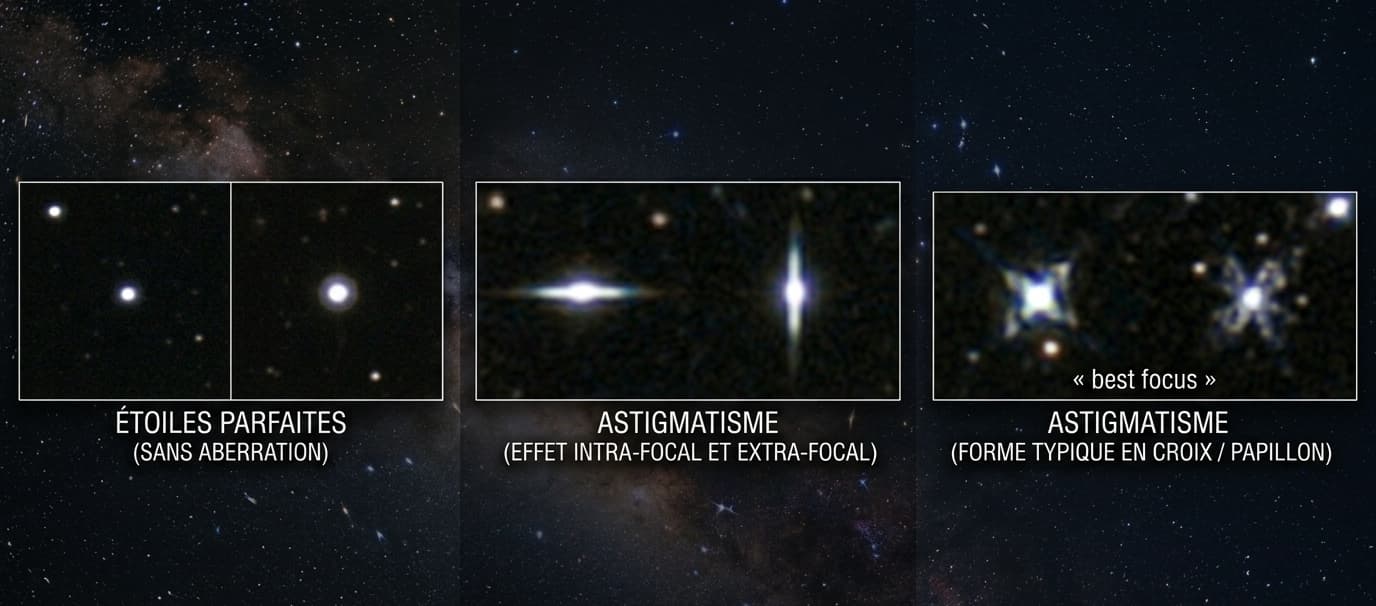
Optically the measurement is clear: the centre is round (elong 1.06 against a field floor of 1.04) and corners climb to 1.19-1.23, yet FWHM does not increase (corner/centre ratio 0.87). That combination rules out field curvature and pure backfocus, which would bloat the stars, and also rules out tilt, which would require clear diagonal asymmetry that the derivatives do not show (H asymmetry 0.09, V 0.012). What remains is field astigmatism, classic on a C8 with a 6.3 reducer whose spacing is not exactly at the nominal value. The effect is moderate and does not prevent publishing.
On processing, the three other points share a common cause: 1h55 of integration is little for a colour sensor. Signal is short, so denoising was pushed, which smooths the nebulosity, and despite that the background keeps visible chroma mottling in the dark corners. The clipped star cores come from the stretch and can be fixed in processing. Comparison with the DSS validates the whole nebular structure: nothing you see there is a background artefact.
Priority actions
- Adjust the 6.3 reducer spacing to the millimetre, then recheck corner elongation with the aberration inspector
- Triple the integration time (aim for 5-6 h) to address the common cause of chroma noise and smoothing
- Redo the stretch with highlight protection to preserve the colour of star cores
- Restrict denoising to the background with a mask rather than applying it globally