Astrophotography diagnosis of ngc7000: Backfocus error and clipped stars
ProcessedL-extreme80*300s
The Doc examined this image of ngc7000 (processed, L-extreme, 80*300s). Estimated overall technical quality: 8/10. 2 defects found: Backfocus error (severity 2/5), Clipped stars (severity 1/5).

Info
- Cible
- ngc7000
- Site
- Bortle 4 · transition rural/banlieue (saisi)
- Position
- 20h57m37s · +44°20'60"
Very favorable conditions: new moon (0%) and Bortle 4, the ideal scenario for an emission nebula. With an L-eXtreme on NGC 7000 the sky background is controlled twice over, by the filter and by the site, which explains the very clean background and the absence of any measurable gradient. In this context you can run 300s subs without any risk of flooding the background, and even consider going longer if your mount allows. A moonless Bortle 4 sky also lets you add broadband luminance on this very star-rich field if you want more natural star colors than dual-band gives.
Setup
- Type d'image
- Traitée
- Télescope
- Askar fra400 with reducer 0.7x
- Caméra
- zwo asi533 mc pro
- Filtre
- L-extreme
- Monture
- am5n
- Exposition
- 80*300s
- Phase de lune
- 0%
- FOV
- 2.25°
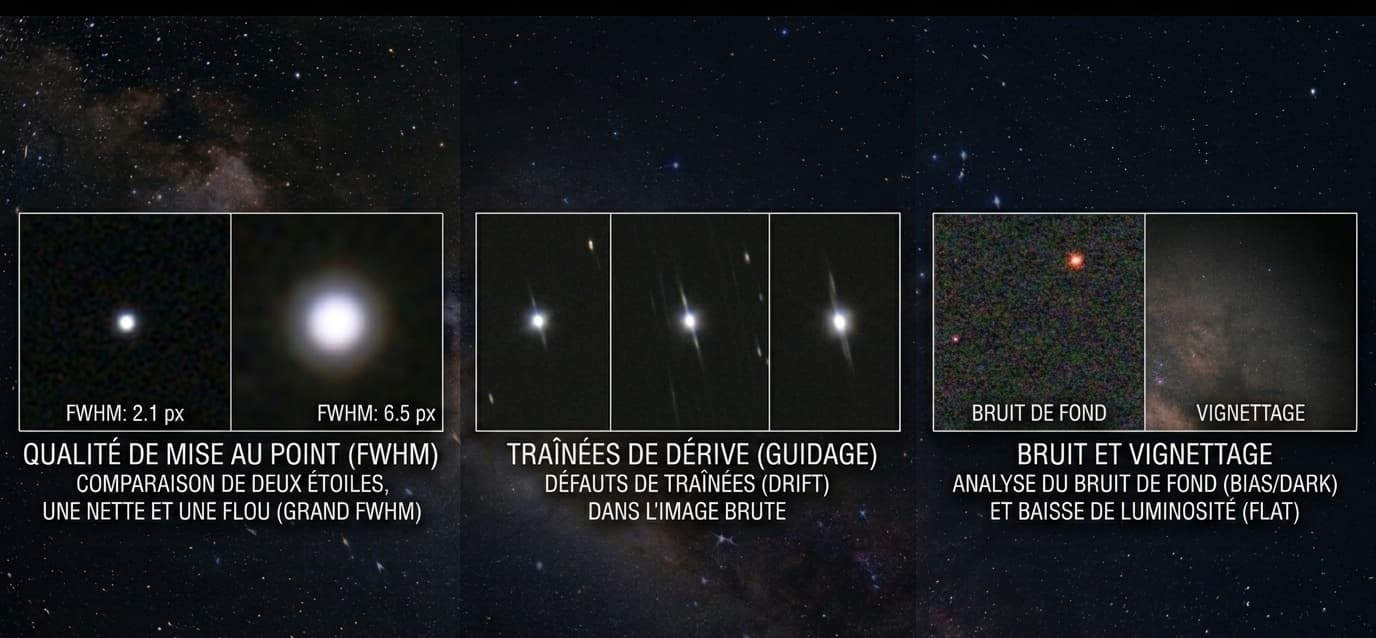
The Askar FRA400 at 0.7x paired with the ASI533 suits the target well: 2.25° of field frames NGC 7000 with the Pelican in the same shot, exactly the composition sought on this region. The central FWHM of 3.1 px indicates comfortable sampling, neither over nor undersampled for typical seeing. The 80 subs of 300s, close to 7 hours, explain the smooth background and the depth reached in the faint extensions. The one setting to revisit is the reducer spacing, whose tolerance is tight and which the corner/center FWHM measurement clearly flags. The measured background to black point margin is small, but that is normal in narrowband, no exposure issue.
The diagnosis in detail
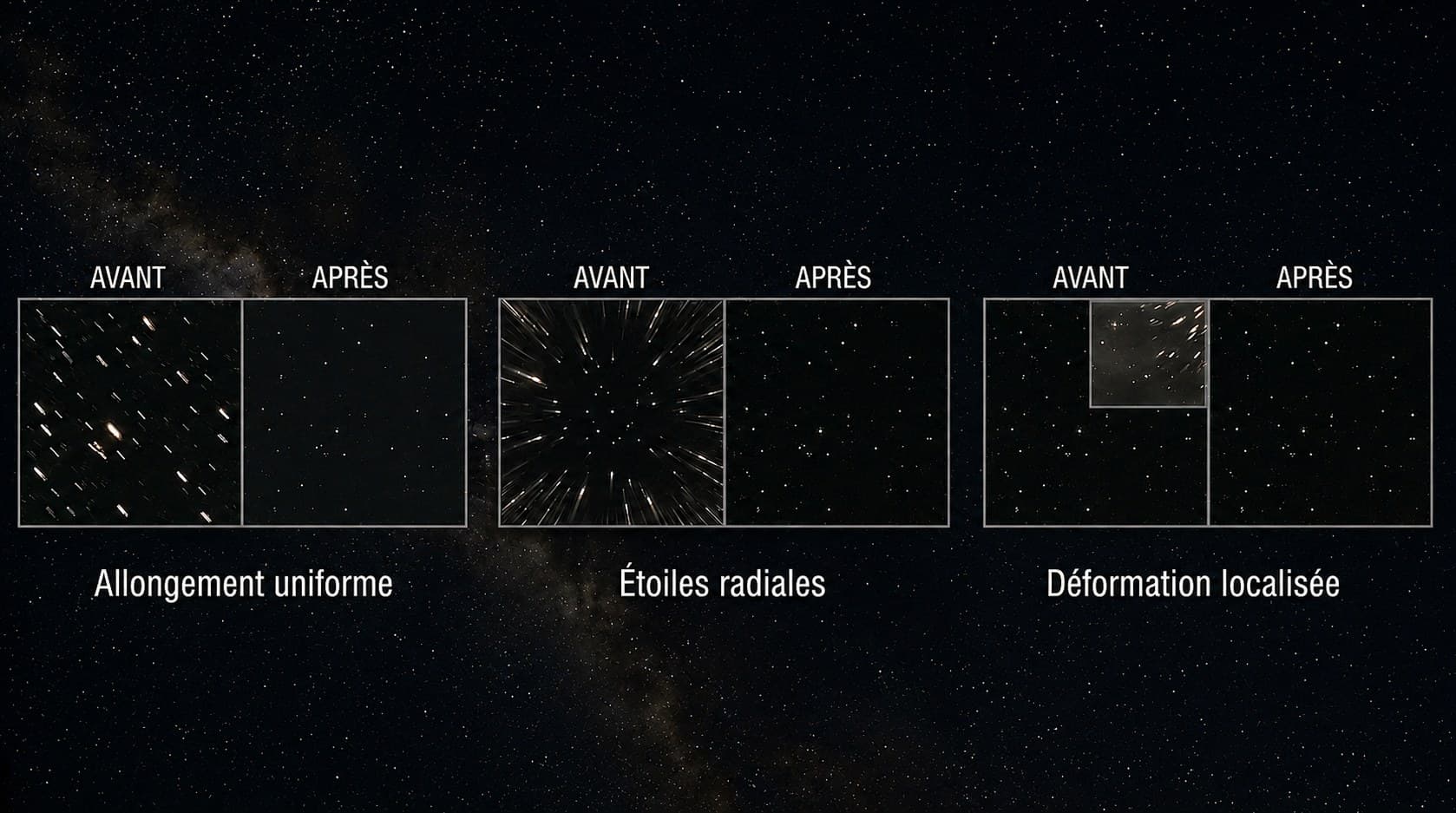
The image is technically sound. The aberration inspector shows a field where stars are round everywhere: elong from 1.01 to 1.05 against a field floor of 1.01, with no preferred direction (PA dispersion of 44°). That rules out any tracking, periodic error or guiding oscillation component: the AM5N does its job perfectly over 300s.
The only measured deviation is a strictly symmetric FWHM rise from center to corners, from 3.09 px to about 3.7 px, a 21% spread. The symmetry rules out sensor tilt, the lack of elongation rules out astigmatism and the lack of a radial tail rules out coma: field curvature remains, meaning a backfocus distance slightly off tolerance behind the 0.7x reducer. It is a moderate defect, visible only when inspecting the corners at 100%, which does not spoil the image but is fixed once and for all with a few tenths of a millimeter of spacers.
On the sky background, the measured 101% variation follows the nebulosity itself rather than an optical profile, so there is no residual vignetting or gradient to correct: the flats and gradient extraction did their job. Processing is restrained, with no plastic smoothing and no dark halos around stars. What remains is the clipping of a few of the brightest star cores, a cosmetic point.
Priority actions
- Fine tune the backfocus behind the 0.7x reducer in 0.5 mm steps, L-eXtreme filter included, and validate with a fresh aberration panel
- Add a few short 10 to 30s exposures to rebuild bright star cores through HDR composition
- Keep the current acquisition settings: tracking, calibration and sky background are already at the right level