Astrophotography diagnosis of sh2-132: Residual vignetting
ProcessedL-extreme52x300s
The Doc examined this image of sh2-132 (processed, L-extreme, 52x300s). Estimated overall technical quality: 8/10. 1 defect found: Residual vignetting (severity 3/5).

Info
- Cible
- sh2-132
Moon at 0%, so no lunar contribution to the sky background: conditions were optimal for an emission target like Sh2-132. With the L-eXtreme on an Ha/OIII nebula, even a somewhat light-polluted sky stays manageable, and the result shows it: the background is clean and the faint bubble extensions come through well. The 52 subs of 300s, over 4 hours of signal, are consistent with such a faint OIII target. If you want to push the bluish part to the southwest, it is more OIII time you need, not better conditions.
Setup
- Type d'image
- Traitée
- Télescope
- Askar fra400 with reducer 0.7x
- Caméra
- zwo asi533 mc pro
- Filtre
- L-extreme
- Monture
- am5n
- Exposition
- 52x300s
- Phase de lune
- 0%
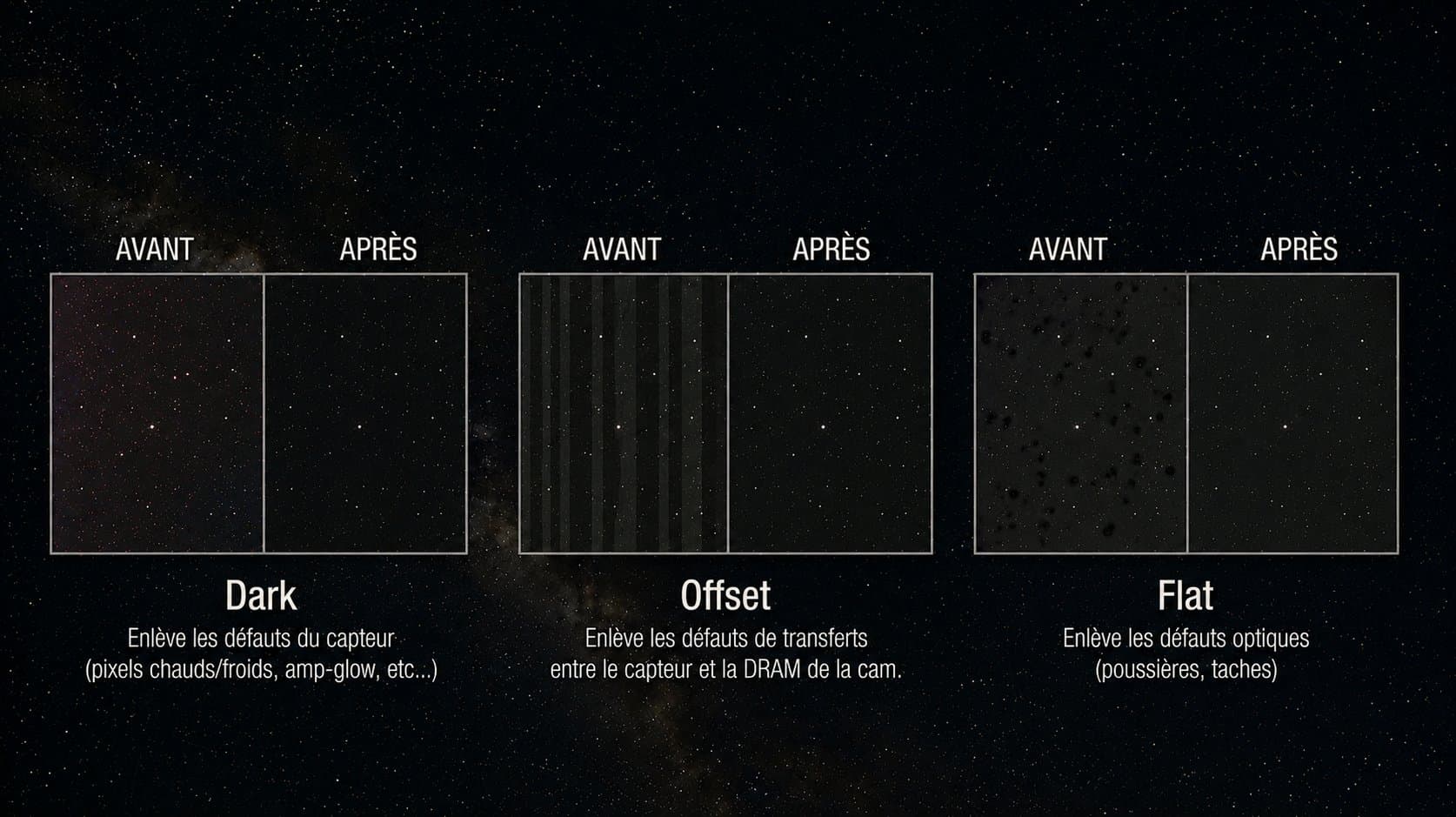
Setup well matched to the target. The FRA400 reduced at 0.7x gives roughly 280 mm of focal length, a wide field where Sh2-132 sits comfortably with margin around it without being lost. With the ASI533's 3.76 um pixels, sampling lands around 2.7 arcsec/px, undersampled but consistent with a wide-field setup, and the measured FWHM of 3.6 to 4.1 px stays healthy. The L-eXtreme is the right choice on an Ha/OIII target. One caveat: the reducer increases edge-of-field falloff, hence the importance of perfectly matched flats.
The diagnosis in detail
On the optical and mechanical side, nothing to complain about. The aberration inspector gives an elongation of 1.01 at center and 1.01 to 1.02 across all nine zones, a corner/center FWHM ratio of 1.007 and horizontal and vertical asymmetries of 0.058 and 0.083, all well below trigger thresholds. The 40 degree PA dispersion confirms the stars are round: there is no preferred elongation direction. In practical terms, the reducer backfocus is correct, the sensor is square to the optical axis, and the AM5N tracked cleanly on 300 second subs.
The only measured defect is field illumination. The radial profile shows a 36% falloff from center to edges, with an R2 of 0.95 and azimuthal anisotropy of 0.02: that is pure rotational symmetry, the typical signature of vignetting rather than a sky gradient (the planar component only weighs 0.01). Visually this translates into darker corners that crush the faint nebula extensions and give an impression of uneven background.
The impact stays cosmetic and fully recoverable. The signal is there, the pink Ha and bluish OIII rendering is credible and readable, and the background shows neither marked chroma noise nor denoising artifacts. A well-executed radial background correction, ideally upstream of a new stack calibrated with fresh flats, will bring the image up to the level of its PSF.
Priority actions
- Shoot a fresh set of flats on the current optical train and recalibrate the stack to remove the 36% radial falloff
- Apply a radially symmetric background extraction (GraXpert or DBE) before stretching, not after
- Check the background under aggressive stretch to confirm it is flat across the whole frame, corners included
- Add OIII time if you want to strengthen the bluish region to the southwest of the bubble