Astrophotography diagnosis of N?buleuse de la Grotte: Residual vignetting, green cast and 3 others
MasterIr/Uv cut49×180s13 oct. 2026
The Doc examined this image of N?buleuse de la Grotte (master, Ir/Uv cut, 49×180s). Estimated overall technical quality: 5/10. 5 defects found: Residual vignetting (severity 3/5), Green cast (severity 3/5), Tracking drift (severity 2/5), Residual hot and cold pixels (severity 2/5), Noise / underexposure (severity 2/5).

Info
- Cible
- N?buleuse de la Grotte
- Date
- 13 oct. 2026, 20:12
- Lune
- Gibbeuse décroissante 89.9% (sous l'horizon)
- Site
- Bortle 3 · rural peu pollué (saisi)
- Position
- 22h59m20s · +62°22'29"
Conditions were excellent and are not to blame. The Moon, although 89.9% gibbous, was below the horizon during the session and 122 degrees from the target, so it contributed nothing to the sky background. The stated Bortle 3 is a rare quality sky that allows broadband work (IR/UV cut) on an emission nebula like Sh2-155, with no need to switch to dual-band. In that context the green background and the peripheral falloff come from the optical train and the missing calibration, not from the sky. You can capitalize on this: under such a sky, lengthening subs to 300 s and accumulating more hours will pay off directly, with no risk of swamping the background.
Setup
- Type d'image
- Master
- Télescope
- C11+Hyper+Uranus
- Caméra
- Poseidon-C PRO
- Filtre
- Ir/Uv cut
- Monture
- AZ EQ6
- Exposition
- 49×180s
- Phase de lune
- Premier croissant (7 %)
- Notes
- Stack sans DOF
- FOV
- 2.49°
The setup is well matched to the target. At 540 mm and 1.436 arcsec/px the sampling is comfortable for typical seeing, and the measured FWHM of 3.9 to 4.8 px (5.6 to 6.9 arcsec) point to average seeing or slight drift rather than a sampling problem. The 2.49 degree field frames Sh2-155 with room to spare; the composition leaves the nebula off-center toward the upper left but fully contained. Gain 125 and offset 50 are healthy, with no dark clipping (0%) and only 0.02% saturated. The -20C sensor temperature is very good. The real weakness is procedural rather than optical: the large 6252x4176 sensor behind a C11 absolutely requires flats, and the 180 s exposure leaves a low background-to-black-point margin (1.79), so it is barely sky-limited under Bortle 3.
The diagnosis in detail
Everything stems from one choice: stacking without darks, flats or bias. That alone explains three of the findings. First, the 25% illumination falloff from center to edges, perfectly radial (R2=0.89, anisotropy 0.02), the signature of uncorrected optical vignetting on a large sensor behind a C11. Second, the scattering of isolated hot pixels, which darks would have subtracted and dithering would have diluted. Third, part of the background noise, since the missing bias degrades the master signal-to-noise ratio.
The second axis is color. The distinctly olive background and greenish stars are the mark of an uncalibrated linear master. The DSS comparison is conclusive: where the reference shows structured orange nebulosity with dark nebulae southwest of Sh2-155, your image barely hints at red around the central cavity. The signal is there, it is simply buried under the cast and under a noise level still high for 2h27 of integration.
Finally, on the mechanical side, the PSF panel shows elongation present from the center (1.13 against a 1.05 floor) with consistent position angles across the field (12.7 degree dispersion). This is not a field aberration but tracking drift, moderate, worsening slightly toward the BR corner. Nothing crippling, but refined polar alignment and guiding would make the stars noticeably tighter.
Priority actions
- Re-stack with flats, dark-flats and darks at -20C gain 125 180s, which fixes vignetting and hot pixels at once
- Apply photometric color calibration (SPCC or Color Calibration) then a green SCNR to remove the olive cast
- Enable dithering between subs in the NINA sequence for future sessions
- Check polar alignment and PHD2 guiding curves to bring center elongation below 1.10
- Accumulate 6 to 8 hours total on Sh2-155, with 300 s subs since the Bortle 3 sky allows it
Similar diagnoses

N?buleuse de la Grotte
Light pollution gradient

N?buleuse de la Grotte
Tracking drift

NGC7822
Residual vignetting
Related articles
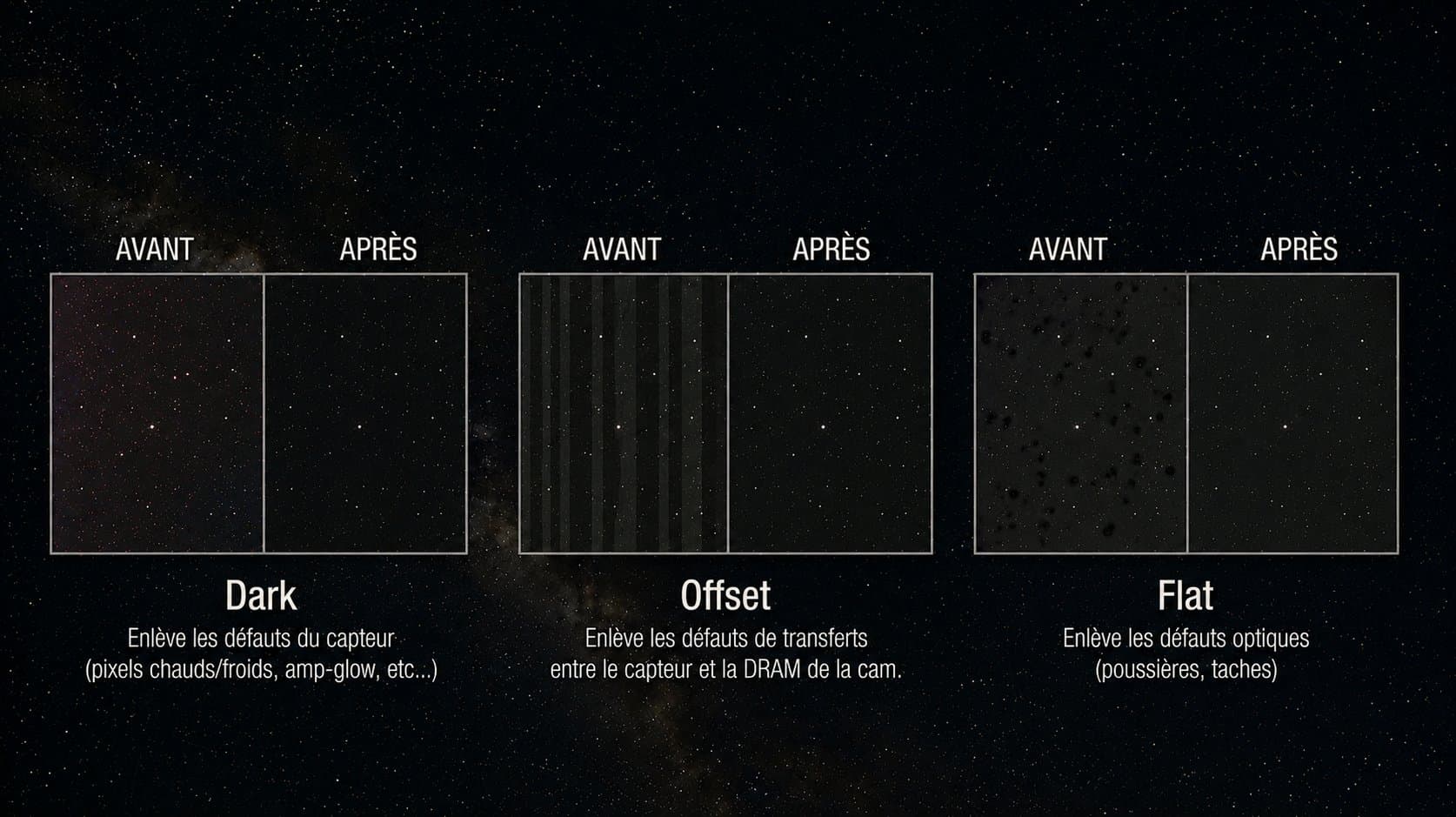 Calibration Frames in Astrophotography: Darks, Offsets, and Flats Explained
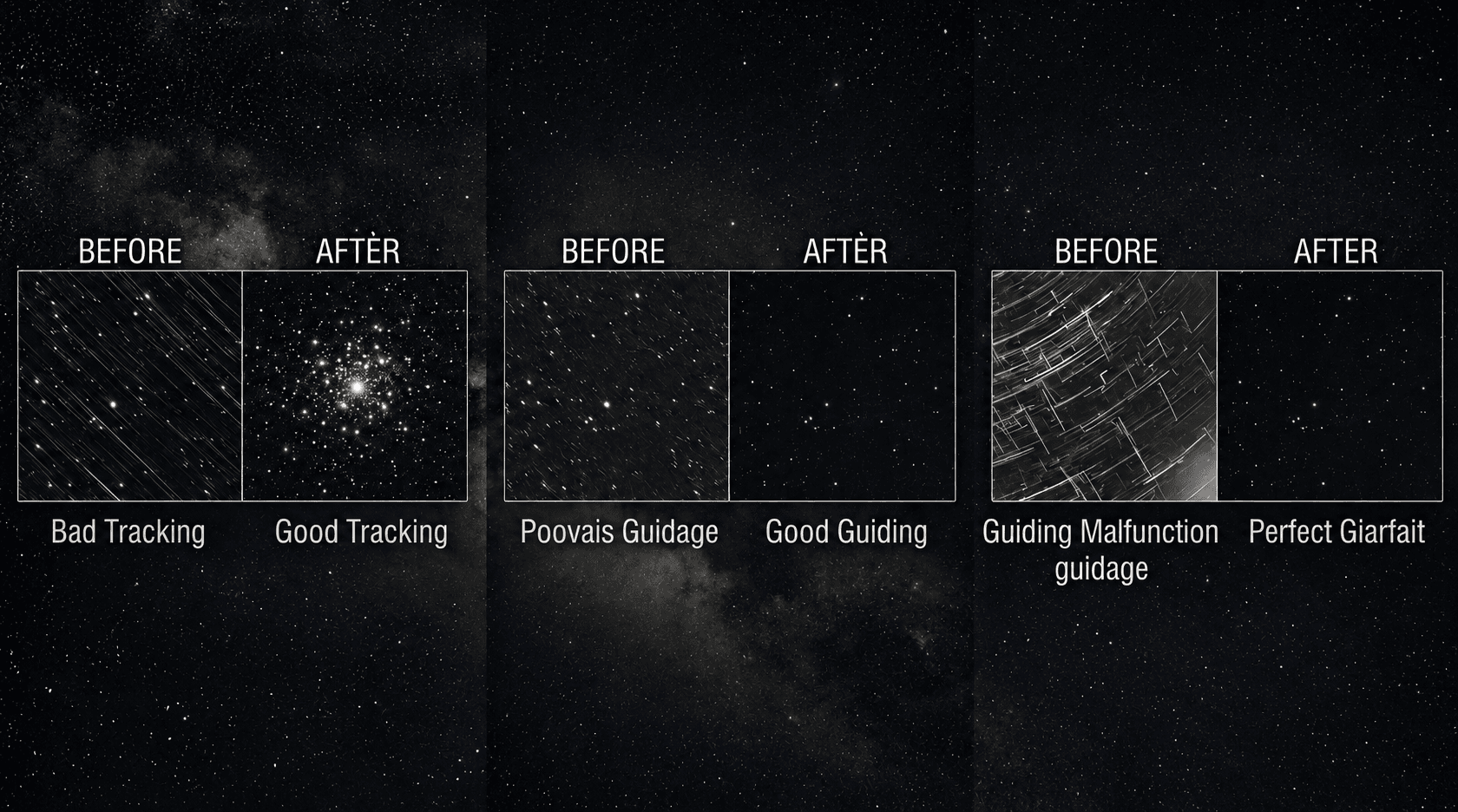 Astrophotography guiding: tuning PHD2 and correcting tracking
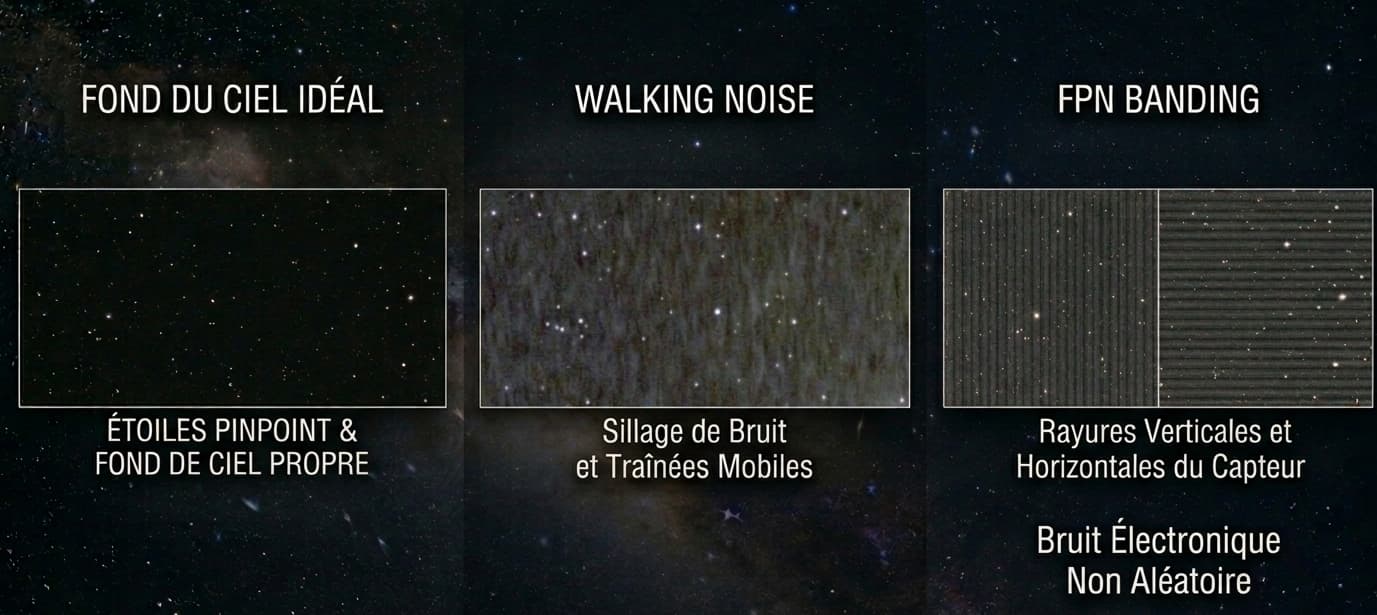 Walking Noise & FPN Banding: Understanding and Eliminating Them