Astrophotography diagnosis of Blue flash nebula: Residual vignetting, noise / underexposure and 2 others
ProcessedUV ir cut
The Doc examined this image of Blue flash nebula (processed, UV ir cut). Estimated overall technical quality: 5/10. 4 defects found: Residual vignetting (severity 3/5), Noise / underexposure (severity 3/5), Focus miss (severity 3/5), Background chroma noise (severity 2/5).
&w=1920&q=75)
Info
- Cible
- Blue flash nebula
Last quarter at 44 percent illumination is an intermediate situation: the Moon brightens the sky background but not enough to ruin a planetary. NGC 6905 is precisely a tolerant target, very compact and with high surface brightness, so it is little penalised by a moderate Moon, unlike a faint galaxy or a diffuse broadband nebula. No clear lunar gradient shows in the field either. To gain contrast, target this object once the Moon has set or is below 20 percent illumination, or wait until it is more than 90 degrees away. An OIII filter would also be a formidable ally on this nebula, even under moonlight.
Setup
- Type d'image
- Traitée
- Télescope
- Skywatcher Dobson Flextube 305/1500
- Caméra
- Pegasus astro smarteye
- Filtre
- UV ir cut
- Monture
- Dobson
- Phase de lune
- Dernier quartier (44 %)
A 305 mm at 1500 mm focal length is the right tool for a planetary as small as NGC 6905: the aperture collects light and the tight sampling resolves the ring. The real handicap is the Dobson mount, which forces very short exposures and rules out deep integration, hence the noisy background observed. The illumination circle also raises a mechanical issue: the sensor sees beyond the fully illuminated zone, which argues for moving to 2 inch. The UV/IR cut filter is a sound broadband choice, but on this emission target an OIII or dual-band would reveal the shell far beyond the core visible here.
The diagnosis in detail
The diagnosis reads in two layers. The first is instrumental and mechanical: the illuminated disc smaller than the sensor betrays an optical train stopping down the beam, and the absence of flats leaves this raw radial falloff in the final image. It is the most visible defect and paradoxically the easiest to fix, with a set of flats and eventually a 2 inch train.
The second layer follows directly from the mount. Without equatorial tracking, individual exposures stay very short, per-sub signal is weak and the accumulated total insufficient. That explains both the general background grain and the dark red colour mottling between stars: two symptoms of the same lack of SNR, worsened by the stretch. The nebula only shows its turquoise core, without the outer halo a deeper stack would reveal.
Finally, the soft stars across the whole field, with no directional elongation, point to imperfect focus or average turbulence. On a 305 mm at 1500 mm, mirror thermal equilibrium and regular Bahtinov checks are decisive to exploit the aperture.
Priority actions
- Shoot and apply flats in the exact configuration of the night to remove the black corners
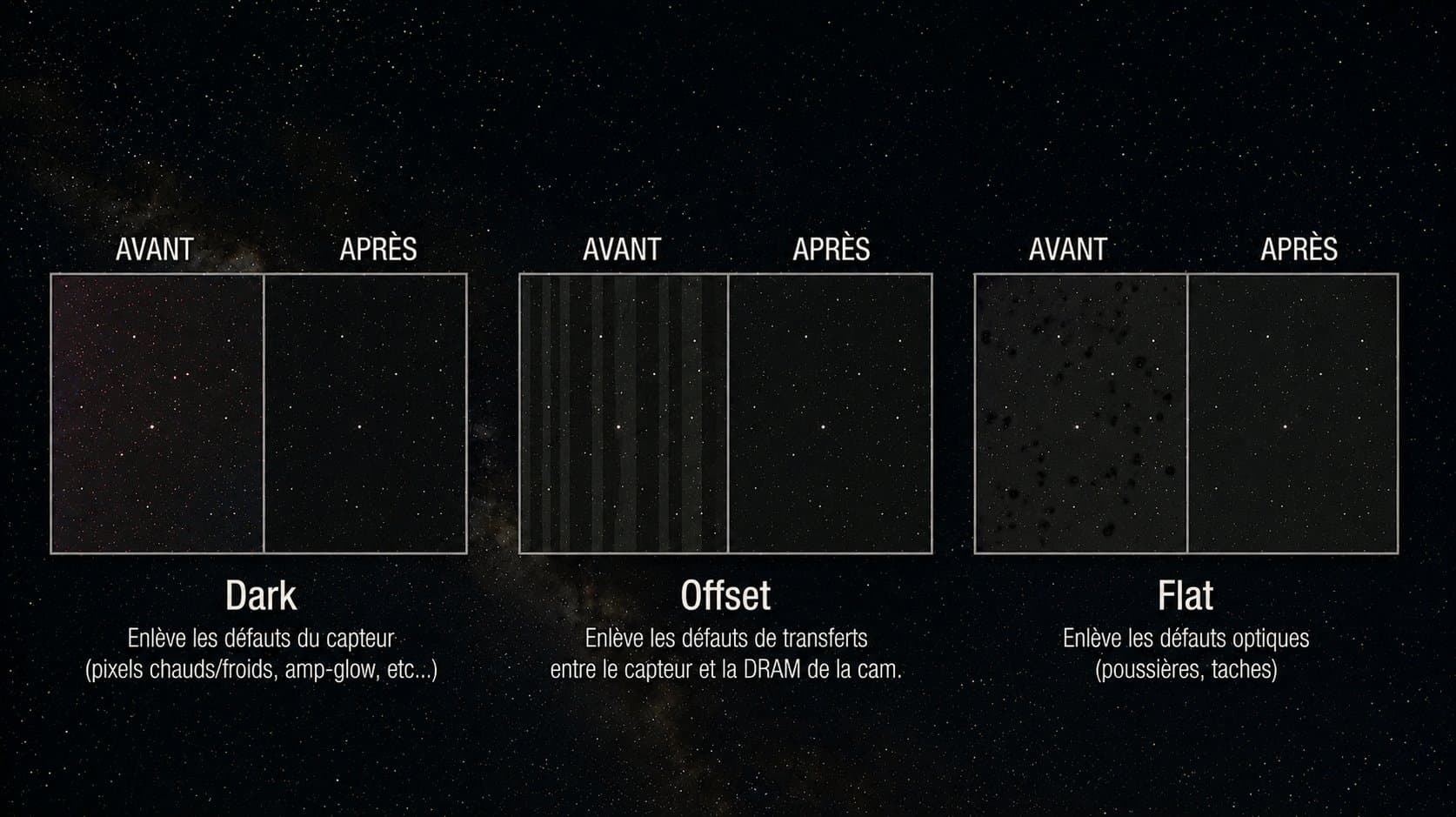
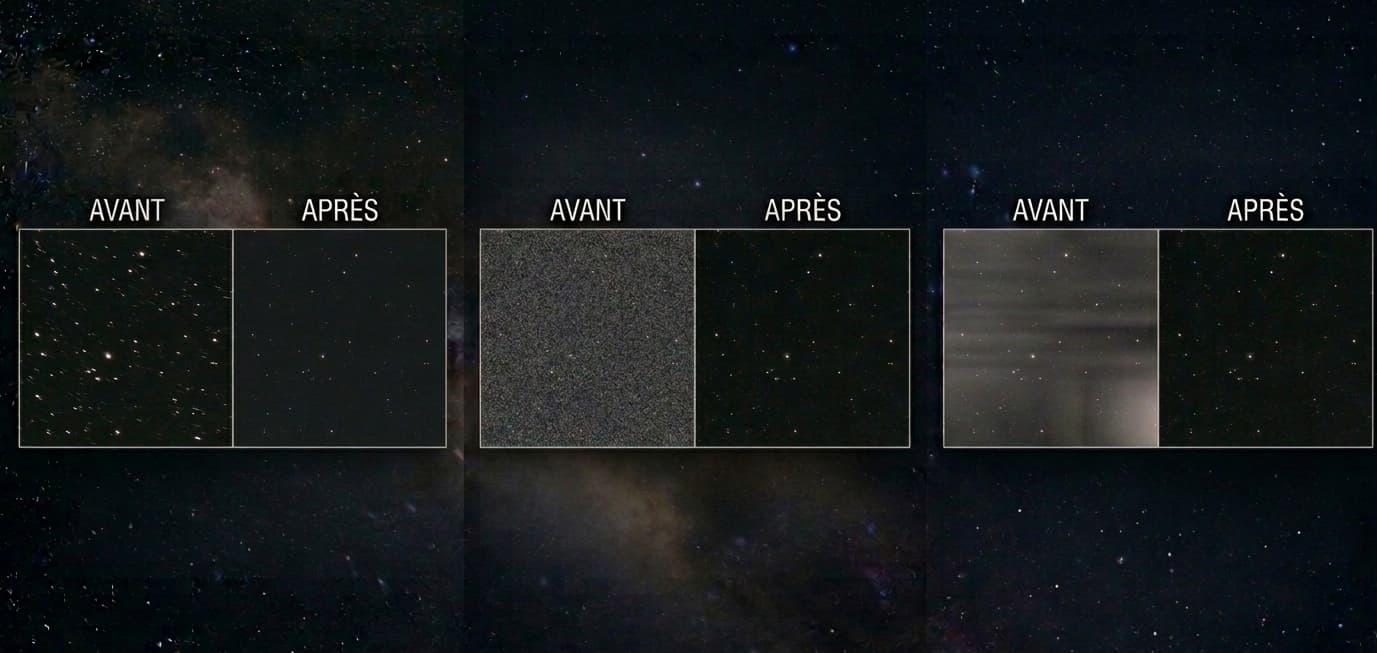
- Add darks and bias matched in gain and temperature to clean the coloured background noise
- Greatly increase total integration time, ideally with an equatorial platform under the Dobson
- Refocus with a Bahtinov mask after the mirror has reached ambient temperature
- Try an OIII filter on this planetary to reveal the outer shell