Astrophotography diagnosis of Caldwell 30: Backfocus error
Rawsans filtre120s04 sept. 2026
The Doc examined this image of Caldwell 30 (raw, sans filtre, 120s). Estimated overall technical quality: 4/10. 1 defect found: Backfocus error (severity 4/5).
&w=1920&q=75)
Info
- Cible
- Caldwell 30
- Date
- 04 sept. 2026, 20:13
- Lune
- Gibbeuse croissante 56.2% (sous l'horizon)
- Site
- Bortle 6 · banlieue dense (VIIRS)
- Position
- 22h37m04s · +34°24'57"
Conditions were rather favorable: the Moon was below the horizon and 81 degrees from the target, so no lunar pollution to worry about, which the background map confirms (plane gradient of only 3%, R2 0.08, meaning no significant oriented gradient). Bortle 6 remains penalizing for a broadband galaxy like NGC 6744 though: sky background rises fast and crushes the contrast of the outer arms. The stated 2.5 arcsecond seeing is consistent with the measured central FWHM. In this sky the answer is accumulation: many subs, ideally a broadband light pollution filter, plus a session from a darker site for the faint extensions.
Setup
- Type d'image
- Brut
- Télescope
- C11
- Caméra
- ZWO ASI533MC Pro
- Filtre
- sans filtre
- Monture
- EQ6r pro
- Exposition
- 120s
- Phase de lune
- Dernier quartier (45 %)
- Seeing
- 2.5
- Notes
- F=2860
- FOV
- 22.0'
The C11 reduced to 1764 mm gives 0.44 arcsecond per pixel, heavily oversampled for 2.5 arcsecond seeing: you lose signal per pixel without gaining real resolution, and binning 2 in processing would help. The 0.37 degree field is tight but NGC 6744 fits, framing is fine. The critical point is the optical train: a square 3008 px sensor behind an SCT reducer demands rigorous spacing, and the measurements show that is not the case. On settings, gain 100 and offset 20 are healthy (only 0.35% dark clipping), but a 20C sensor on a cooled ASI533MC Pro is a missed opportunity: go down to -10C.
The diagnosis in detail
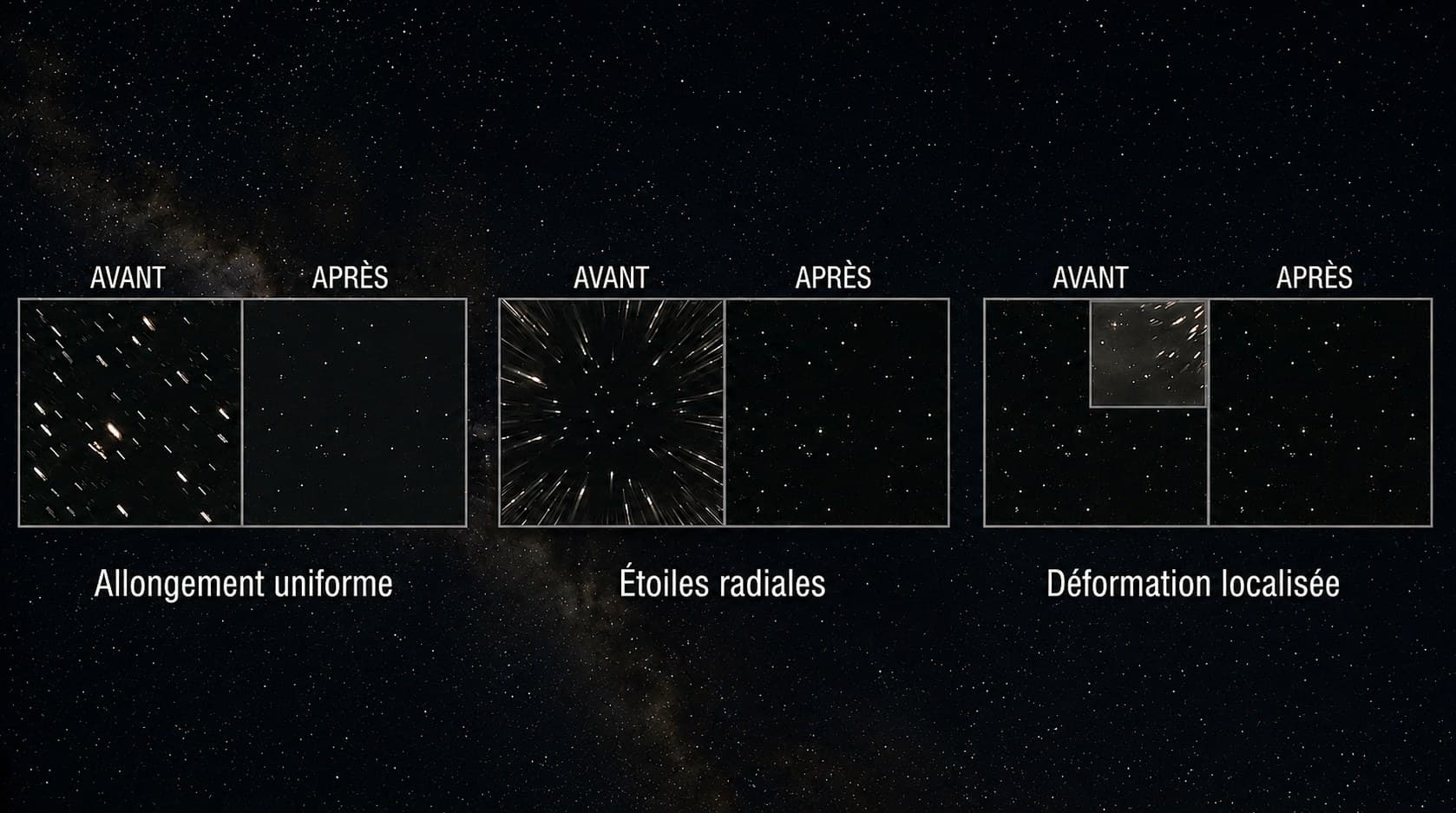
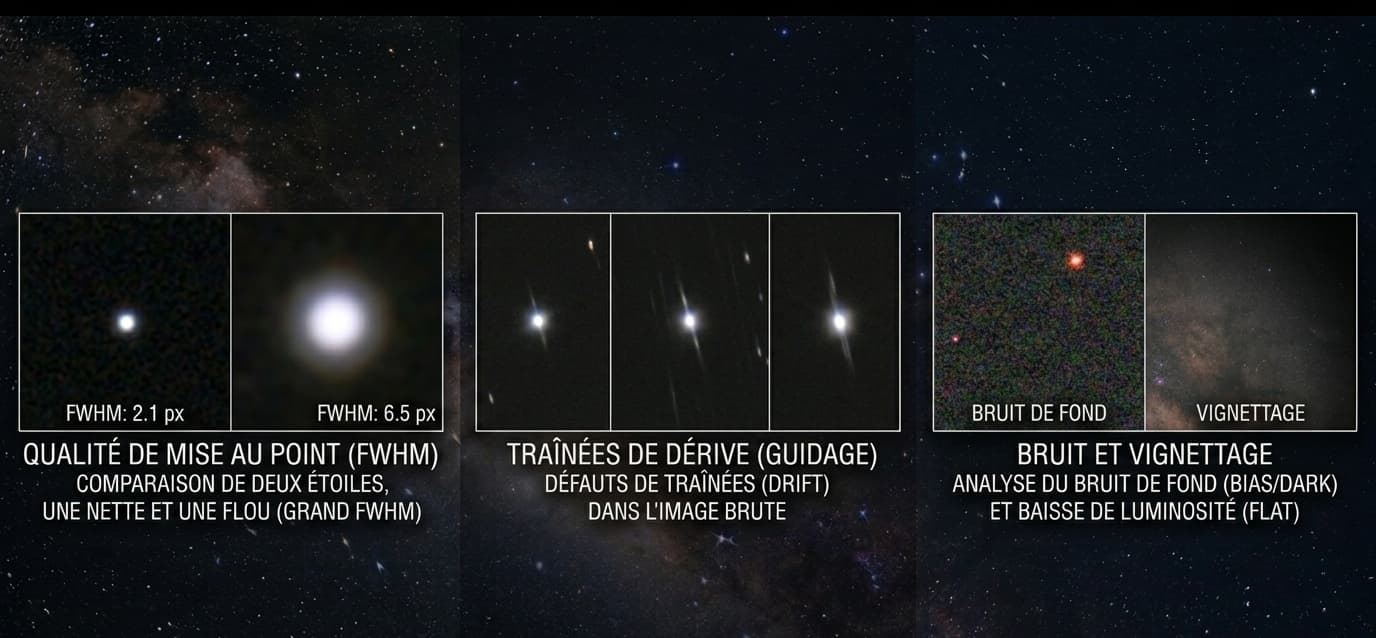
The diagnosis is clear and reads entirely in the PSF measurements. At the center, FWHM is 1.42 px with an elongation of 1.03, meaning strictly pinpoint stars at the field floor. That immediately rules out any tracking, guiding or global focus problem: the mount did its job over 120 seconds and focus was good. Off-axis, however, FWHM climbs to 4.3 px top-left, 6.3 px right, 7.8 px left and up to 9.6 px bottom-left, with bloated but barely elongated stars. That is the classic signature of uncorrected field curvature, typically an out-of-spec backfocus behind the C11 reducer.
The second limitation is signal to noise. With 120 seconds at f/6.3 on a faint southern galaxy, a sensor at 20C and a Bortle 6 sky, the background stays noisy and the spiral arms of NGC 6744 barely emerge. The background to black point margin of 2.7 confirms you are not yet sky-limited, and oversampling at 0.44 arcsecond per pixel dilutes the signal further.
Finally, the 11% radial falloff measured on the background is normal optical vignetting at this stage: it will disappear with properly shot flats.
Priority actions
- Correct the back focal distance behind the C11 f/6.3 reducer and validate with an aberration inspector test before the next session
- Enable cooling on the ASI533MC Pro at -10C and rebuild a dark library
- Extend exposures to 180 to 300 s and accumulate several hours to bring out the faint arms of NGC 6744
- Shoot flats in the exact same configuration to correct the 11% radial falloff
- Consider binning 2 in processing, 0.44 arcsecond per pixel is heavily oversampled for 2.5 arcsecond seeing