Astrophotography diagnosis of Caldwell 30: Tracking drift and sensor tilt
RawIr-Cut60s04 sept. 2026
The Doc examined this image of Caldwell 30 (raw, Ir-Cut, 60s). Estimated overall technical quality: 5/10. 2 defects found: Tracking drift (severity 3/5), Sensor tilt (severity 2/5).
&w=1920&q=75)
Info
- Cible
- Caldwell 30
- Date
- 04 sept. 2026, 19:30
- Lune
- Gibbeuse croissante 55.8% (sous l'horizon)
- Site
- Bortle 6 · banlieue dense (VIIRS)
- Position
- 22h37m02s · +34°25'15"
Favorable conditions: the Moon is below the horizon, so its 55.8% illumination has no effect on this sub, and its 81 degree separation would be comfortable anyway. What remains is Bortle 6, which weighs on a broadband galaxy shot through a plain Ir-Cut: the background rises fast and the SNR on the spiral arms of NGC 2403 will stay limited. With a reported 2.5 arcsec seeing, the measured FWHM around 5 to 6 px (about 2.5 arcsec) matches the atmosphere once the drift is removed, so nothing to blame on turbulence. For this kind of target from town, the real answer is volume: pile up integration hours and shorten unit exposures.
Setup
- Type d'image
- Brut
- Télescope
- C11
- Caméra
- ZWO ASI533MC Pro
- Filtre
- Ir-Cut
- Monture
- EQ6r pro
- Exposition
- 60s
- Phase de lune
- Dernier quartier (46 %)
- Seeing
- 2.5
- Notes
- réducteur Celestron F=6.3
- FOV
- 22.1'
A coherent setup in principle, but stretched on focal length. The C11 reduced to 1764mm gives 0.44 arcsec/px with the ASI533MC, clear oversampling for 2.5 arcsec seeing: you pay in SNR what you do not gain in resolution, so a bin 2 during processing makes sense. The 0.37 degree field is tight but NGC 2403 fits, framing is fine. On settings, gain 100 and offset 20 are healthy, and 0.12% dark clipping is negligible. The background to black point margin of 2.88 does however indicate a slightly short exposure to be truly sky limited in broadband: 120s guided would be more efficient than 60s. The 0°C sensor temperature deserves to go down to -10°C to limit dark current.
The diagnosis in detail
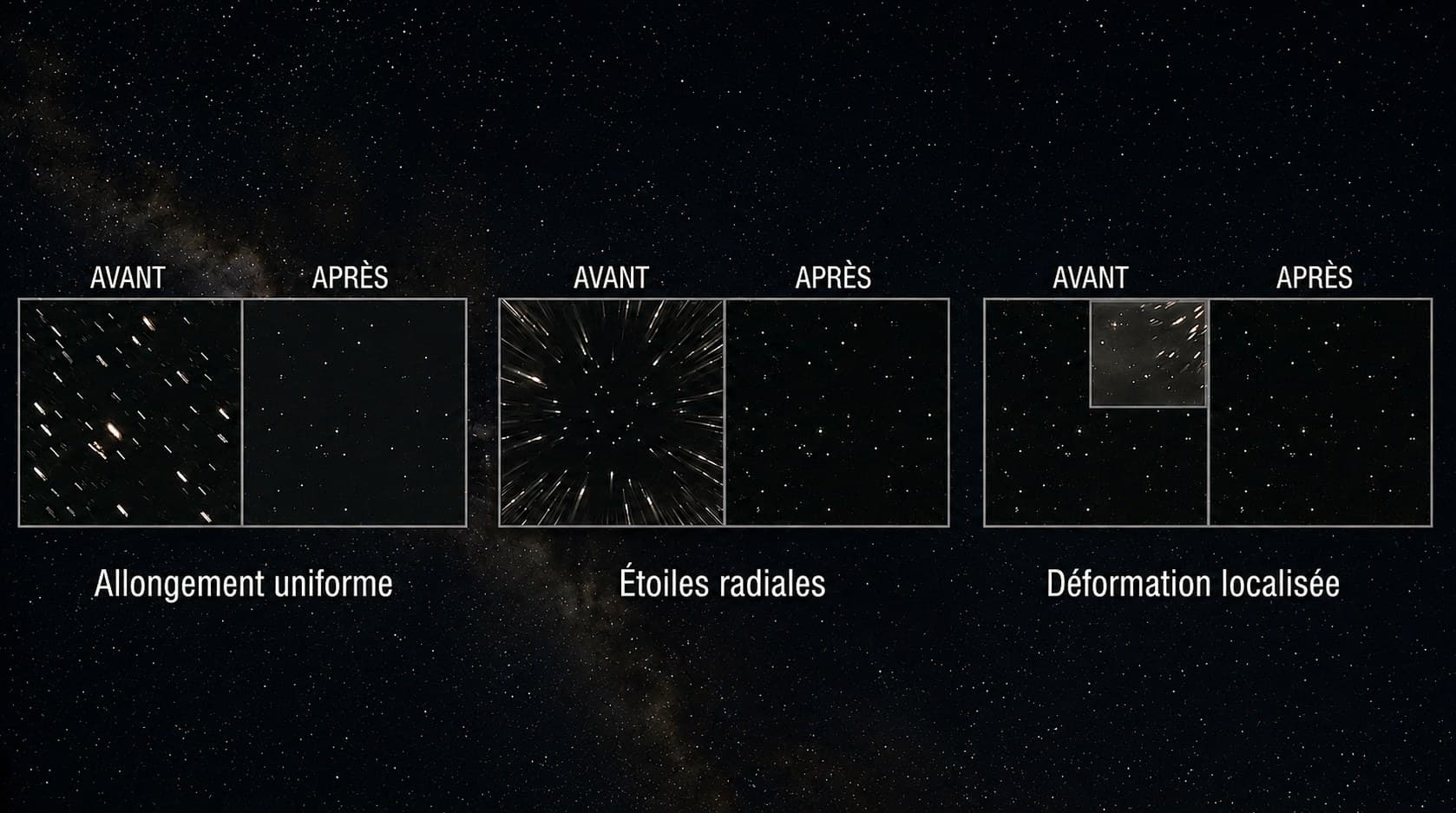
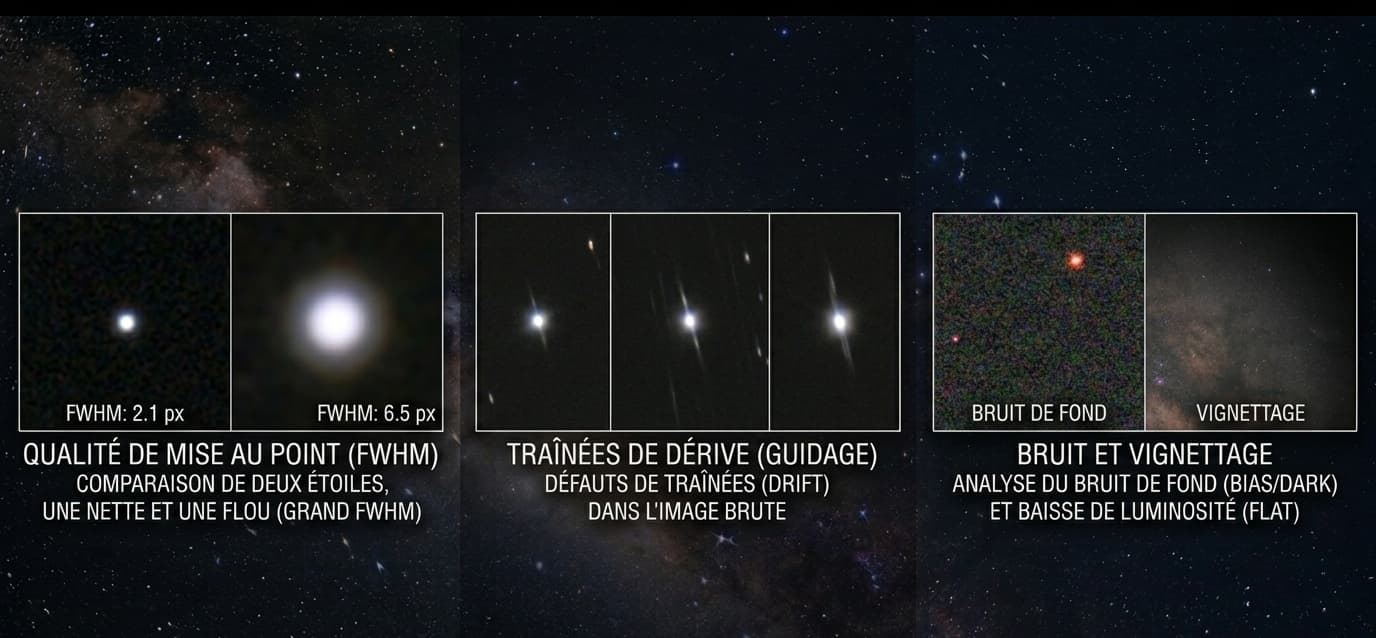
The diagnosis comes down to one dominant cause. The aberration inspector measures an elongation of 1.36 at the exact center of the field, while this image's instrumental floor sits at 1.09: a field optical aberration always leaves the center clean, so optics are not the culprit. The very low angular spread between zones, 6.3 degrees, confirms that every star streaks in the same direction, the classic signature of tracking drift over 60s at 1764mm.
The second observation is subtler and partly contaminated by the first. The FWHM asymmetry is clearly horizontal (0.158) and nearly zero vertically (0.007), with a corner to center ratio of 1.257: the left side of the field, notably the top left and bottom left corners, is more bloated than the right side. That is the mark of a slight focal plane tilt behind the reducer, but its amplitude stays modest and a reliable measurement requires a properly guided master, since drift artificially inflates FWHM values.
The rest is healthy. The measured background shows rotational symmetry with only a 6% falloff toward the edges, perfectly normal optical vignetting on an uncalibrated sub, and no significant oriented gradient. The histogram clips neither at the top nor problematically at the bottom.
Priority actions
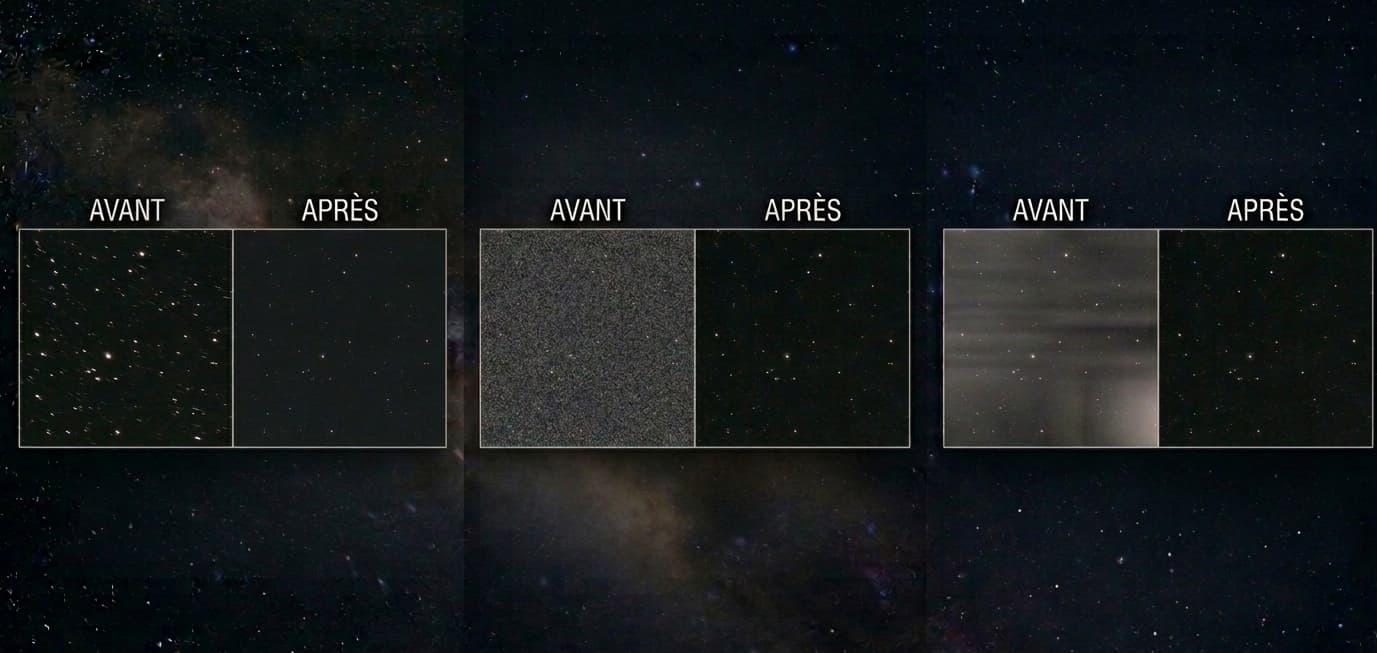
- Set up autoguiding, ideally with an off axis guider, and target an RMS below 0.5 arcsecond before any other correction
- Redo polar alignment with a drift assistant before the next session
- Rerun the aberration inspector on a guided master to confirm or rule out the sensor tilt
- Cool the sensor to -10°C and extend exposure to 120s once guiding is operational
- Consider bin 2 during processing to recover SNR from this 0.44 arcsecond per pixel oversampling