Astrophotography diagnosis of Crescent Nebula: Backfocus error and clipped stars
RawBaader UV/IR Cut180s23 août 2026
The Doc examined this image of Crescent Nebula (raw, Baader UV/IR Cut, 180s). Estimated overall technical quality: 6/10. 2 defects found: Backfocus error (severity 3/5), Clipped stars (severity 1/5).
&w=1920&q=75)
Info
- Cible
- Crescent Nebula
- Date
- 23 août 2026, 22:45
- Lune
- Croissant décroissant 16.9% (5.2° d'alt., 68.4° de la cible)
- Site
- Bortle 6 · banlieue dense (saisi)
- Position
- 20h12m12s · +38°21'36"
Average but usable conditions. The Moon is only 16.9% illuminated and 5.2 degrees above the horizon, and at 68.4 degrees from the target its impact is negligible: no measurable lunar pollution here. Bortle 6 is the real limiting factor on NGC 6888, a faint emission nebula: with a broadband UV/IR Cut the sky background climbs fast and Ha contrast stays low, as the small background-to-black-point margin confirms (e_margin 2.52). On this target under this sky, a dual-band such as L-eXtreme or L-Ultimate would gain far more than extra broadband hours.
Setup
- Type d'image
- Brut
- Télescope
- Quattro 150P + CC
- Caméra
- Ares-C PRO
- Filtre
- Baader UV/IR Cut
- Monture
- EQ6-R Pro
- Exposition
- 180s
- Phase de lune
- Waxing gibbous (83 %)
- FOV
- 1.28°
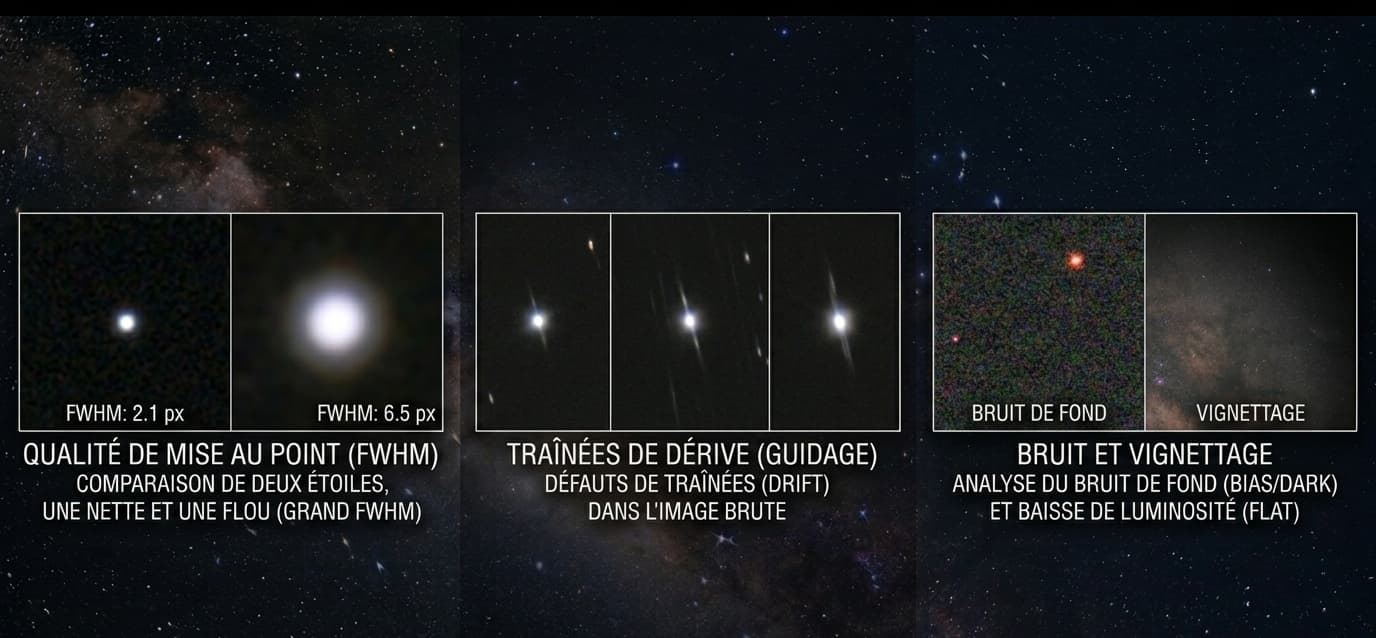
Coherent setup for the target. At 518 mm and f/3.45 with a 1.28 degree field, the Crescent (roughly 18 by 12 arcminutes) fits comfortably, maybe a touch small at centre, but that leaves room for the surrounding nebulosity. Sampling at 1.497 arcsec/px is comfortable and consistent with a central FWHM of 3.8 px, about 5.7 arcsec total: seeing and backfocus are the limits, not resolution. Gain 125 and offset 40 are healthy (no dark clipping), and -10C cooling is fine. The 180s exposure is slightly short given the measured background margin, but under Bortle 6 in broadband it is a reasonable compromise to limit saturation.
The diagnosis in detail
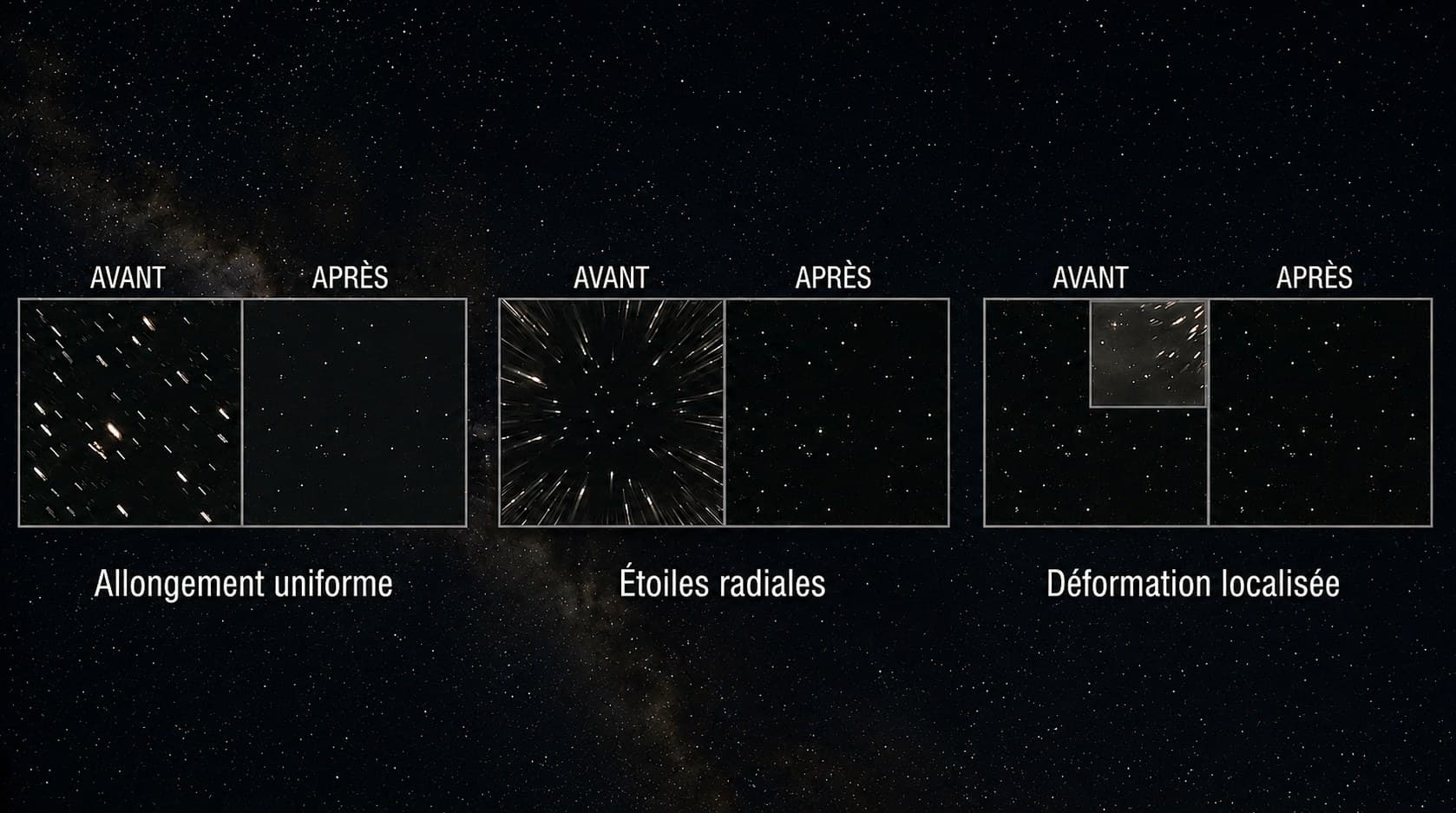
The diagnosis is simple and well isolated: this image has no mount problem, it has an imaging-train problem. The EQ6-R is doing its job, the field centre is the sharpest point of the frame, and major-axis orientations are far too consistent to betray drift or guiding oscillation.
The degradation is purely radial. FWHM goes from 3.79 px at centre to 5.03 px top-left and 5.54 px bottom-left, a 1.45 corner-to-centre factor, with stars staying oval rather than turning into radial comets. That is the signature of residual field curvature, meaning backfocus is off behind the corrector: at f/3.45 the depth of focus is so shallow that a 1 mm error produces exactly this profile. The slight left-versus-right imbalance suggests a small tilt component on top, but it stays below the threshold for characterised tilt and should resolve itself once the spacing is right.
On the sky side the background is clean and radially symmetric, with no exploitable oriented gradient, and comparison with the DSS confirms that the red nebulosity around the Crescent is genuine signal, not an artefact. The 2.52 background margin simply means you are close to the read-noise-limited regime in broadband: favour more subs over longer exposures.
Priority actions
- Set backfocus to the millimetre behind the coma corrector, accounting for filter thickness, then revalidate with the aberration inspector
- Mechanically lock the imaging train (threaded adapters) to remove the residual tilt component at f/3.45
- Under Bortle 6 on this emission target, consider a dual-band filter to gain Ha contrast
- Increase the number of subs rather than the exposure length, since the background is already near the sky-limited regime