Astrophotography diagnosis of Crescent Nebula: Backfocus error, tracking drift and 1 other
RawBaader UV/IR Cut180s23 août 2026
The Doc examined this image of Crescent Nebula (raw, Baader UV/IR Cut, 180s). Estimated overall technical quality: 6/10. 3 defects found: Backfocus error (severity 3/5), Tracking drift (severity 2/5), Clipped stars (severity 1/5).
&w=1920&q=75)
Info
- Cible
- Crescent Nebula
- Date
- 23 août 2026, 22:51
- Lune
- Croissant décroissant 16.9% (4.8° d'alt., 68.4° de la cible)
- Site
- Bortle 6 · banlieue dense (saisi)
- Position
- 20h12m12s · +38°21'35"
Fair conditions for this target. The Moon is at 16.9% illumination and only 4.8 degrees above the horizon, 68.4 degrees from the Crescent: its contribution to sky background is negligible, confirmed by the background map (plane component of just 14%, R2=0.09, so no significant oriented gradient). What remains is Bortle 6, which limits contrast on an emission nebula shot through a plain UV/IR Cut: the crescent's H-alpha signal is very faint on this sub. On an emission target like NGC 6888, a dual-band filter would help markedly under Bortle 6, cutting light pollution while preserving H-alpha and OIII. Failing that, total integration has to compensate.
Setup
- Type d'image
- Brut
- Télescope
- Quattro 150P + CC
- Caméra
- Ares-C PRO
- Filtre
- Baader UV/IR Cut
- Monture
- EQ6-R Pro
- Exposition
- 180s
- Phase de lune
- Waxing gibbous (83 %)
- FOV
- 1.28°
A coherent combination. At 518 mm and f/3.45 with a 1.28 degree field, NGC 6888 fits comfortably in frame, perhaps even a little small at center: this field leaves room to compose with the surrounding nebulosity. The 1.497 arcsec/px sampling sits in the comfortable range, well matched to the measured FWHM (3.5 px at center, about 5.2 arcsec). On settings: gain 125 and -10C are healthy, offset 40 causes no dark clipping (0%). Exposure deserves a note: the background-to-black-point margin e_margin=2.22 is low, the background is not clearly lifted off the black point in broadband under Bortle 6, so lengthening the exposure slightly or piling up more subs would improve SNR.
The diagnosis in detail
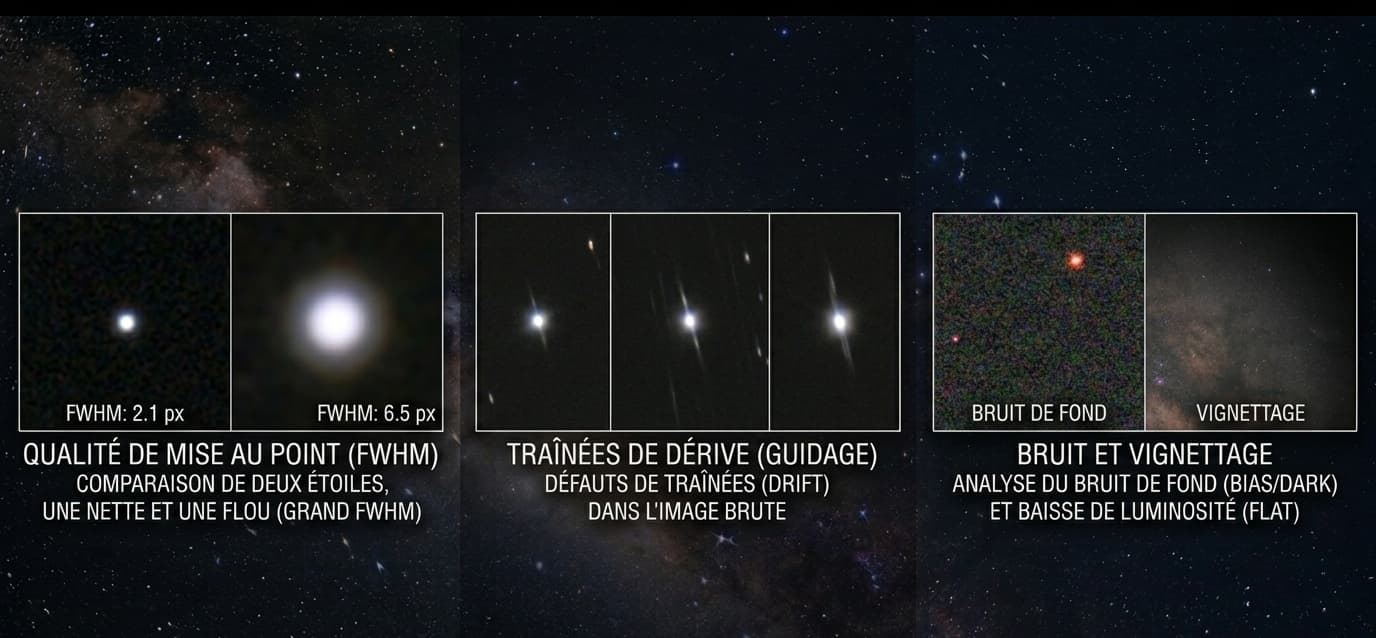
The sub is technically sound, but two instrumental signatures read clearly in the measurements. The first, and clearest, is a radial PSF degradation: 3.5 px FWHM at center against 4.6 to 5.6 px in the corners, a factor of 1.60. The rise is symmetric across all four corners, with oval rather than comet-shaped stars, which points to field curvature tied to back spacing rather than sensor tilt or pure coma. At f/3.45, backfocus tolerance is on the order of a tenth of a millimeter: this is the first adjustment to revisit.
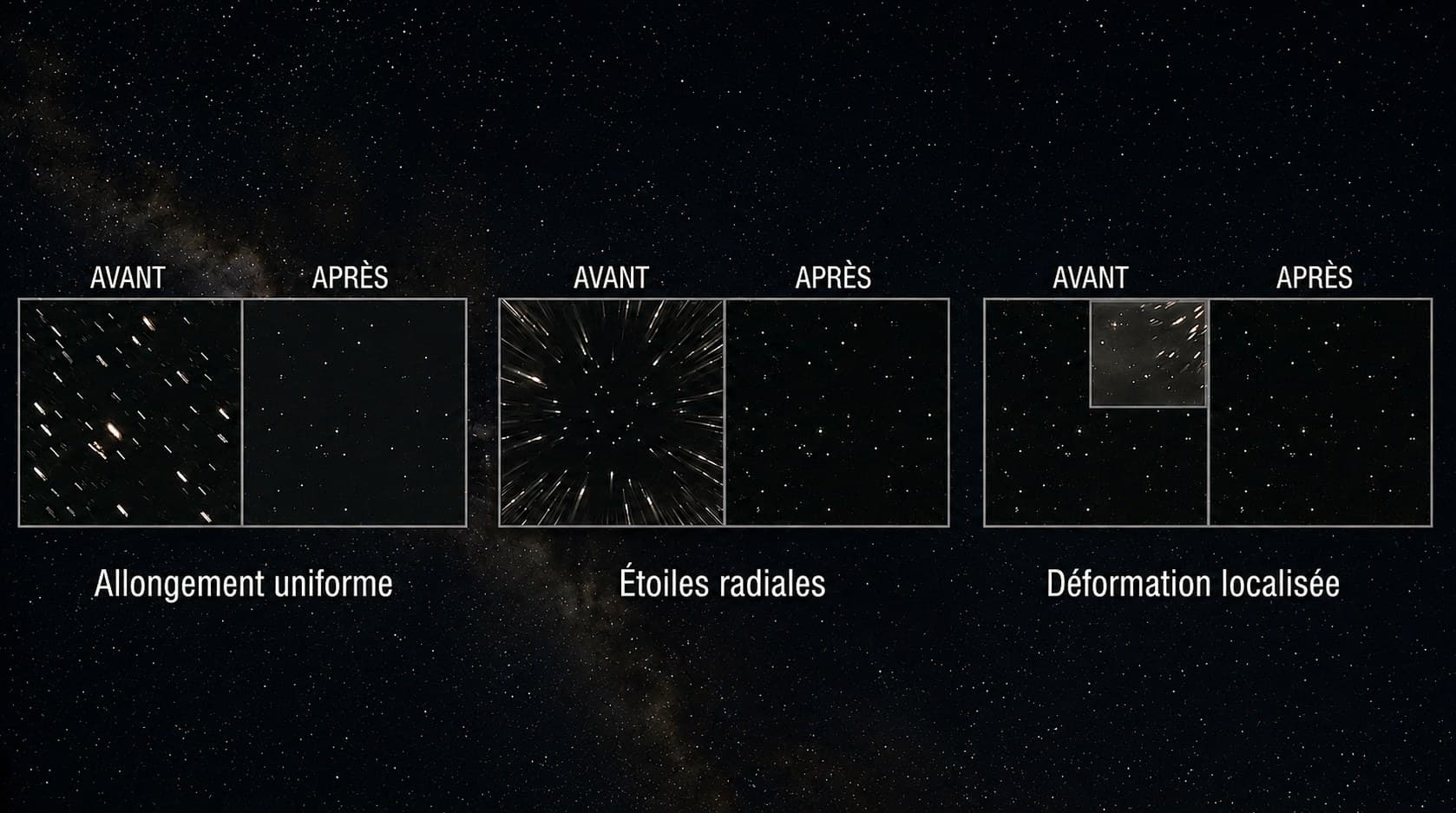
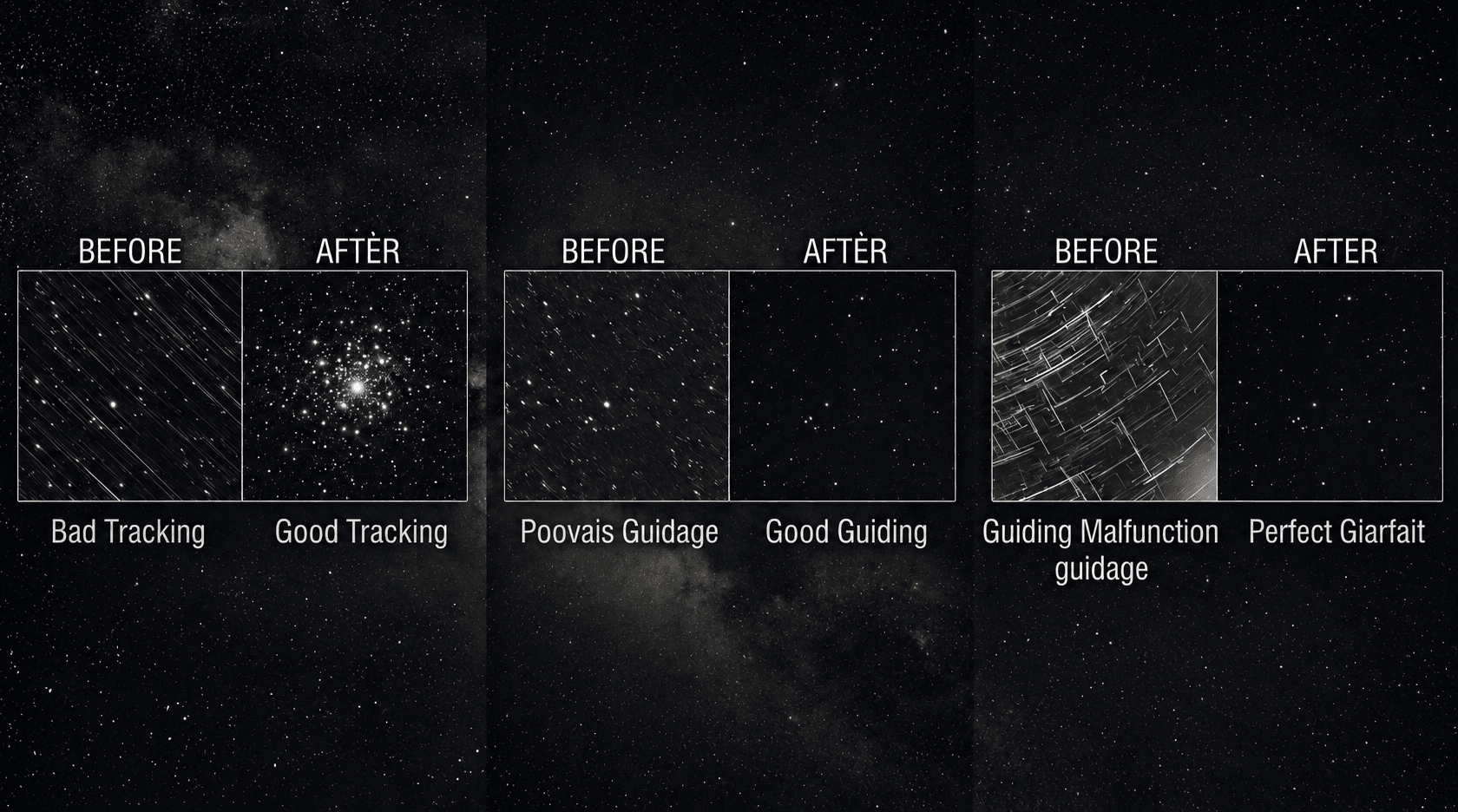
The second is subtler: an elongation of 1.13 at center, barely above the OSC floor of 1.12, but with position angles clustered within an 11.8 degree spread across the whole field. That directional coherence is the mark of tracking drift, not an optical aberration. The amplitude stays low and does not really hurt the frame, but it will accumulate in the stack if polar alignment is not redone.
Finally, the background is radially symmetric (plane/radial dominance 0.1, azimuthal anisotropy 0.03): that is normal optical vignetting before flats on a sub, to be corrected with a good flat set rather than flagged as a defect at this stage. The crescent's signal is faint compared to the DSS, which mostly reflects the use of a broadband filter under Bortle 6.
Priority actions
- Set the coma corrector backfocus to a tenth of a millimeter and validate with corner FWHM on test frames
- Redo a rigorous polar alignment and check guiding RMS in PHD2 before the next session
- Consider a dual-band filter for NGC 6888 under Bortle 6, since the H-alpha signal is very faint in broadband
- Increase total integration, the measured background margin (2.22) showing a sub still far from sky-limited
- Shoot a flat set to correct the measured +40% radial vignetting toward the edges