Astrophotography diagnosis of IC 1805: Residual vignetting and clipped stars
Processedl-extreme70x300s
The Doc examined this image of IC 1805 (processed, l-extreme, 70x300s). Estimated overall technical quality: 7/10. 2 defects found: Residual vignetting (severity 2/5), Clipped stars (severity 2/5).

Info
- Cible
- IC 1805
- Site
- Bortle 4 · transition rural/banlieue (saisi)
- Position
- 1h50m48s · +61°53'60"
Conditions were favorable. Bortle 4 with a 33% waning crescent poses no problem on IC 1805, a pure emission nebula, especially behind an L-eXtreme that only passes Ha and OIII: lunar contribution and urban skyglow are cut at the source. This is exactly the use case where dual-band saves hours. The histogram measurement confirms this logic: the background to black point margin is low (e_margin 0.91), which is normal and expected in narrowband at 300s, not a sign of underexposure. Nothing to change on the planning side, other than aiming for moonless nights if you later want to add a clean RGB star layer.
Setup
- Type d'image
- Traitée
- Télescope
- askar fra400 with 0,7x reducer
- Caméra
- ZWO ASI2600MC Pro
- Filtre
- l-extreme
- Monture
- am5n
- Exposition
- 70x300s
- Phase de lune
- Waning crescent (33 %)
- FOV
- 4.50°
Very coherent setup for the target. The FRA400 with 0.7x reducer gives 4.50 degrees of field, exactly what is needed to frame Heart and Soul in the same image with comfortable composition margin. The ASI2600MC Pro samples comfortably at this ratio and the measured FWHM around 5.8 px at center stays consistent with a 70-sub stack and mild oversampling. The L-eXtreme is the right choice on an Ha dominant target. The 5h50 total is decent, but on a nebula of this extent, doubling the time would make the faint outer structures of the Soul region noticeably cleaner.
The diagnosis in detail
The instrumental side is clean and that deserves to be said plainly. The aberration inspector gives an elongation of 1.00 at center, a corner/center FWHM ratio of 1.036 and a PA dispersion of 27 degrees, which means the stars are round everywhere, with no tilt, no backfocus error, no residual coma and no sign of tracking drift. On a 0.7x reducer this result is not trivial: the backfocus is correct and the AM5N guides well on 300s subs.
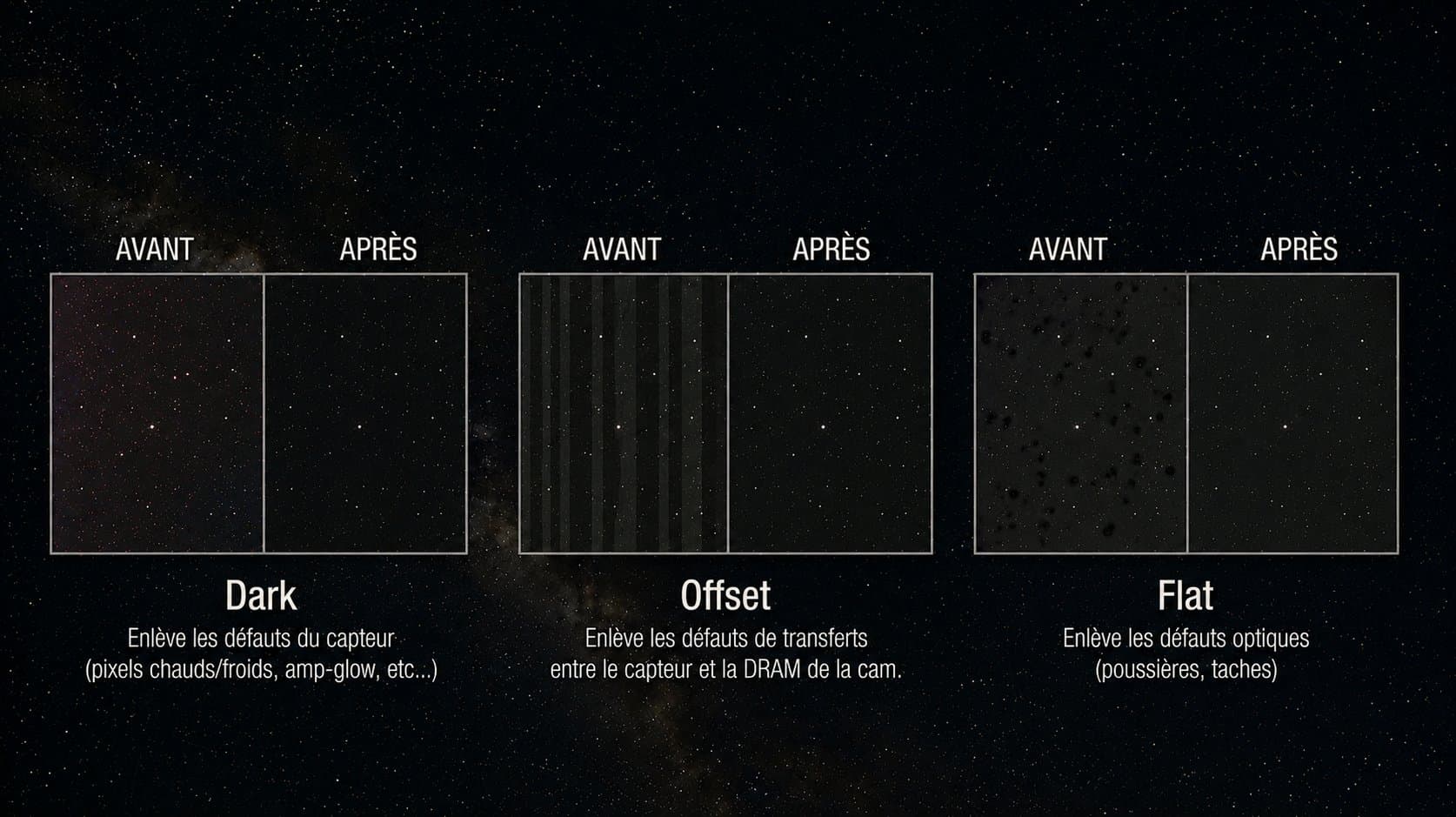
The weak point therefore lies solely in the background calibration chain. The illumination map measures a 35% falloff from center to edges, with a clear rotational signature and a negligible oriented plane component. This is not light pollution gradient nor a lunar effect, it is genuine vignetting that the flats did not fully remove. Across a 4.50 degree field where nebulosity extends into the corners, this falloff flattens the peripheral Ha signal and makes the central zone between the two nebulae look emptier than it really is.
Secondarily, the cores of the brightest stars are flat white with no chromatic gradient. This is common and fairly harmless in narrowband, but a highlight recovery pass or a softer star mask during the stretch would restore some nuance.
Priority actions
- Reshoot a flat series on the complete optical train, without disassembly, to remove the residual 35% radial falloff
- Redo the background processing with a division based illumination correction (GraXpert or DBE) rather than a plain gradient subtraction
- Soften the stretch on bright stars or apply highlight recovery to limit clipped cores
- Add integration time to better bring out the faint outer extensions of the Soul region