Astrophotography diagnosis of IC 1805: Backfocus error
Rawl-extreme27×300s
The Doc examined this image of IC 1805 (raw, l-extreme, 27×300s). Estimated overall technical quality: 7/10. 1 defect found: Backfocus error (severity 3/5).

Info
- Cible
- IC 1805
- Site
- Bortle 4 · transition rural/banlieue (saisi)
- Position
- 1h19m60s · +61°00'00"
Decent conditions for this target. Bortle 4 is comfortable, and a 46 percent last quarter barely penalizes an emission nebula shot through an L-eXtreme: the two narrow bands reject most of the lunar continuum. The background map confirms it, the plane gradient tops out at 4 percent amplitude with an R2 of 0.01, so nothing directional or meaningful as light pollution. The measured background sits well clear of the black point (6.67 margin), so the sky is not the limiting factor here. That said, if you want to push the OIII on the bubble, aim for a moonless night, that channel suffers the most from residual lunar sky.
Setup
- Type d'image
- Brut
- Télescope
- askar fra400 with 0,7x reducer
- Caméra
- ZWO ASI2600MC Pro
- Filtre
- l-extreme
- Monture
- am5n
- Exposition
- 27×300s
- Phase de lune
- Last quarter (46 %)
- FOV
- 6.50°
The setup is well matched to the target. At 6.50 degrees of field, the FRA400 reduced to 0.7x takes in the whole Heart plus Soul complex, and the chosen framing holds both with comfortable margins: a very sensible use of this wide-field combination. The 300s subs are consistent for dual-band, a median of 0.24 with a 6.67 background/black-point margin shows a properly sky-limited regime with no global saturation (0 percent). Dark clipping at 0.76 percent stays marginal but flags a barely sufficient offset, worth watching if you shorten exposures. The one link to adjust remains the backfocus spacing behind the reducer.
The diagnosis in detail
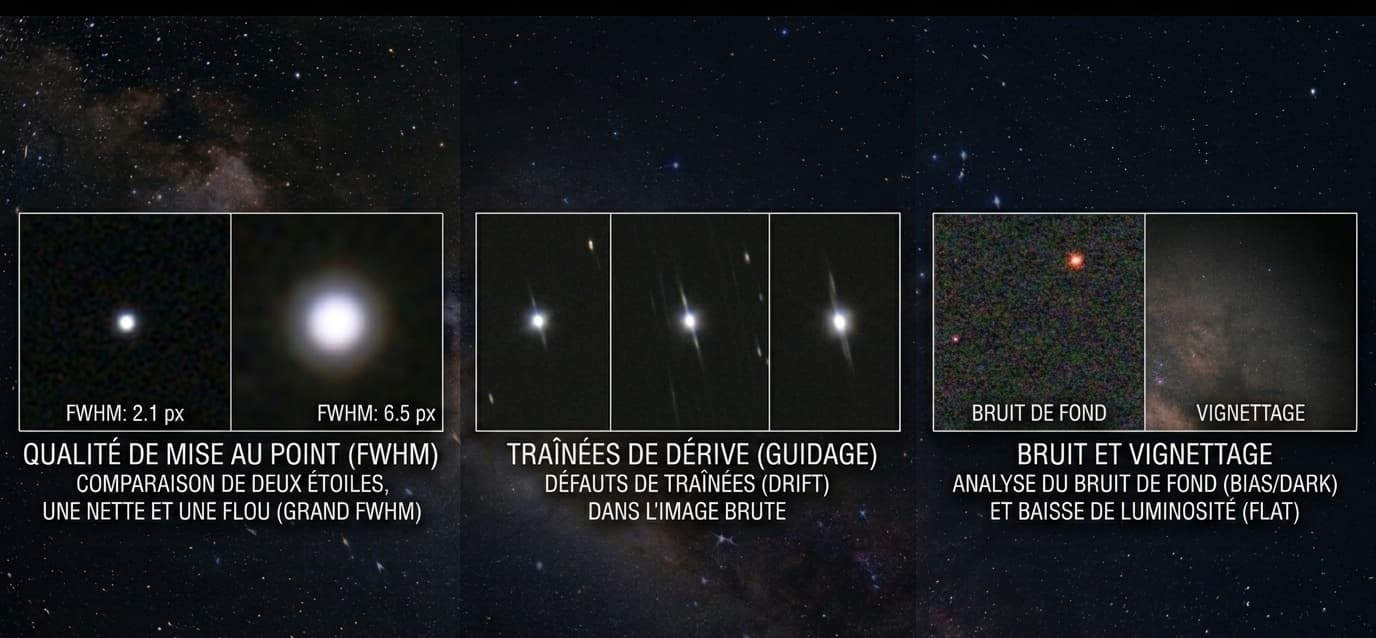
The diagnosis comes down to a single, purely mechanical point. The Moffat measurements give a center FWHM of 2.25 px, which is excellent for a 300s sub, and a central elongation of 1.11, barely above the field floor (1.04). In other words, the AM5N tracking is healthy, guiding leaves no directional signature (26 degrees of PA scatter, so no preferred direction) and central focus is good.
The degradation is strictly peripheral: 3.42 px top left, 3.68 px bottom left, 3.26 px bottom right, against only 2.36 px top right. The rise is broadly symmetric but not perfectly even, which is typical of an off-spec backfocus with a very slight residual tilt component. Since elongation stays low everywhere, this is neither true coma nor astigmatism: it is field curvature that the reducer is not flattening out.
Nothing disqualifying for this set: 27 stacked 300s frames will remain perfectly publishable, the corners will simply be a little softer than the center. But fixing the spacing before the next session will give you a uniform field and will be worth more than any extra hour of integration.
Priority actions
- Re-measure and adjust the backfocus spacing behind the 0.7x reducer (55 mm, filter included), in 0.5 mm steps
- Validate on a test sub by comparing corner FWHM to center, target a ratio under 1.25
- Check the tightness and squareness of the filter drawer and camera adapter to remove the slight top-right / bottom-left asymmetry
- Stack the current set as is, it is usable, and consider a light edge crop if the corners bother you