Astrophotography diagnosis of IC 1805: Astigmatism and sensor tilt
Raw180s08 août 2026
The Doc examined this image of IC 1805 (raw, 180s). Estimated overall technical quality: 7/10. 2 defects found: Astigmatism (severity 2/5), Sensor tilt (severity 2/5).

Info
- Cible
- IC 1805
- Date
- 08 août 2026, 01:45
- Lune
- Gibbeuse croissante 72.5% (22.9° d'alt., 40.8° de la cible)
- Site
- Bortle 2 · rural typique (VIIRS)
- Position
- 2h33m03s · +61°31'50"
Conditions are broadly excellent: a Bortle 2 sky is as good as it gets for pulling out the faint outer structure of the Heart Nebula, and the background map confirms it with a near-zero plane gradient (1% amplitude, R squared 0.02). The gibbous Moon at 72.5% and only 22.9 deg above the horizon, 40.8 deg from the target, could have been a problem in broadband, but on an emission target with a narrow filter its impact stays marginal, which the absence of an oriented gradient confirms. You can keep imaging without waiting for moonset on this configuration.
Setup
- Type d'image
- Brut
- Télescope
- EQMod Mount
- Caméra
- ZWO ASI585MM Pro
- Exposition
- 180s
- Phase de lune
- Dernier croissant (27 %)
- FOV
- 3.36°
The setup matches the target well: 3.36 deg of field at 190mm focal length frames IC 1805 completely, including NGC 896 at top left, with comfortable margins. The 3.15 arcsec/px sampling is clearly undersampled, which explains the measured 1.3 px FWHM: a star spans barely a pixel and a half, so stellar shape is poorly resolved and the elongation metrics should be read with caution. On settings, gain 150 and offset 15 produce no dark clipping (0%) and no saturation (0%), and -20C is healthy. The 1.57 background-to-black-point margin is low, but that is normal in narrowband under a Bortle 2 sky: no reason to lengthen the exposure.
The diagnosis in detail
This sub is very clean where it matters. The field centre shows an elongation of 1.15 against a field floor of 1.07, meaning a near-circular PSF: no tracking component, no drift, no periodic error, no guiding oscillation. For a 180s exposure that is a very good mount result.
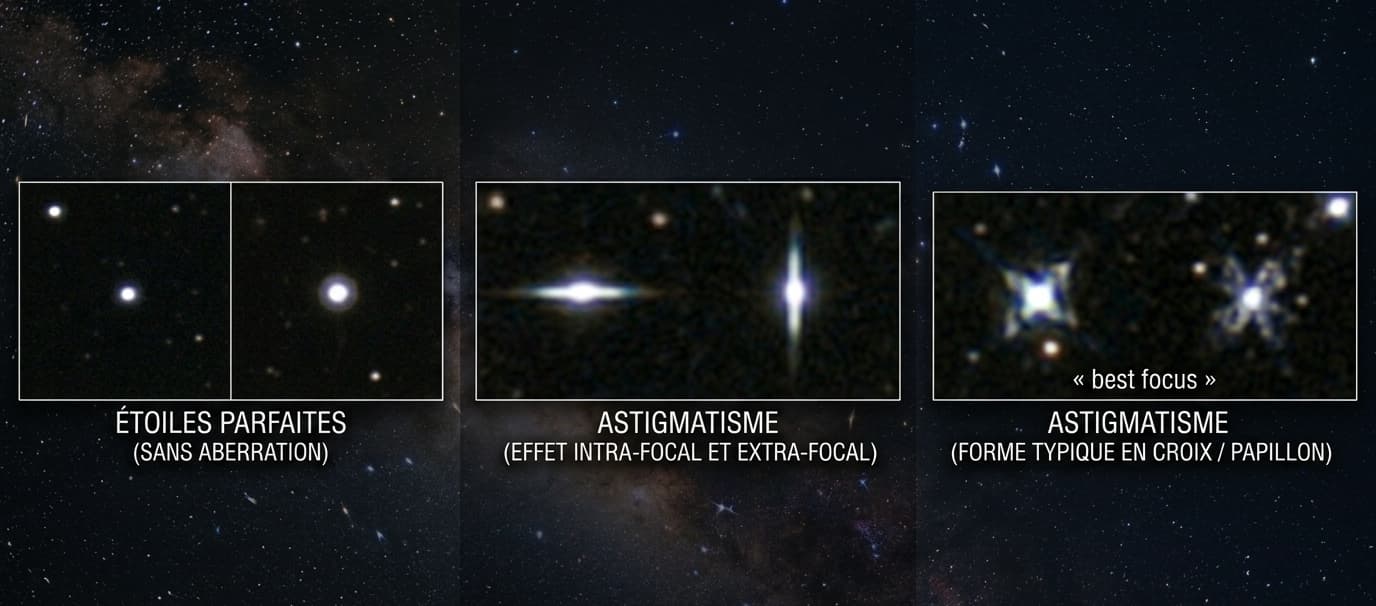
The only area to work on is the periphery. The corner/centre FWHM ratio is 1.20, so the edges barely broaden, but elongation clearly rises: 1.35 bottom-left, 1.28 bottom, 1.25 right, 1.24 left. That combination of stars staying tight while stretching along one axis is the signature of field astigmatism. On top of it sits an asymmetry between opposite corners, with top-left at 1.09 against 1.35 bottom-left, betraying a slight tilt of the focal plane. Both stack up along the same diagonal.
Note that the 3.15 arcsec/px sampling makes these measurements fragile: with stars barely sampled across 1.3 px, a small shape variation translates into a large relative elongation gap. So I keep both defects at moderate severity. The background itself is exemplary: radial symmetry, a 10% falloff from centre to edges, strictly the normal optical vignetting of a raw sub before flats.
Priority actions
- Retighten the imaging train evenly and replace side-clamp fittings with threaded M48/M54 connections
- Shoot a 60s test sub and rerun the aberration inspector to see whether the BL/TL asymmetry persists
- Adjust backfocus in 1 mm steps and compare corner elongation between tests
- Acquire flats to correct the 10% centre-to-edge falloff before stacking