Astrophotography diagnosis of IC5070_Askar50P: Periodic error (unguided)
Raw300s08 août 2026
The Doc examined this image of IC5070_Askar50P (raw, 300s). Estimated overall technical quality: 7/10. 1 defect found: Periodic error (unguided) (severity 2/5).
&w=1920&q=75)
Info
- Cible
- IC5070_Askar50P
- Date
- 08 août 2026, 21:40
- Lune
- Gibbeuse croissante 80.5% (sous l'horizon)
- Site
- Bortle 2 · rural typique (VIIRS)
- Position
- 20h55m09s · +43°11'54"
Excellent conditions: Bortle 2 and Moon below the horizon (crescent at 96 deg separation), so no lunar pollution is possible and the sky background is very dark. On an emission nebula shot in Ha this is the ideal context: SNR on the nebular signal will be very good and gradients almost nonexistent (the background map shows only a weak radial symmetry of 8-9%, fixable with a simple flat). Nothing forces you to cut the session short for sky reasons; the only real limit here is mechanical, not atmospheric.
Setup
- Type d'image
- Brut
- Télescope
- EQMod Mount
- Caméra
- ZWO ASI585MM Pro
- Exposition
- 300s
- Phase de lune
- Dernier croissant (20 %)
- FOV
- 3.36°
The Askar 50P (190mm f/3.8) and ASI585MM Pro pairing is coherent for this wide target: IC5070 and the whole Pelican complex fit comfortably within the 3.36 deg field. The 3.15 arcsec/px sampling is undersampled (small 2.9 micron pixels on a short focal length), which explains native FWHM around 1.3 px: stars sit on few pixels, so any tracking error shows up quickly. Healthy settings: gain 100 (unity), offset 15 with no dark clipping (0%), sensor at -16.5C. The sky-to-black margin e_margin of 2.02 is low but NORMAL for narrowband at 300s, no concern.
The diagnosis in detail
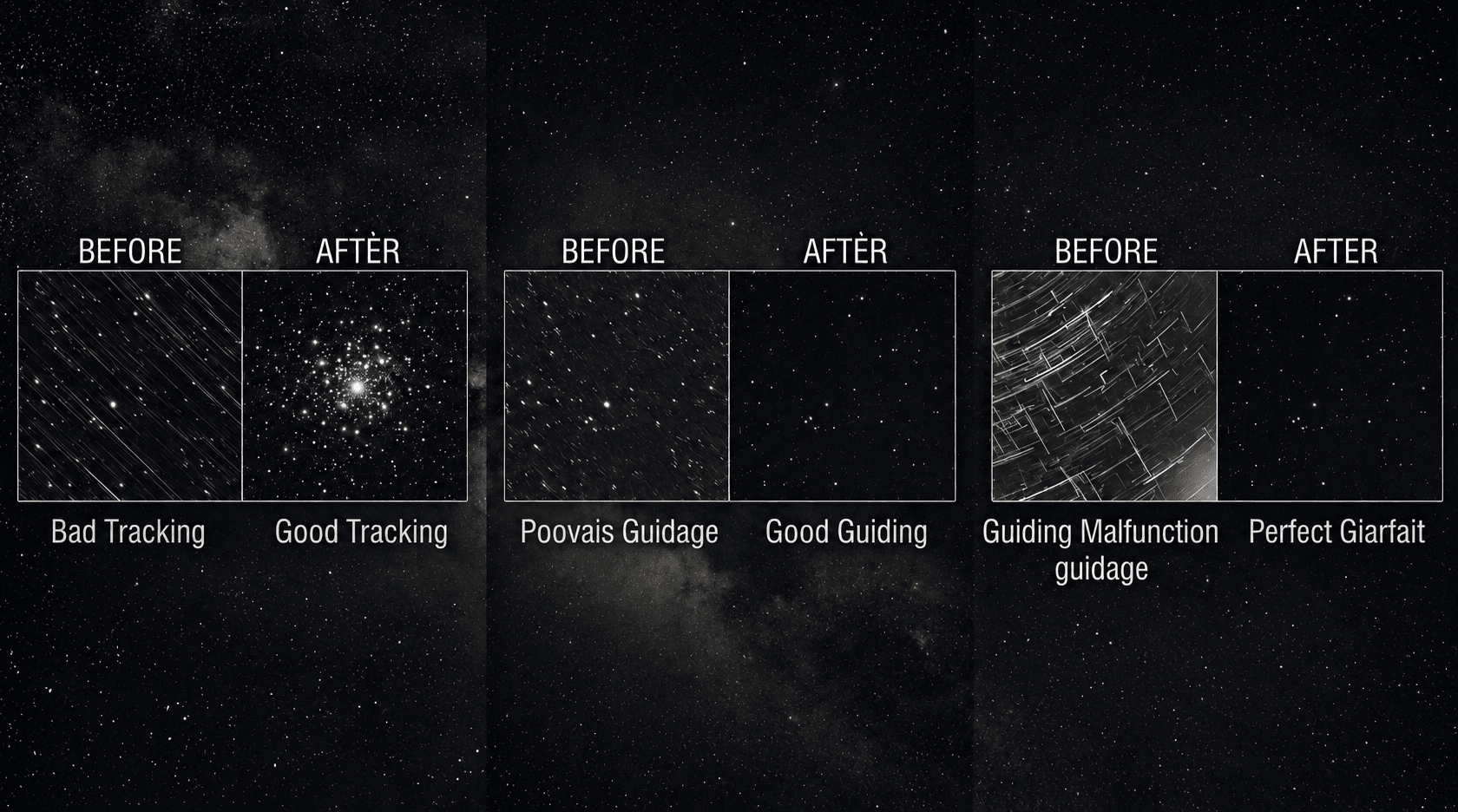
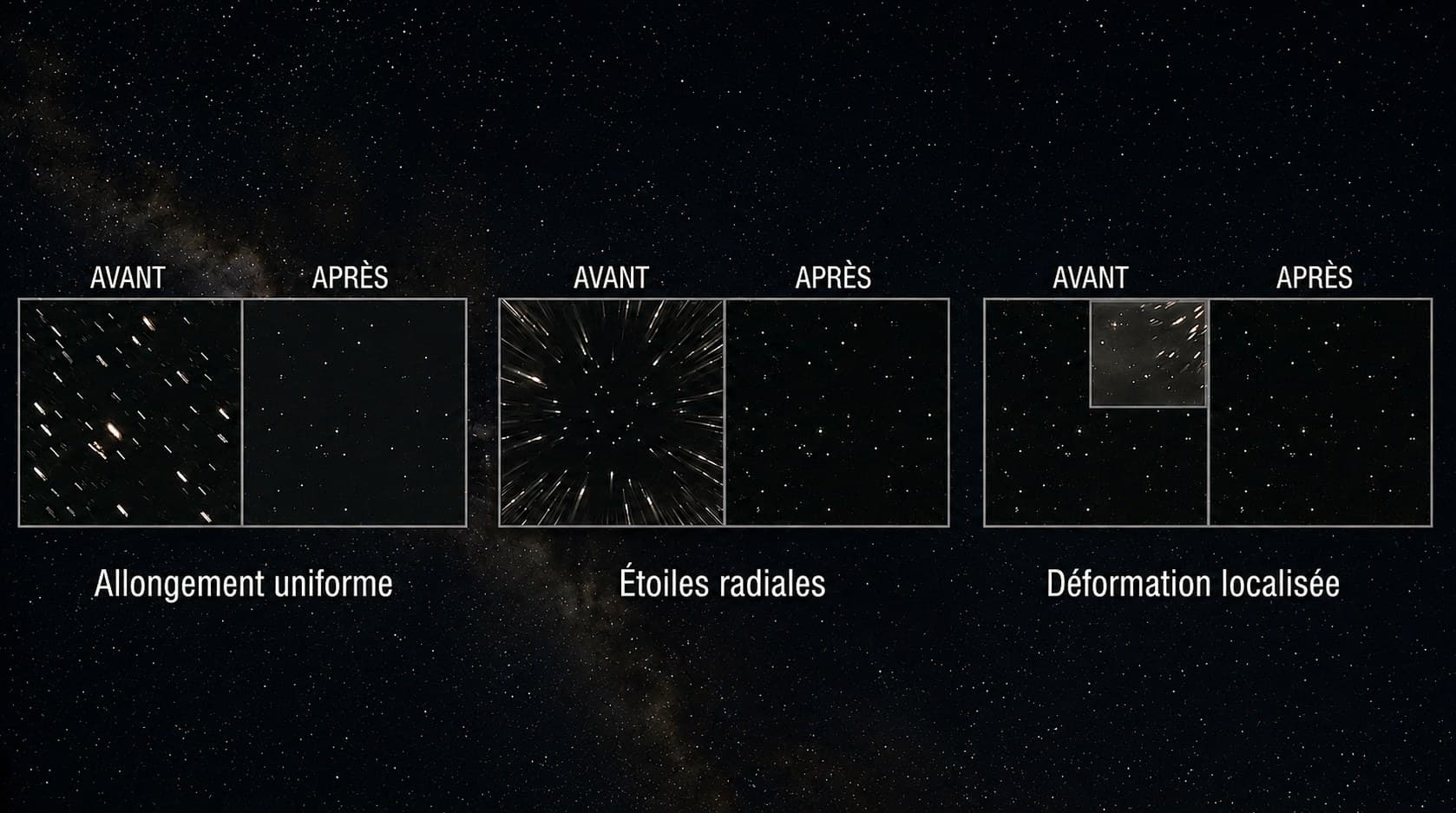
This sub is well made. The PSF plate shows a clean optical field: the corner/center FWHM ratio of 1.157 and the low horizontal/vertical asymmetry (0.033 / 0.076) rule out sensor tilt, backfocus or marked coma, the four corners behaving comparably to the center. The only measured defect is an elongation that reaches the center itself (elong C = 1.24, above the field floor of 1.08). A deformation present all the way to the center is not field-optical in origin: it comes from tracking. The major-axis direction stays within a narrow range (PA 77-85 deg) across several zones, but its amplitude fluctuates (1.08 to 1.34 depending on zone) and the 25 deg PA spread points to a not-fully-straight motion: typical of unguided periodic error on a 300s exposure.
The effect stays mild because the stars are intrinsically tight (FWHM ~1.3 px); however, the undersampled scale makes this small elongation visible proportionally sooner. In the stack it will translate into slightly oval stars if left uncorrected.
The rest is exemplary for a sub: dark sky background matching the DSS, no clear trail, hot pixels at the level expected on a single sub (sigma reject will remove them), and a simple flat will handle the weak 8-9% radial falloff of the background.
Priority actions
- Set up autoguiding to remove the periodic error visible all the way to the center
- Failing guiding, shorten the sub to 120-180s (the Bortle 2 narrowband SNR budget easily allows it)
- Take a set of flats to correct the weak background radial falloff (8-9%)