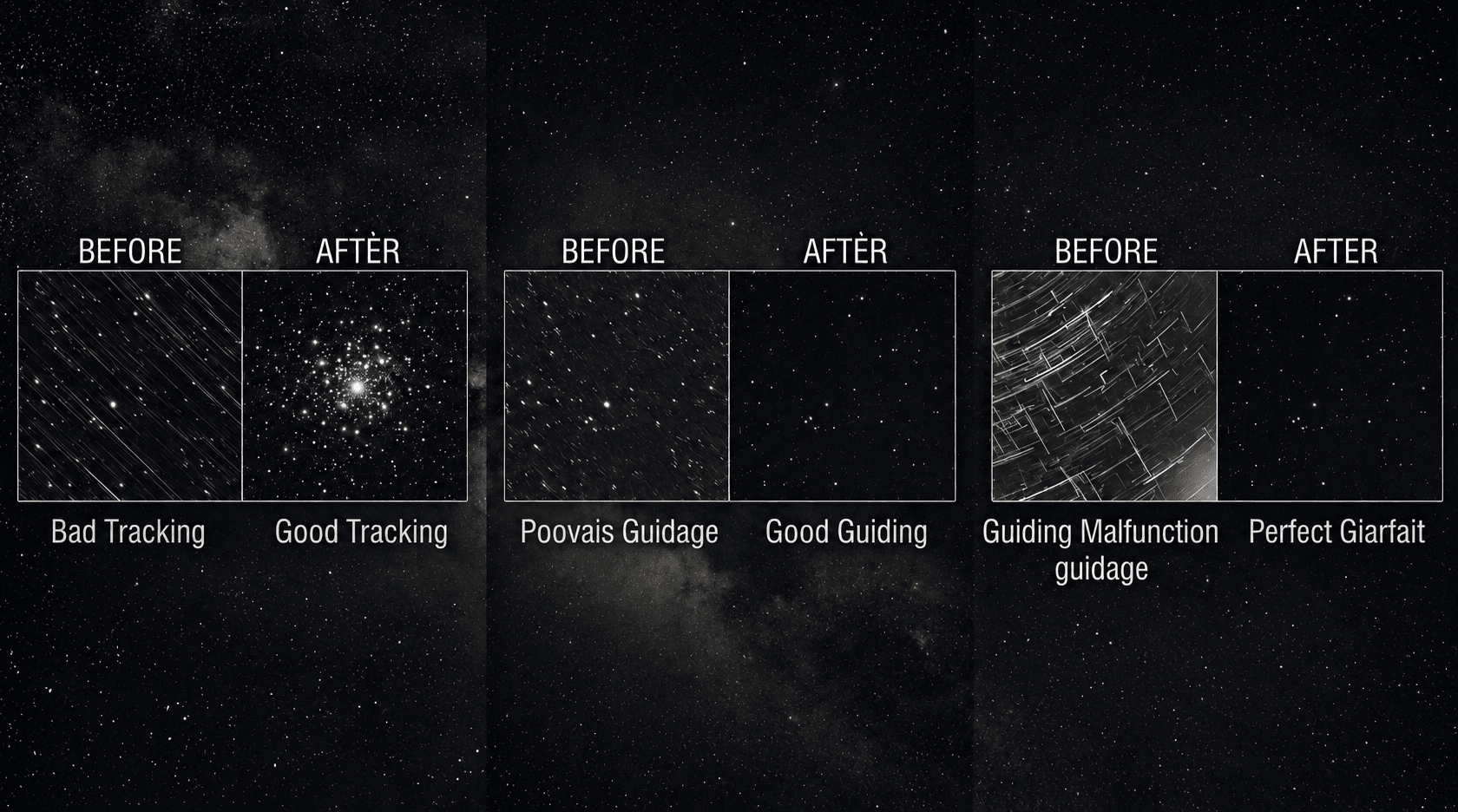
You nailed your polar alignment, started autoguiding, and yet your stars still come out as streaks, S-curves, or little kidney beans. Frustrating, because everything else is right: the focus, the framing, the sky. The culprit is almost always tracking, and more precisely the way it is tuned. The good news is that every star shape tells a precise story, and that story points directly to the setting that needs fixing.
In this article, we link each tracking signature to the adjustment that cures it: aggressiveness and MinMo in PHD2, calibrating on the west side of the meridian, backlash in declination, polar alignment, mount balance, and the classic debate of periodic error vs. PEC vs. encoders. We stay on the tuning side. To dissect the star shapes themselves in full visual detail, see our dedicated article on elongated stars.
Key takeaways |
|---|
1. Your star shape is a diagnosis. Uniform straight streaks mean drift (polar alignment or flexure). Slow S-shaped stars mean uncorrected periodic error. Kidney beans or short zigzags mean guiding overcorrection. |
2. Before touching PHD2, fix the upstream issues: careful polar alignment, clean balance, calibration done in the right location. Half of all guiding problems are mechanical problems, not software parameters. |
3. Guiding cannot fix everything. Field rotation on an alt-azimuth mount and occasional vibrations are beyond the reach of classic autoguiding. Those require a hardware or method change. |
Why good guiding changes everything
In long-exposure imaging, your mount must track the sky to arc-second precision for several minutes at a time. The slightest drift or jerk, and a star point becomes a streak or a comma. Autoguiding corrects these errors in real time: a guide camera watches a guide star, measures its displacement, and sends correction commands to the mount.
But autoguiding is not magic. Poorly tuned, it can make things worse: too aggressive, it chases the seeing and makes the star oscillate around its position. Too sluggish, it lets the periodic error of the worm gear slip through. And it cannot fix what it cannot measure, such as field rotation or a gust of wind.
This article has two goals: learning to read what your stars are telling you, then adjusting the right piece of the puzzle. Before you even open PHD2, know that the Doc recognizes your tracking signature from a single raw frame: submit a sub and it will tell you whether you are dealing with drift, oscillation, or periodic error.
Reading what your stars reveal about your tracking
Every tracking defect leaves a characteristic imprint. Learn to distinguish them, because the correction to apply depends entirely on the signature. The table below summarizes everything that follows.
Star signature | Likely tracking cause | Adjustment to make |
|---|---|---|
Straight streak, same length and same direction across the frame | Linear drift (polar alignment, flexure) | Redo polar alignment (drift align or plate-solve), hunt for flexure |
S-shaped stars, slow periodic elongation in RA | Uncorrected periodic error | Enable guiding, adjust RA aggressiveness, or record PEC |
Kidney bean, comma, short zigzag | Guiding overcorrection | Lower aggressiveness, raise MinMo, check DEC backlash |
A few randomly deformed subs, the rest clean | Wind or vibrations | Shield from wind, lower the center of gravity, discard affected subs |
Sharp stars at center, arc-shaped toward corners, rotation around one point | Field rotation (alt-az mount) | Add a field derotator, shorten exposures, or switch to an equatorial mount |
Linear drift (uniform straight streaks)
If all your stars trail in straight lines, the same length and pointing in the same direction across the whole frame, that is linear drift. The sky slides steadily in one direction, frame after frame. Two main causes: imperfect polar alignment (the mount axis does not point exactly at the celestial pole, so the field slowly rotates) or mechanical flexure between the imaging scope and the guide scope.
A key diagnostic clue: if you are guiding but still drifting, differential flexure is the prime suspect, because the guide camera does not see the same displacement as the imaging camera. The fix is not in PHD2 but in the rigidity of your setup.
Periodic error (S-shaped stars, slow oscillation)
A periodic error (PE) comes from the tiny machining imperfections in the right-ascension worm gear. With each worm revolution, the tracking rate speeds up then slows slightly, causing the star to oscillate gently in RA. On a sufficiently long unguided exposure, stars draw a slight S-shape or elongate repeatedly along the same axis.
The period of this oscillation matches the worm revolution time, typically a few minutes. That is the signature that distinguishes it from drift: drift is continuous and monotonic, while periodic error goes back and forth. Correcting it is a matter of well-tuned guiding or PEC, both covered in detail below.
Guiding overcorrection (kidney beans, short zigzags)
This is the most common trap for those who have just switched on autoguiding. Stars shaped like kidney beans, commas, or tight little zigzags do not signal an absence of guiding, but on the contrary guiding that is too aggressive. That is guiding overcorrection: PHD2 reacts to every micro-movement of the star, including those caused by seeing, and sends corrections that overshoot the target. The star then oscillates back and forth around its position.
On the guiding graph it is immediately obvious: a nervous sawtooth trace that crosses the zero line constantly with symmetric peaks. This is exactly the kind of behavior corrected by aggressiveness and MinMo, covered right below.
Wind and vibrations (randomly deformed subs)
If most of your exposures are clean but a few, at random, show doubled or lightning-bolt stars, think vibrations and wind. A gust pushing the tube, a passing car, a nearby pump, and the star jumps abruptly for the duration of one frame. Classic autoguiding, which corrects at the arc-second level over seconds, is too slow to catch a high-frequency vibration.
The diagnosis comes from the pattern: the defect is intermittent, not systematic. The fix is not in software but in the environment. Lower the center of gravity, shield from wind, and reject the affected subs at stacking time.
Field rotation (alt-az mounts)
On an alt-azimuth mount (smart telescopes, SCT on a fork without an equatorial wedge, motorized Dobsonians), the telescope tracks by moving on two axes: altitude and azimuth. Tracking of the central point is perfect, but the field slowly rotates around that guide star. The result: sharp stars at center, and increasingly arc-shaped stars as you move toward the corners. That is field rotation.
No guiding adjustment fixes this, because it is not a tracking error: it is a geometric limitation of the alt-az design. The solutions are hardware-level: a field derotator, shorter exposures to limit the arc, or switching to an equatorial mount.
Tuning PHD2 correctly
Once the signature is identified, move on to the software settings. PHD2 is free and powerful, but its parameters make more sense once you understand what they do. We go from the most impactful to the most subtle.
Aggressiveness and MinMo
Aggressiveness defines what fraction of the measured error PHD2 corrects at each step. At 100%, it corrects the entire offset at once, which invites overcorrection and oscillation. At 50-70%, it corrects progressively, which dampens the response. For the RA axis, a value around 70% is a good starting point. If you see kidney-bean stars and a sawtooth guiding curve, lower aggressiveness in 10% steps.
MinMo (minimum motion, or hysteresis) sets the threshold below which PHD2 does not correct at all. It is your anti-seeing guard: as long as the star moves less than the MinMo, it is treated as atmospheric turbulence rather than real drift, so nothing is done. A typical value is around 0.15 to 0.20 pixels. Too low, and PHD2 chases the seeing and overcorrects. Too high, and it lets genuine errors slip through.
Symptom | Likely reading | Adjustment |
|---|---|---|
Sawtooth curve, rising RMS | Overcorrection, PHD2 chasing seeing | Lower aggressiveness, raise MinMo slightly |
Slow uncorrected drift, elongating stars | Response too soft or threshold too high | Raise aggressiveness, lower MinMo |
Good in RA, bad in DEC only | Declination backlash | Configure DEC backlash compensation, guide DEC in one direction only |
A tip from the Doc: use PHD2's Guiding Assistant. It measures your seeing, drift, and backlash over a few minutes, then suggests MinMo values and settings tailored to your night. Far more reliable than guessing.
Calibrating at the meridian, on the west side
Calibration teaches PHD2 the orientation of your guide camera and the amplitude of your mount's response on each axis. For it to be accurate, calibrate in an area where the RA motion is clean and consistent: near the meridian and near the celestial equator (declination close to 0 degrees). Near the pole, RA motion is tiny and calibration becomes imprecise.
One detail often overlooked on the west side: after a meridian flip, the DEC axis reverses. PHD2 handles this correctly if you have provided your coordinates and the mount connection reports the pointing position. Recalibrating for every target is not necessary if nothing has shifted in the optical train, but a calibration done in the wrong location (too close to the pole) is a classic source of unexplained erratic guiding.
DEC backlash compensation
Backlash is the mechanical play in the declination gear: when the mount must reverse its DEC correction direction, there is a brief moment where the worm turns in free air before the gear re-engages. During that dead time the star drifts uncorrected, then bounces when the play is taken up again.
Two clean approaches, which can be combined as needed. The first: measure then enter the backlash compensation value in PHD2. The Guiding Assistant quantifies the DEC play and suggests a value; enable moderate rather than aggressive compensation, because too much compensation overshoots the target and triggers DEC oscillations. The second, often the most robust: set PHD2's Dec guide mode to North only or South only. You then guide DEC only in the direction opposite to the natural residual drift; since PHD2 never has to reverse direction, backlash never manifests, all without touching your polar alignment. This is the standard and cleanest method on mounts with significant play.
Keep in mind that the root cause is best treated mechanically when possible: adjusting the worm gear preload of your mount reduces backlash at its source. A very slight declination imbalance can also help keep the gear meshing against one consistent flank. One common misconception to avoid: never deliberately worsen your polar alignment to force a constant DEC drift. You would reintroduce field rotation and needlessly complicate your settings, for a benefit that one-direction guiding already provides cleanly.
Before guiding: polar alignment and balance
Worth repeating because it is fundamental: the majority of tracking problems are solved upstream of the software. Clean mechanics make guiding easy; neglected mechanics make guiding impossible to tune.
Drift align and polar plate-solve
A good polar alignment aligns your mount's right-ascension axis with the Earth's rotation axis. The more precise it is, the less the field rotates, and the less work guiding has to do, especially in DEC. Two reliable methods:
Drift alignment, of which PHD2's Static Polar Alignment tool is a guided variant: you observe the drift of a star and adjust the mount's azimuth and then altitude until the drift is eliminated. Slow but formidably precise, and independent of pole visibility.
Polar plate-solving, offered by NINA (Three Point Polar Alignment) or SharpCap: the software plate-solves the star field, calculates your polar alignment error, and guides you through the correction. Fast and accessible, ideal when Polaris is not visible.
Aim for a polar alignment error of around one arc-minute or better. Beyond that, you will see a residual DEC drift that guiding must continuously fight, wearing on backlash and degrading RMS.
Slight east-side RA imbalance
Balancing distributes the weight around the axes so the motors work without strain. A significant imbalance stresses the drive and amplifies backlash. The standard practice is to balance almost perfectly, then introduce a very slight imbalance in right ascension so that the east side (counterweight or tube, depending on the setup) pulls gently.
The idea: keep the RA worm gear constantly pressed against the same flank of the gear. This eliminates RA play and makes tracking smoother. The imbalance should stay minimal, just enough to maintain contact without overloading the motor. It is a finishing adjustment, done once polar alignment is complete.
Periodic error: guiding, PEC, or encoders?
Periodic error deserves its own section because three approaches coexist and are often confused.
Guiding is the most universal solution. Well-tuned autoguiding corrects periodic error in real time, alongside drift and small irregularities. For a modern mount with a PE of a few arc-seconds, clean guiding is more than enough to produce round stars. This is the recommended default approach.
PEC (periodic error correction) is a recording of your worm gear's error curve, which the mount then replays to anticipate the oscillation. Useful for unguided imaging, or as a complement to guiding to lighten its workload. Its limit: it only corrects the repeatable, worm-synchronous error. Everything that is random, such as seeing, wind, and non-periodic irregularities, is beyond its reach. PEC is most justified when you want to image unguided, or when your PE is so severe that guiding alone struggles to keep up.
High-resolution encoders are the premium hardware solution. Mounted on the axis, they continuously measure the actual position of the mount and correct periodic error at the source, without a guide star. On equipped mounts, PE becomes nearly zero and guiding becomes optional. It is effective and comfortable, but costly, so it is reserved for demanding setups or very long focal lengths.
In short: for the vast majority of amateurs, well-tuned guiding resolves periodic error without any need to touch PEC. PEC is a situational complement; encoders are a luxury that makes guiding unnecessary.
FAQ: tuning guiding and tracking in astrophotography
What aggressiveness should I set in PHD2 to avoid oscillations?
Start around 70% aggressiveness in right ascension. If you see kidney-bean stars and a sawtooth guiding curve that constantly crosses zero, that is overcorrection: lower aggressiveness in 10% steps and raise MinMo slightly (toward 0.18 to 0.20 pixels) to ignore seeing. Conversely, if the star drifts without being corrected, raise aggressiveness. PHD2's Guiding Assistant suggests values tailored to your night and is the most reliable starting point.
How do I recognize periodic error in my stars?
Periodic error produces S-shaped stars or elongation that goes back and forth along the same axis (right ascension), with a period matching one worm revolution, typically a few minutes. Its cyclic nature is what distinguishes it from linear drift, which is continuous and monotonic. For the full visual signature, see our article on elongated stars.
Should I guide or record PEC?
In the vast majority of cases, guiding is sufficient and is the recommended approach: it corrects periodic error at the same time as drift and other irregularities. PEC is most justified when you want to image unguided, or as a complement when your PE is so strong that guiding alone struggles. PEC only corrects repeatable error, not seeing or wind. If your mount has high-resolution encoders, neither is necessary.
Why are my stars elongated even with autoguiding active?
Several possibilities. If the elongation is uniform everywhere, suspect drift from differential flexure between the imaging scope and the guide scope: guiding is correcting the wrong reference frame. If stars are kidney-shaped, that is overcorrection (lower aggressiveness). If only one axis is affected, check DEC backlash. And if stars elongate into arcs only in the corners, that is field rotation (alt-az mount), which guiding cannot correct. Submit your raw frame to the Doc to narrow it down.
How do I set the balance to help guiding?
First balance nearly perfectly on both axes, then introduce a very slight imbalance in right ascension toward the east so that side pulls gently. This keeps the worm gear in constant contact with one flank of the gear and eliminates RA play, resulting in smoother tracking. The imbalance should stay minimal, just enough to maintain contact without straining the motor. Make this adjustment once polar alignment is complete.
Can an alt-az mount handle long exposures?
Yes, but with one limitation: field rotation. In alt-azimuth mode, central tracking is good but the field rotates slowly, causing stars to elongate into arcs in the corners on long exposures. The workarounds are a field derotator, short exposures stacked in large numbers (which is what smart telescopes do), or switching to an equatorial mount for long exposures without compromise. No guiding adjustment corrects field rotation, because it is not a tracking error but a geometric limitation of the design.
Conclusion
Tuning your guiding is not about fumbling through PHD2 menus until something works. It is about reading the signature your stars leave on your frames, identifying the cause, and applying the right fix: polar alignment and balance upstream, aggressiveness and MinMo to tame overcorrection, DEC backlash when only one axis goes wrong, and calibration in the right location so PHD2 starts on solid ground.
Keep in mind that not everything is solved in software: field rotation and vibrations are hardware and method problems. And when you encounter the same symptom described across other image defects, the approach remains the same as the one covered in our overview of astrophotography problems: observe, diagnose, fix the right piece. If you are unsure about your tracking signature, run a diagnosis with the Doc: it recognizes drift, oscillation, and periodic error from a single raw frame, and puts you on the right track in seconds. Your next night out will reward you with round stars.