Astrophotography diagnosis of IC5070_Askar50P: Periodic error (unguided)
Raw300s09 août 2026
The Doc examined this image of IC5070_Askar50P (raw, 300s). Estimated overall technical quality: 7/10. 1 defect found: Periodic error (unguided) (severity 2/5).
&w=1920&q=75)
Info
- Cible
- IC5070_Askar50P
- Date
- 09 août 2026, 00:52
- Lune
- Gibbeuse croissante 82% (6.6° d'alt., 96.7° de la cible)
- Site
- Bortle 2 · rural typique (VIIRS)
- Position
- 20h55m09s · +43°11'55"
Very favorable conditions. A Bortle 2 sky is the best case for an emission nebula like IC 5070, and the measured background confirms it: only 8% gradient and 0.02 azimuthal anisotropy, so almost nothing to remove. The 82% gibbous Moon is up, true, but only 6.6 deg above the horizon and above all 96.7 deg from the target, which makes its contribution negligible here, all the more so in narrowband on a monochrome camera. You can keep shooting freely that night, and if the Moon climbs later in the session, the angular separation stays your best ally.
Setup
- Type d'image
- Brut
- Télescope
- EQMod Mount
- Caméra
- ZWO ASI585MM Pro
- Exposition
- 300s
- Phase de lune
- Dernier croissant (19 %)
- FOV
- 3.36°
A coherent combination. With a 3.36 deg field, IC 5070 and the Pelican surroundings fit comfortably in frame, with margin for the nebulous extensions visible in the DSS. Gain 100 on the ASI585MM and a sensor temperature of -18.5C are healthy settings, dark current under control. Offset 15 holds up: 0% dark clipping, the left tail of the histogram is not truncated. The sky/black-point margin of 2.02 is low in absolute terms, but that is normal behavior for a narrowband monochrome acquisition at 300s, do not chase a higher value at the cost of blown stars. Given the measured elongation, the real headroom is on the mount side, not the settings.
The diagnosis in detail
The verdict is simple: this sub is good, with a single reservation on tracking. The Moffat measurements give very tight FWHM values, 1.36 to 1.61 px depending on the zone, and a corner/center ratio of 1.056: the optics hold the field without argument. Horizontal (0.005) and vertical (0.01) FWHM asymmetries sit in the noise, which rules out tilt, backfocus and coma. Nothing to correct there.
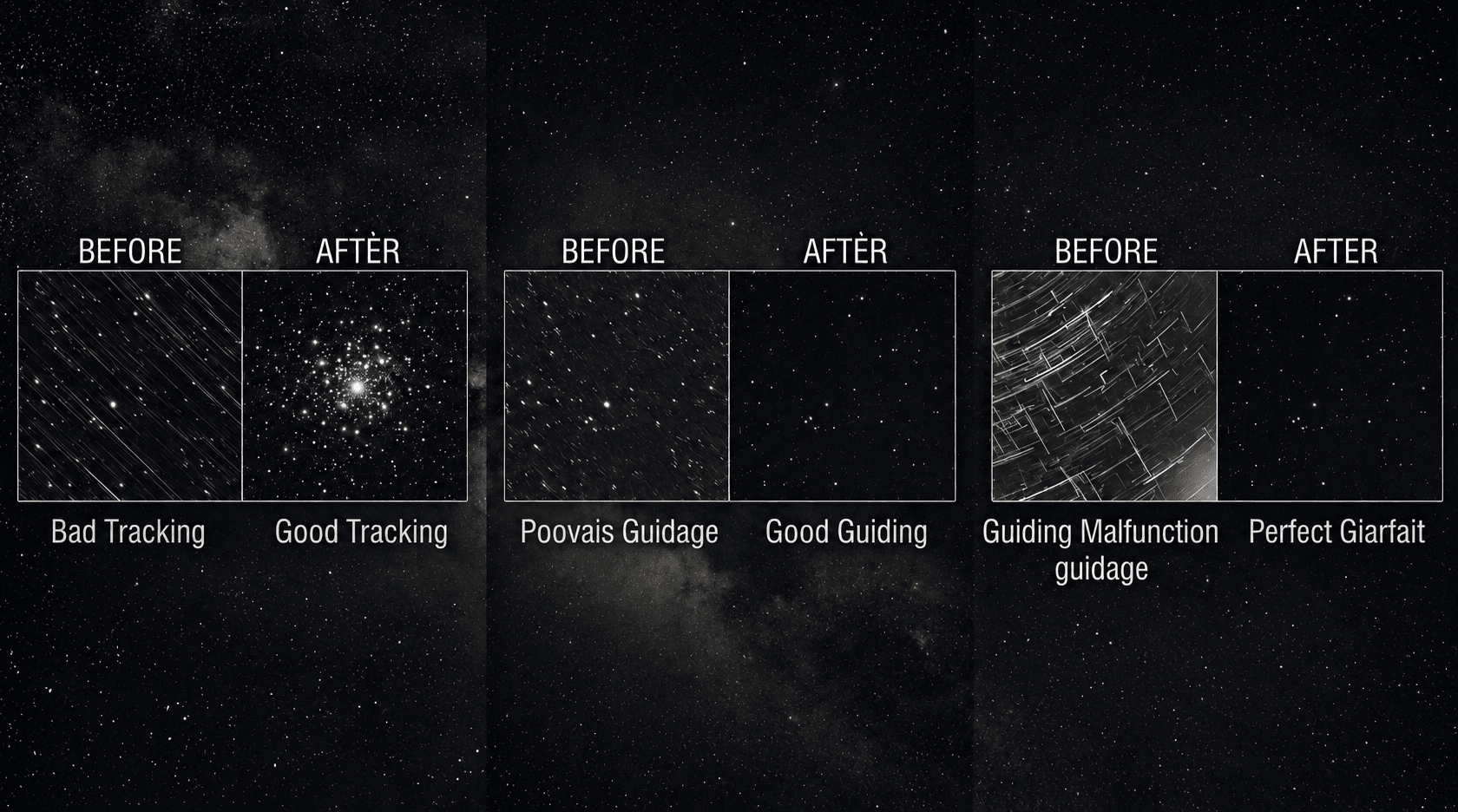
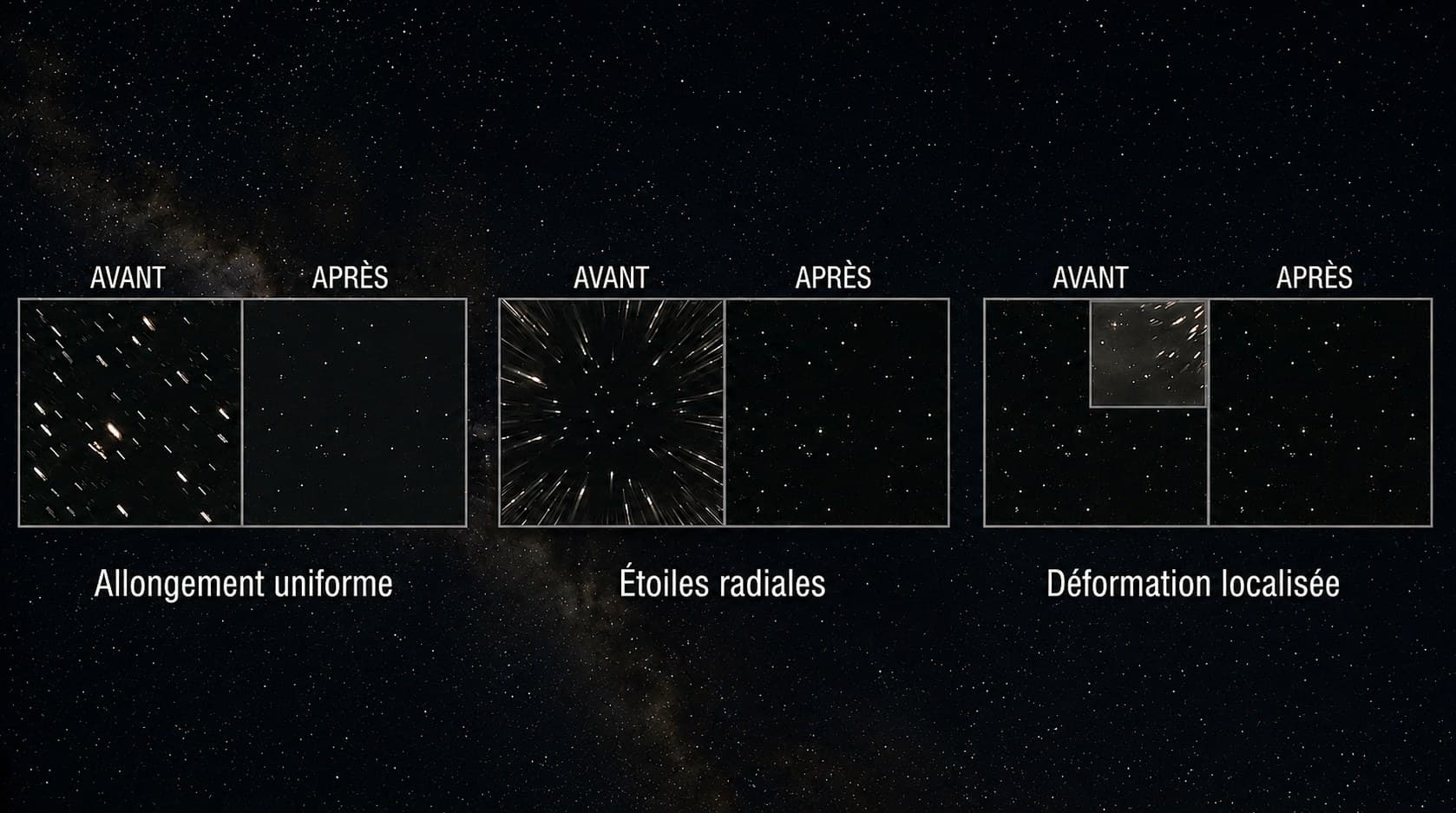
The point of attention lies elsewhere. Elongation at center reaches 1.27 while the field floor is 1.11, and the bottom edge shows the same value. A deformation present at center is never a field aberration, it comes from the mount. With 27.7 deg of PA dispersion, the direction is not rigorously constant, which looks more like residual periodic error than a clean drift. On a 300s exposure, that is exactly where the worm gear speaks up.
On the background side everything is quiet: 8% gradient oriented at 355 deg, modest under Bortle 2, and the visible nebulosity matches the DSS reference point for point, so real signal rather than artifact. Comparison done, the sampling is fine and the signal usable.
Priority actions
- Check or enable autoguiding to bring center elongation back toward the 1.11 floor
- Redo a careful polar alignment before the next session
- If guiding is unavailable, drop to 120s subs and compensate with sub count
- Stack with sigma rejection to remove satellite trails and residual hot pixels