Astrophotography diagnosis of M 101: Noise / underexposure and residual vignetting
ProcessedLPLP 162×60s (total ~2.7 h)03 mars 2024
The Doc examined this image of M 101 (processed, LP, LP 162×60s (total ~2.7 h)). Estimated overall technical quality: 6/10. 2 defects found: Noise / underexposure (severity 3/5), Residual vignetting (severity 2/5).
&w=1920&q=75)
Info
- Cible
- M 101
- Date
- 03 mars 2024, 00:00
- Position
- 14h03m12s · +54°21'00"
Moon at 32%, tolerable but not ideal on a broadband galaxy under LP: the sky brightness limits the contrast of M101's faint extensions. The LP filter cuts pollution but works no miracles on a continuum-emission target like a galaxy. With no declared Bortle, the e_margin of 2.54 shows a background close to sky-limited but with weak object signal: you are more constrained by total time than by conditions. Favor moonless nights to maximize SNR on the arms and HII regions.
Setup
- Type d'image
- Traitée
- Télescope
- TS-Optics Photoline 80mm f/6 (TLAPO804)
- Caméra
- ZWO ASI585MC
- Filtre
- LP
- Monture
- ZWO AM3
- Exposition
- LP 162×60s (total ~2.7 h)
- Phase de lune
- 32%
- Notes
- Logiciels : PixInsight, Siril, GraXpert, ASIAIR
- FOV
- 1.20°
The 80mm f/6 refractor (480mm) with the ASI585MC gives a 1.20° field: M101 (~0.4° across) is comfortably framed, well centered with margin, a coherent choice. The sampling is fine for a galaxy, which makes the image more SNR-demanding: each pixel collects little signal, hence the need to stack exposures. The LP filter is the right compromise under moderate pollution, but a galaxy remains a time-hungry broadband target. The scope/camera pairing is sound; the limiting factor here is integration time, not the gear.
The diagnosis in detail
The PSF plate is reassuring: center elongation 1.03 (field floor 1.02), FWHM 2.2 to 3.0 px, PA dispersion 32.8° and corner/center ratio 0.97. The automatic tilt pre-verdict (36% confidence) is not supported: no clear diagonal asymmetry between opposite corners, elongations stay at the monochrome camera floor. Tracking and optics are clean, so I retain no shape defect. The real issue is signal-to-noise. With 162x60s, i.e. 2.7h under LP on a galaxy, the background is grainy and M101's spiral arms lack substance compared to the DSS reference, where the HII regions and extensions stand out clearly. The e_margin of 2.54 confirms a barely lifted background. Add a slight residual radial falloff (+6% center to edges, revolution symmetry), a sign of a flat to refine rather than an oriented gradient (plane amplitude only 1%). Nothing severe, but these two points limit the final rendering of a demanding target.
Priority actions
- Accumulate much more integration time (aim 6 to 10h) on M101 to bring out the arms and HII regions
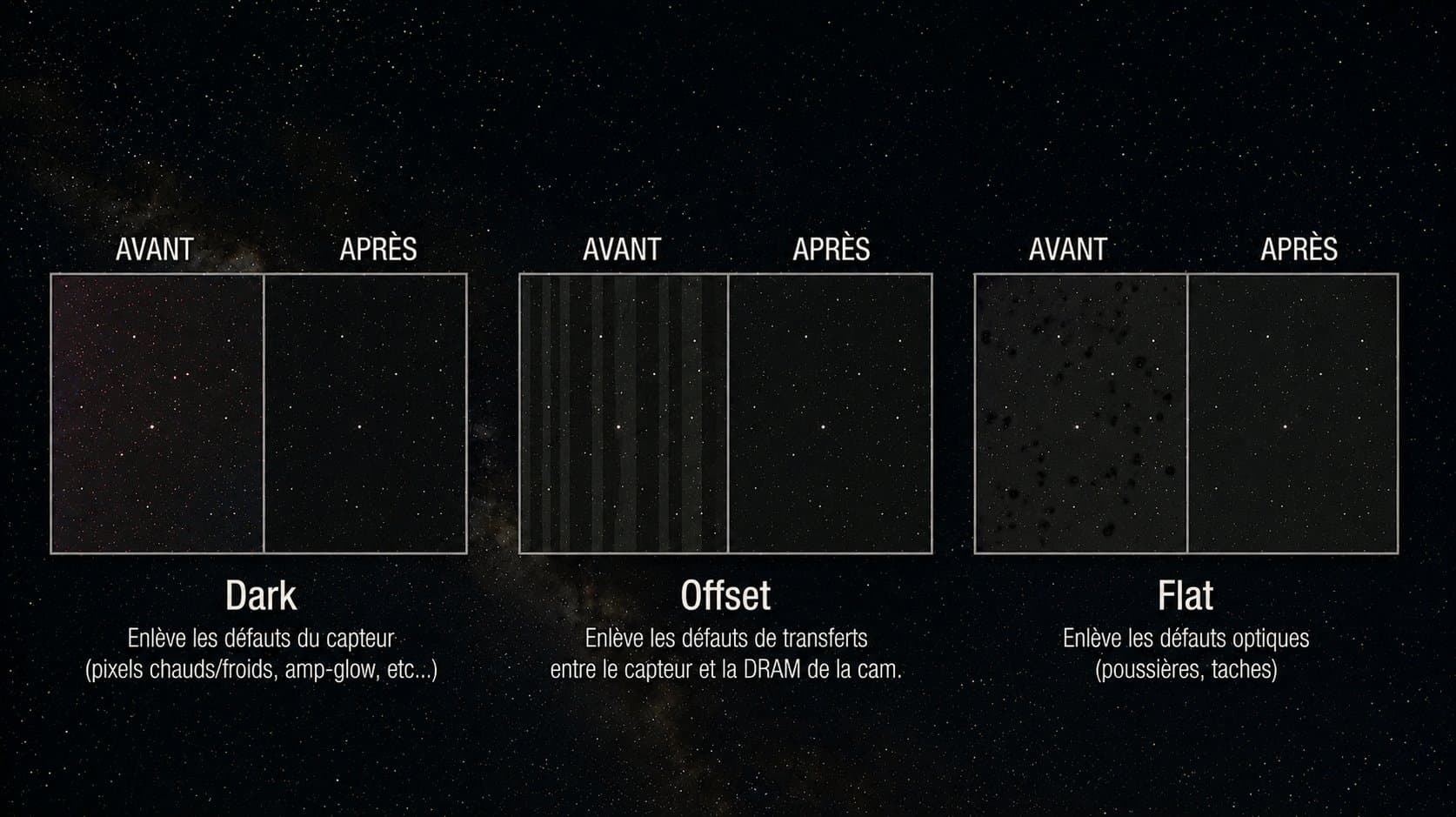
- Reshoot precise flats to eliminate the residual radial background falloff
- Favor moonless nights to maximize the contrast of faint extensions
- Apply GraXpert/DBE then measured denoising on the background once signal is accumulated