Astrophotography diagnosis of M 101: Residual vignetting, clipped stars and 2 others
ProcessedLP, MULTIBANDLP 219×60s · MULTIBAND 58×60s (total ~4.6 h)07 mars 2024
The Doc examined this image of M 101 (processed, LP, MULTIBAND, LP 219×60s · MULTIBAND 58×60s (total ~4.6 h)). Estimated overall technical quality: 6/10. 4 defects found: Residual vignetting (severity 2/5), Clipped stars (severity 2/5), Over-denoising (severity 2/5), Green cast (severity 2/5).
&w=1920&q=75)
Info
- Cible
- M 101
- Date
- 07 mars 2024, 00:00
- Position
- 14h03m12s · +54°21'00"
Moon at 38% on the night of capture: moderate illumination that weighs mostly in broadband on a faint galaxy like M101. The measured background stays clean and radially symmetric (no plane gradient, 0% amplitude), so the moon did not really degrade your session, but it limits the contrast reachable on the faint arm extensions. To push SNR on the outer arms and surrounding IFN, aim for a moonless night or low moon, which will let you relax the denoise without raising background noise.
Setup
- Type d'image
- Traitée
- Télescope
- TS-Optics Photoline 80mm f/6 (TLAPO804)
- Caméra
- ZWO ASI585MC
- Filtre
- LP, MULTIBAND
- Monture
- ZWO AM3
- Exposition
- LP 219×60s · MULTIBAND 58×60s (total ~4.6 h)
- Phase de lune
- 38%
- Notes
- Logiciels : PixInsight, GraXpert, ASIAIR
- FOV
- 54.0'
The Photoline 80 f/6 (480mm) plus ASI585MC combo gives fine sampling and a 0.90deg field where M101 (about 0.45deg) fits comfortably, well centered, with room for the companions. That is a fitting framing. The measured FWHM around 1.9 to 2.0px confirms good focus and decent seeing. The uncooled 585 sensor is a bit marginal in broadband on a pale galaxy: this matches the smoothing observed. An e_margin of 2.21 indicates the 60s subs are a little short, with the background not very lifted off the black point; lengthening to 120-180s would improve background SNR.
The diagnosis in detail
On the instrumental side, nothing to fault: the PSF plate shows round stars everywhere (center elong 1.11, corner/center ratio 1.052, PA dispersion 31.5deg indicating symmetric stars), so no tilt, no backfocus, no coma or tracking issue. The mechanics and optics do their job, and the 1.9-2px FWHM attests to careful focusing. The background is radially symmetric, with no oriented gradient, a sign of good control of light pollution and the moon.
The areas to work on are all on the processing side. The 8% residual vignetting is faint but real and easily corrected with a better-matched flat or a background extraction. The star cores and the galaxy nucleus are clipped to white, which freezes the central tones: a more careful stretch and a recovery mask would suffice. Finally, the image is a bit smoothed (plastic look of the arms) for 4.6h on an uncooled sensor, and the colorimetry is cold: the bulge should lean toward cream and the HII regions toward pink.
The priority is photometric color calibration and a more measured denoise, then flattening the background. Since the acquisition is healthy, all of this replays in post-processing without a new night.
Priority actions
- Apply photometric color calibration (SPCC) to recover the cream of the bulge and the pink of the HII regions
- Reduce denoise strength and mask it to low-SNR areas only for a natural texture
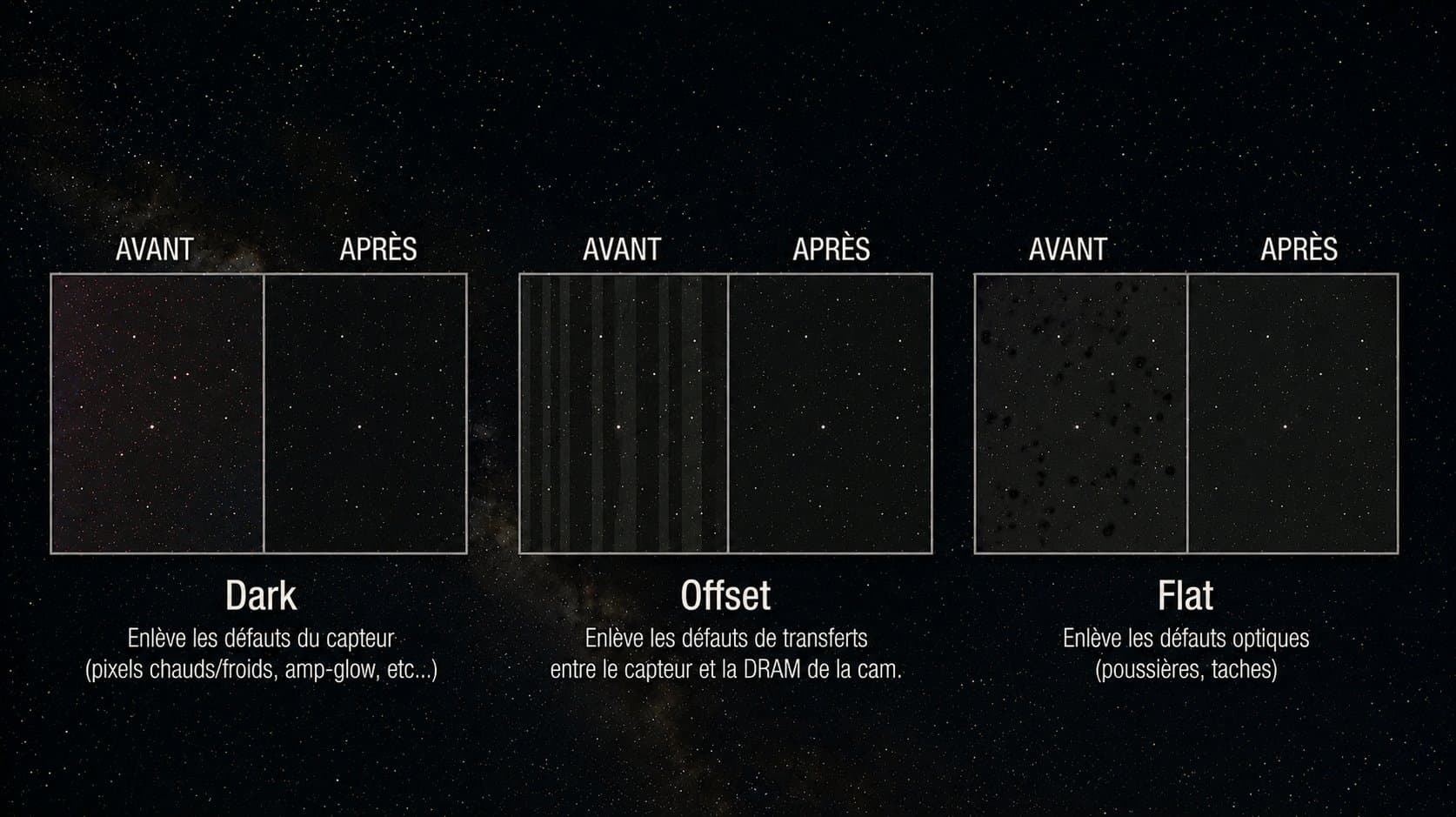
- Flatten the residual vignetting via better-matched flats or background extraction (GraXpert/DBE)
- Soften the highlight stretch with a star mask to limit core clipping
- Lengthen unit exposures toward 120-180s to better lift the background off the black point