Astrophotography diagnosis of SH 2-73: Light pollution gradient, moon gradient and 1 other
MasterNo Filter170x60s24 mai 2026
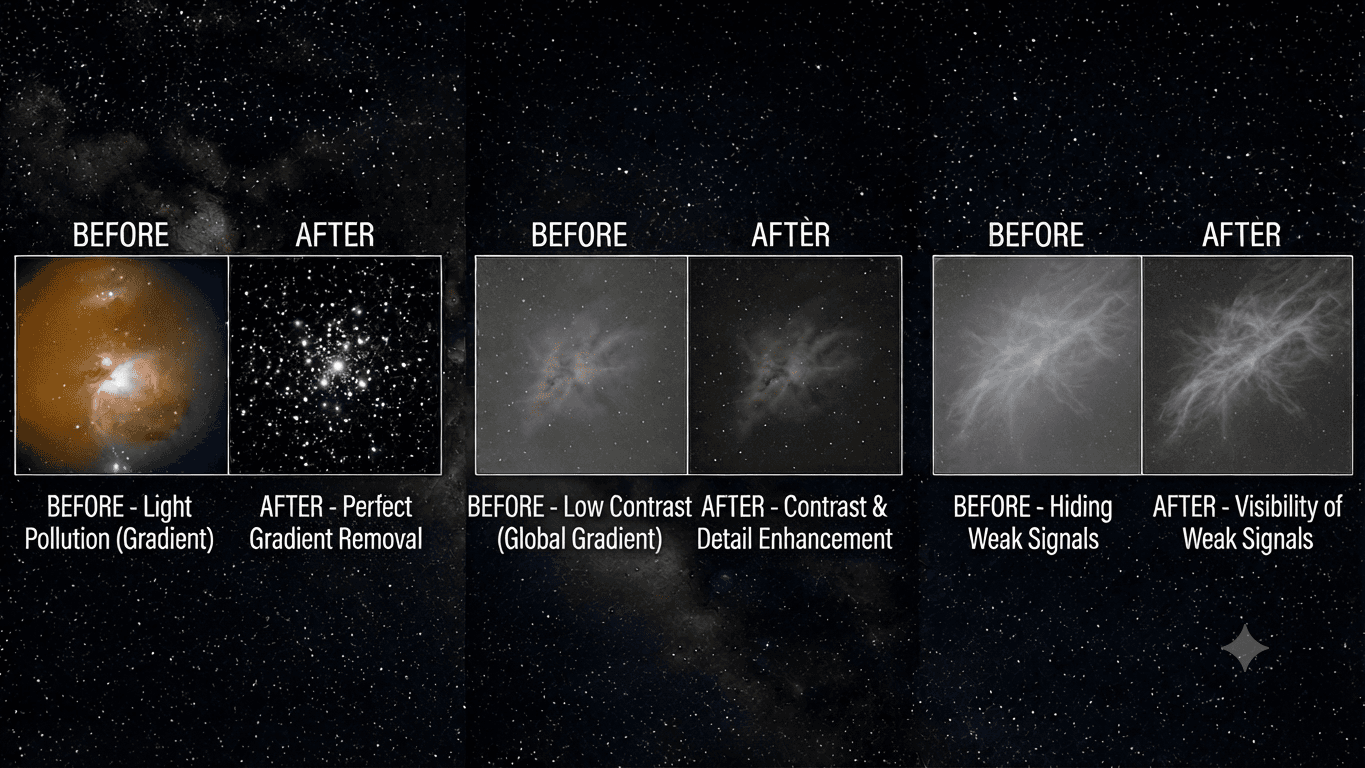
The Doc examined this image of SH 2-73 (master, No Filter, 170x60s). Estimated overall technical quality: 6/10. 3 defects found: Light pollution gradient (severity 3/5), Moon gradient (severity 2/5), Noise / underexposure (severity 2/5).
&w=1920&q=75)
Info
- Cible
- SH 2-73
- Date
- 24 mai 2026, 21:31
- Lune
- Croissant décroissant 35.3% (35° d'alt., 72.8° de la cible)
- Site
- Bortle 5 · banlieue résidentielle (saisi)
- Position
- 16h10m15s · +21°52'28"
Average conditions for this faint diffuse target. Bortle 5 already imposes a penalizing bright background in broadband, and the Moon (35% crescent, 35deg altitude, 73deg from the target) adds a background ramp measured at 60% amplitude. The 73deg separation is fair but not enough to cancel lunar scatter at this altitude. For a target as faint as Sh2-73 in broadband without a filter, these conditions strongly limit achievable contrast and explain the tight SNR (e_margin 2.31). Ideally aim for a moonless, darker sky, or accumulate many more hours to compensate.
Setup
- Type d'image
- Master
- Télescope
- Askar SQA70 Pro
- Caméra
- ATR585C
- Filtre
- No Filter
- Exposition
- 170x60s
- Phase de lune
- Premier quartier (59 %)
- FOV
- 1.83°
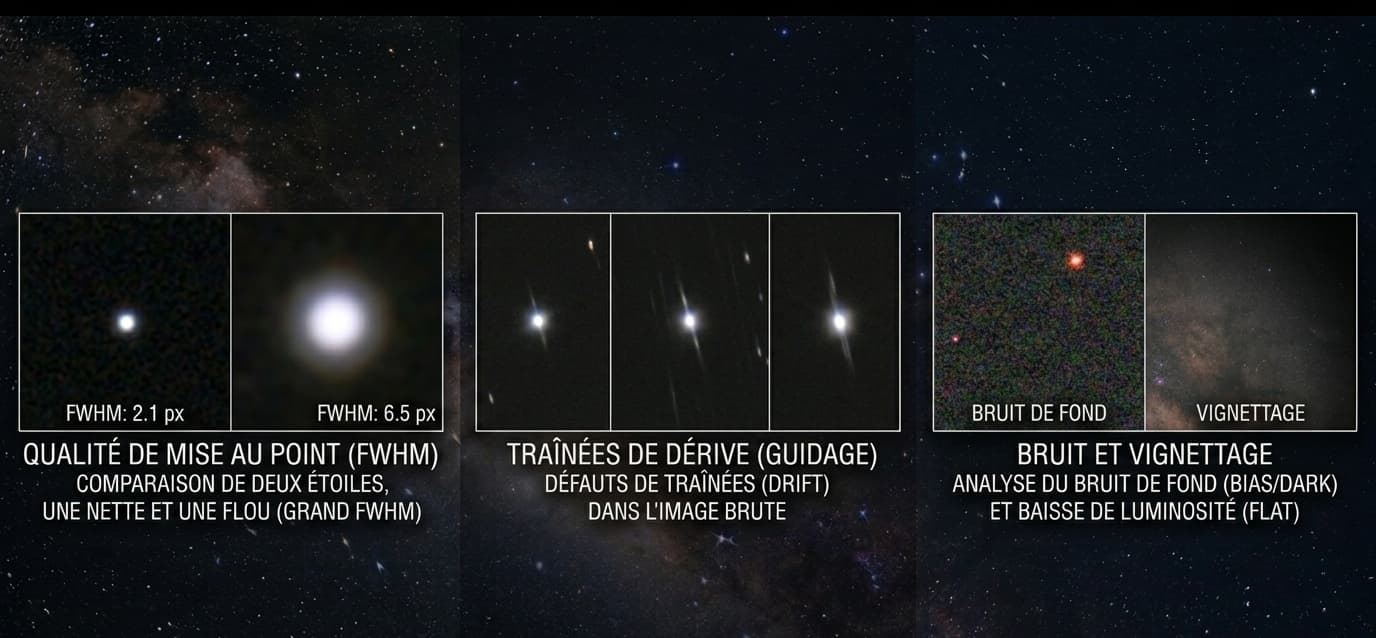
The Askar SQA70 Pro (338mm) and ATR585C pairing is consistent: a 1.83deg field and 1.768 arcsec/px sampling, very comfortable for typical seeing, and the target fits well in the frame. The measured PSF (FWHM ~3.0-3.7px at the edges, ~4.6px at center where a bright star inflates the fit) is healthy and uniform, indicating well-set optics and backfocus. The only debatable point is the lack of a filter on a faint target under Bortle 5 with the Moon up: a broadband light-pollution filter would help lift the background without distorting star colors.
The diagnosis in detail
On the instrument side this master is healthy. The PSF panel gives elongations of 1.03 to 1.04 across the nine zones, at the field floor, with a PA dispersion of only 20deg and a corner/center ratio of 0.80 indicating corners even slightly finer than the center (the central star artificially inflates the C FWHM to 4.6px). The 0.146 horizontal asymmetry stays below the firm threshold and the tilt pre-verdict is not confirmed by a true diagonal asymmetry between opposite corners: I therefore reject tilt. Round stars, clean tracking, correct backfocus.
The dominant issue is the sky background. The background map measures a plane at 60% amplitude oriented ~21deg, dominating the radial component by a factor of 8.1, which rules out simple vignetting. This ramp comes from Bortle 5 light pollution, reinforced by the Moon above the horizon: I keep both causes, pollution being predominant and the lunar contribution secondary (the tint is olive rather than bluish). The DSS confirms a faint dark cloud in the area, so the real diffuse structure is not an artifact, but it is buried here.
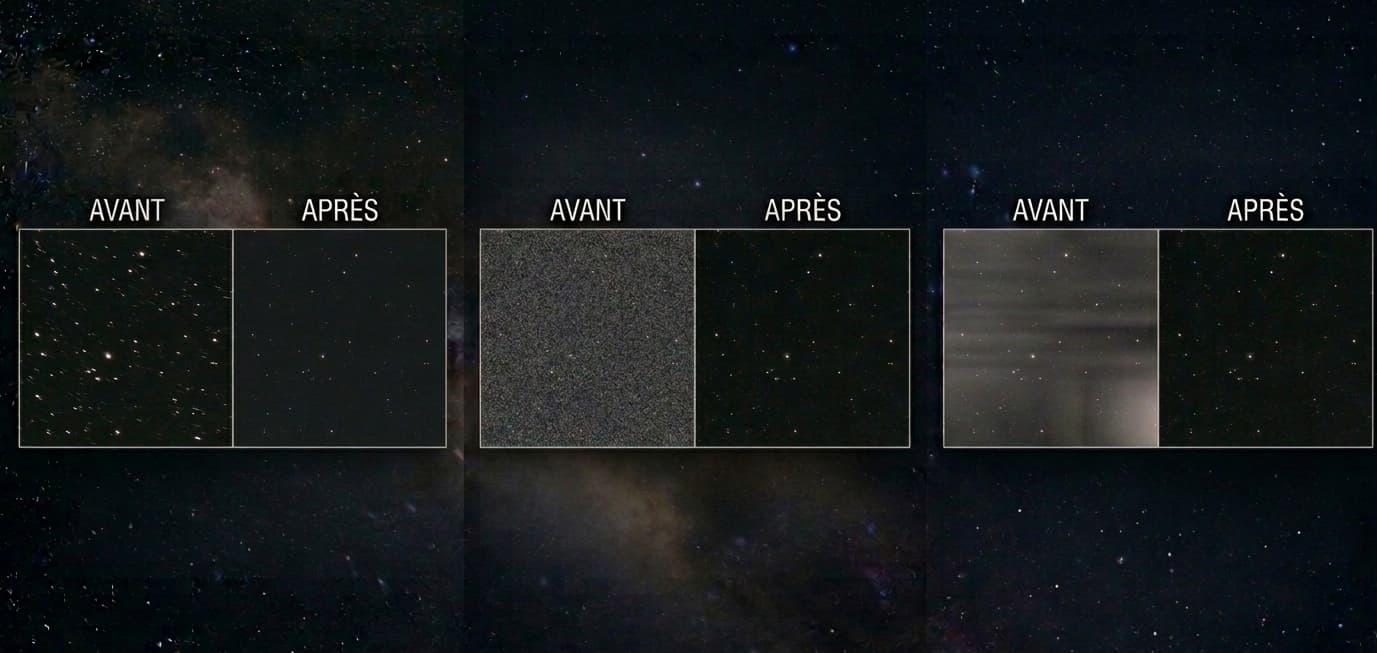
Finally the SNR is tight: e_margin of 2.31 far from the sky-limited regime, 60s subs in broadband, a very faint target. The residual grain and lack of contrast on Sh2-73 follow from this. The priority is a careful gradient removal then more integration under a more favorable sky.
Priority actions
- Apply gradient extraction (GraXpert or DBE/ABE) on the linear master before any other processing
- Neutralize the background and calibrate color (SPCC/PCC) to remove the olive cast
- Accumulate many more hours and image under a moonless sky to lift this faint target
- Lengthen sub-exposures (120-180s) to improve background SNR