Astrophotography diagnosis of M16: Backfocus error and clipped stars
ProcessedHa, OIII, SII 6.5nmHa 55×300s · OIII 60×300s · SII 53×300s (total ~14.0 h)17 juin 2026
The Doc examined this image of M16 (processed, Ha, OIII, SII 6.5nm, Ha 55×300s · OIII 60×300s · SII 53×300s (total ~14.0 h)). Estimated overall technical quality: 8/10. 2 defects found: Backfocus error (severity 3/5), Clipped stars (severity 2/5).
&w=1920&q=75)
Info
- Cible
- M16
- Date
- 17 juin 2026, 00:00
- Site
- Bortle 5 · banlieue résidentielle (saisi)
- Position
- 18h18m48s · -13°48'00"
Very favorable conditions for this target. A 21% Moon and a Bortle 5 sky have almost no impact in 6.5 nm narrowband on an emission nebula like M16: the Ha/OIII/SII signal cuts through light pollution and the weak Moon easily. The 14 h total fully exploits these conditions and explains the good background signal-to-noise. Nothing to fault on the sky side: you could have imaged even under a stronger Moon without notable degradation on this kind of target.
Setup
- Type d'image
- Traitée
- Télescope
- Sky-Watcher Quattro 150P
- Caméra
- ZWO ASI585MM Pro
- Filtre
- Ha, OIII, SII 6.5nm
- Monture
- Te-Seek HM-17PE
- Exposition
- Ha 55×300s · OIII 60×300s · SII 53×300s (total ~14.0 h)
- Phase de lune
- 21%
- Notes
- PHD2, PixInsight, Nighttime Imaging 'N' Astronomy (N.I.N.A. / NINA)
- FOV
- 48.0'
Coherent and well sized setup. The Quattro 150P at 600 mm f/4 with the ASI585MM (2.9 um) gives ~1.0"/px and a 0.80 deg field, framing M16 with comfortable margin for the nebular complex and the pillars. The f/4 is demanding: it requires a perfectly spaced coma corrector, and that is exactly where the corner degradation comes from. The 6.5 nm triple narrowband is ideal for this emission nebula from a Bortle 5 site. The background to black-point margin (1.23) is normal in tight narrowband, not a sign of underexposure.
The diagnosis in detail
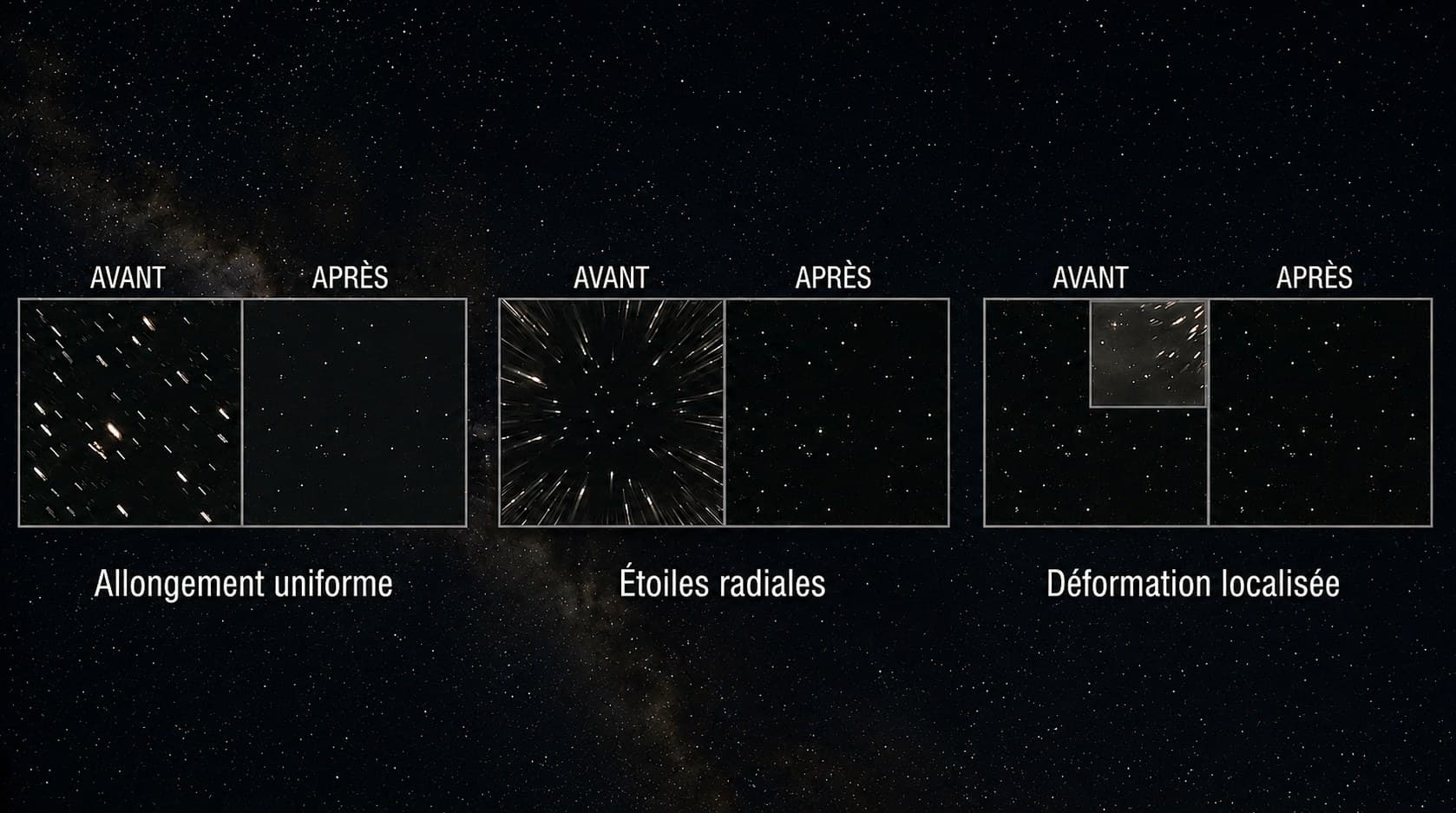
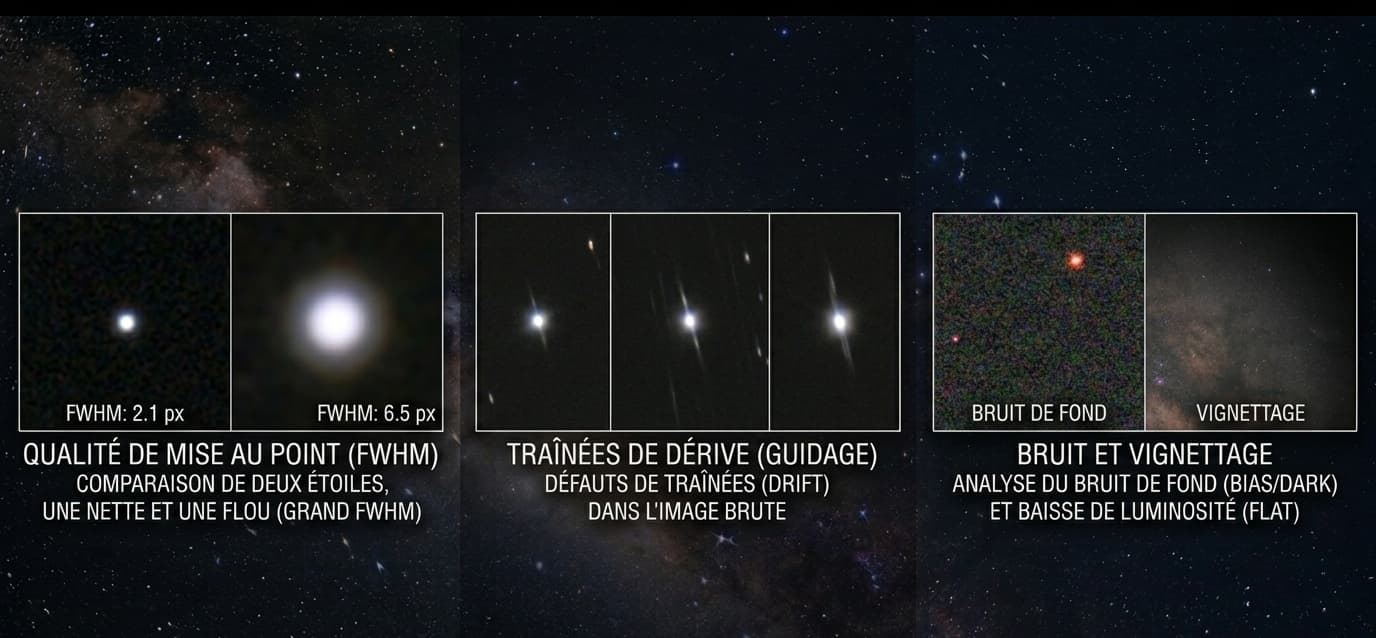
The acquisition is solid: flawless tracking (round stars everywhere, elong 1.01-1.07, scattered PA), a sharp center at 3.28 px FWHM and excellent signal-to-noise from the 14 h. The DSS reference confirms all structures (pillars, filaments, dark pockets) are real, with no gradient artifact.
The dominant defect is purely optical: FWHM rises symmetrically across the four corners (up to 4.52 px top-right, 1.40 ratio) while stars stay round. This signature rules out tilt (no diagonal asymmetry) and pure coma (no radial comets): it is residual field curvature / corrector backfocus, classic on an f/4 Newtonian where the spacing tolerance is on the order of a millimeter.
Secondarily, a few bright stars have cores clipped by the 300 s subs. This is minor and recoverable by adding short exposures. The rest of the processing (SHO color, background handling, denoise) is well controlled.
Priority actions
- Fine-tune the coma corrector backfocus (0.5-1 mm spacers) then re-validate with an aberration panel until the corner/center ratio is below 1.15
- Check the rigidity and flatness of the optical train (focuser, tightness) to make edge focus reliable
- Add a few short exposures per filter to rebuild the clipped star cores in HDR