Astrophotography diagnosis of M16: Backfocus error, focus miss and 1 other
ProcessedS,H,O13h
The Doc examined this image of M16 (processed, S,H,O, 13h). Estimated overall technical quality: 7/10. 3 defects found: Backfocus error (severity 2/5), Focus miss (severity 2/5), Clipped stars (severity 2/5).
&w=1920&q=75)
Info
- Cible
- M16
- Site
- Bortle 5 · banlieue résidentielle (saisi)
- Position
- 18h18m48s · -13°48'00"
First quarter at 10% illumination: the Moon is nearly negligible and, on an emission target processed in SHO, its impact on the background is nil. The entered Bortle 5 is comfortable for narrowband, which largely shrugs off residual light pollution: with 13h of integration you have an excellent signal-to-noise ratio on the narrow bands, confirmed by a clean background with no parasitic gradient. No conditions concern to flag here, the window was favorable.
Setup
- Type d'image
- Traitée
- Télescope
- SkyWatcher 150P
- Caméra
- ZWO ASI585MM Pro
- Filtre
- S,H,O
- Monture
- TeSeek HM17
- Exposition
- 13h
- Phase de lune
- Premier quartier (10 %)
- FOV
- 48.0'
The 150P at 750mm with the ASI585MM (2.9µm) gives about 0.8"/px, which is clearly oversampled for your seeing: with a measured FWHM of ~7px (≈5.5"), you could bin 2x2 without losing any real resolution while gaining SNR. The 0.80° field frames M16 and its cluster well, a successful composition. SHO on the mono 585MM is consistent with the emission target. The real lever stays mechanical: a coma corrector matched to the Newton and fine backfocus tuning will tighten the edge stars.
The diagnosis in detail
The image is broadly successful: the Eagle nebulosity is dense, structured and matches the DSS reference (no gradient artifact, the pillars and veils are real signal), the background is clean and tracking is excellent (perfectly round stars, central elong 1.11 but PA dispersion consistent with non-directionally elongated stars). The benefit of the 13h SHO exposure shows in detail finesse and low noise.
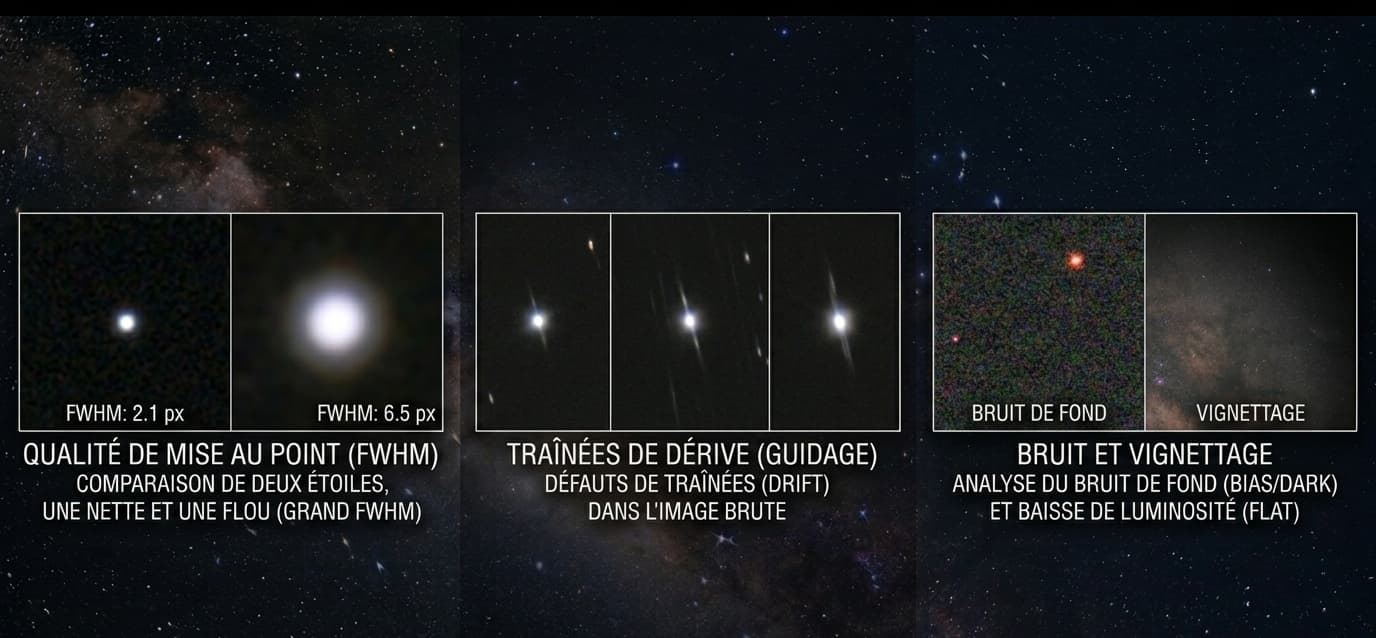
The main improvement area is the stars. Two effects combine: first a general bloat (uniform FWHM ~7px, i.e. ~5.5" at your sampling) revealing improvable focus and/or average seeing; then a symmetric FWHM growth toward the four corners (corner/center ratio 1.23) typical of field curvature or slightly off backfocus, with no tilt component since corner elongation stays low. The 150P without a coma corrector naturally explains this edge degradation.
Finally, a few bright star cores are clipped during the stretch, an easily recoverable post-processing point with separate star handling. Nothing blocking: these fixes are incremental and the image is already very presentable.
Priority actions
- Fine-tune backfocus (1mm steps) and add a coma corrector matched to the 150P Newton to tighten edge stars
- Improve focus (Bahtinov/temperature-slaved autofocus) and consider 2x2 binning given the oversampling
- Protect bright star cores during the stretch with a star mask or StarXTerminator extraction