Astrophotography diagnosis of M31: Oversaturation, sensor tilt and 3 others
ProcessedANTLIA tri band RGB Ultra 250x300s
The Doc examined this image of M31 (processed, ANTLIA tri band RGB Ultra 2, 50x300s). Estimated overall technical quality: 7/10. 5 defects found: Oversaturation (severity 3/5), Sensor tilt (severity 2/5), Tracking drift (severity 2/5), Clipped stars (severity 2/5), Background chroma noise (severity 2/5).
&w=1920&q=75)
Info
- Cible
- M31
- Site
- Bortle 7 · périurbain pollué (saisi)
- Position
- 0h42m22s · +41°24'18"
New moon (0%) so no lunar background contribution, that is the right window. Bortle 7 remains the limiting factor: M31 is a broadband target with high surface brightness, so it comes through fine under this sky, but the outer extensions and faint halo stay buried in the urban background. The histogram confirms it: background-to-black-point margin of 1.41, far from the sky-limited threshold of 5-10, with a Bowley skew of 0.76 reflecting a background packed near the black point after processing. The tri-band filter helps on HII regions but cuts part of the bulge continuum. Under this sky, aim for 8 to 10h of integration to cleanly pull out M31's outer halo rather than 4h.
Setup
- Type d'image
- Traitée
- Télescope
- skywatcher 80ED avec reducteur 0.85x
- Caméra
- ZWO ASI2600MC AIR
- Filtre
- ANTLIA tri band RGB Ultra 2
- Monture
- MLAStro SAL-33
- Exposition
- 50x300s
- Phase de lune
- 0%
- FOV
- 2.37°
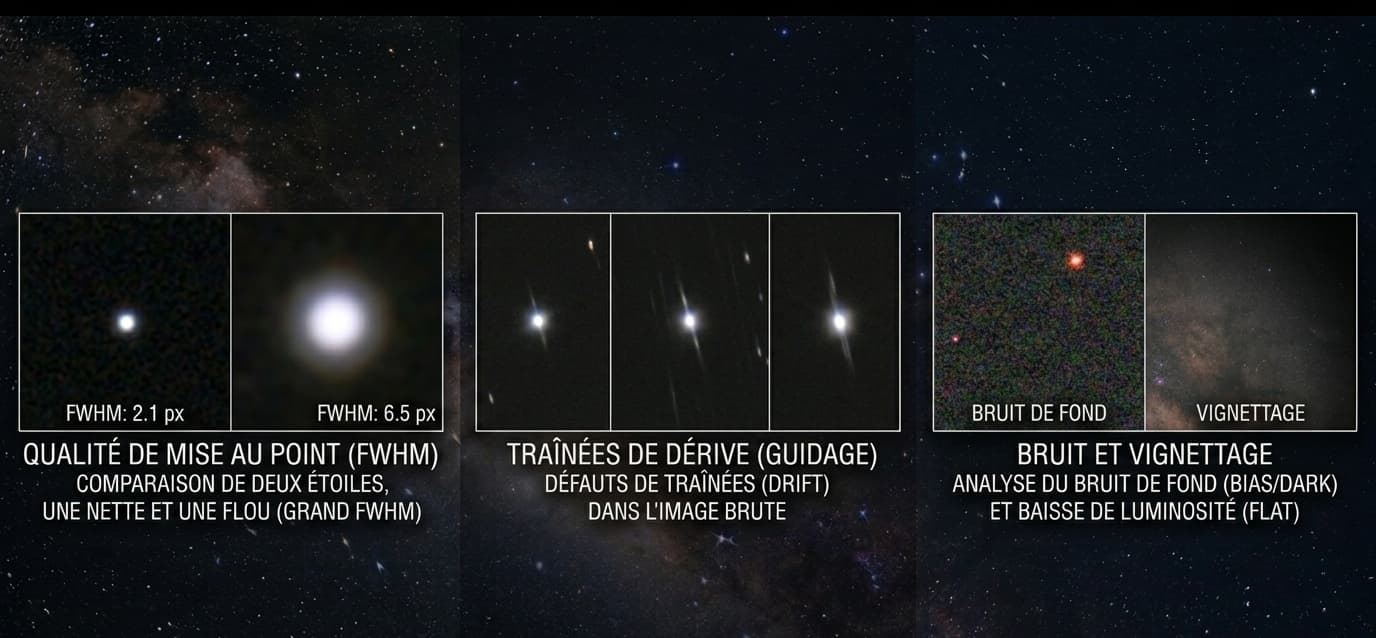
The setup is well matched to the target. An 80ED reduced at 0.85x gives 2.37 degrees of field: M31 fits entirely with M32 and M110 in frame, there is no better compromise. The measured FWHM (3.7 px at center, 4.2-4.8 px at the edges) on the ASI2600 stay reasonable for a short focal length, sitting in a slightly oversampled regime that leaves headroom. The Antlia tri-band on a galaxy is a debatable choice: it brings out the HII regions in the arms, but it cuts the stellar continuum and the bulge, which impoverishes overall color. For M31 under Bortle 7, a broadband light pollution filter or plain L would give a more nuanced bulge, possibly with a dedicated Ha layer added for the HII regions.
The diagnosis in detail
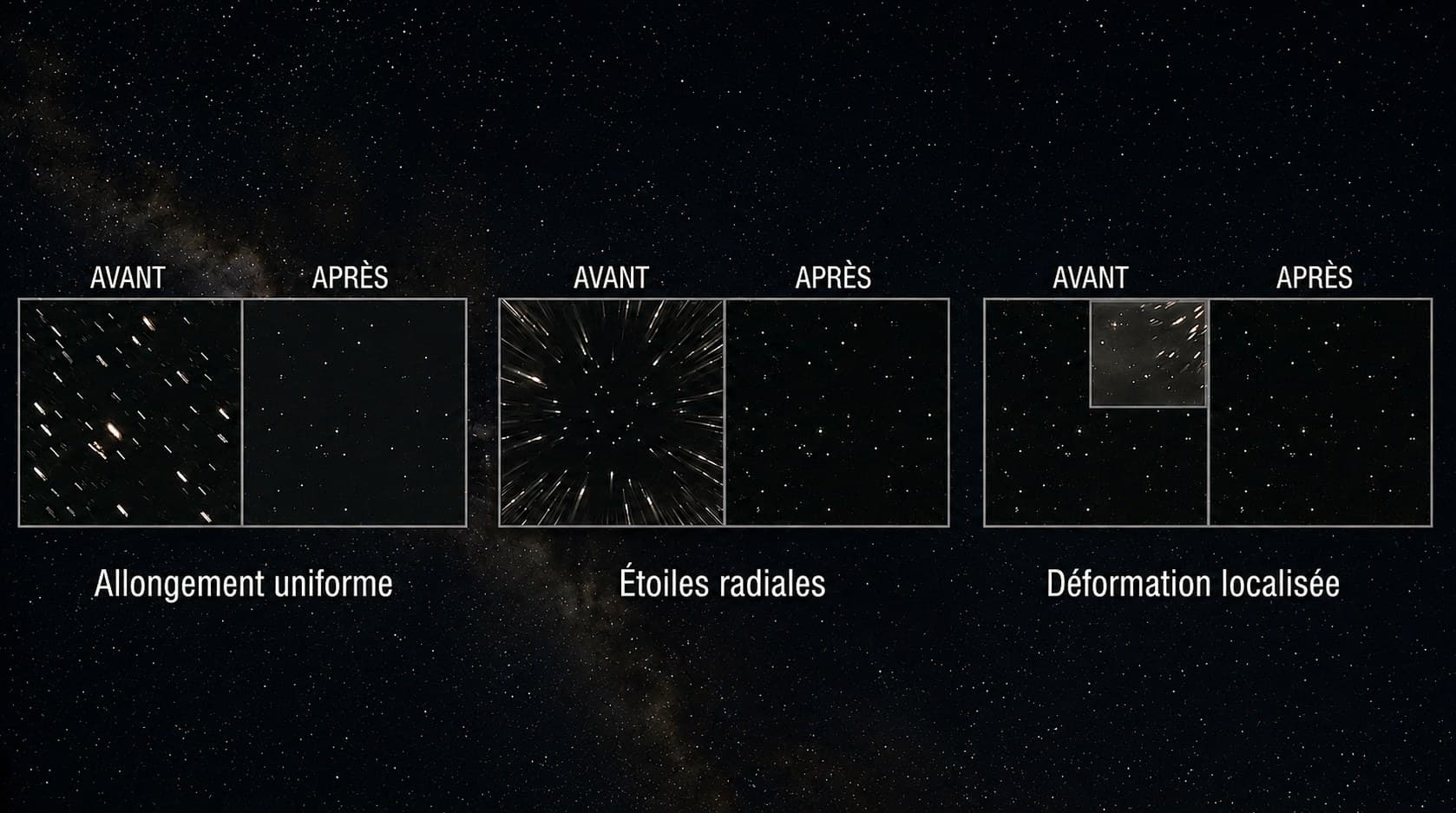
The diagnosis reads on two independent planes: acquisition and processing. On acquisition, the PSF panel is telling. Elongation at center reaches 1.17 while the field floor is 1.04, and PA scatter is only 8.4 degrees: stars are slightly stretched in the same direction across the whole field, which is the signature of tracking drift rather than an optical aberration. On top of that, the 1.305 corner/center FWHM ratio, with a center at 3.73 px and edges at 4.6-4.8 px but a top-left corner at 4.18 and a top edge at 3.64, reveals uneven degradation between opposite zones, hence slight sensor plane tilt. Both effects stay modest, the image remains entirely usable.
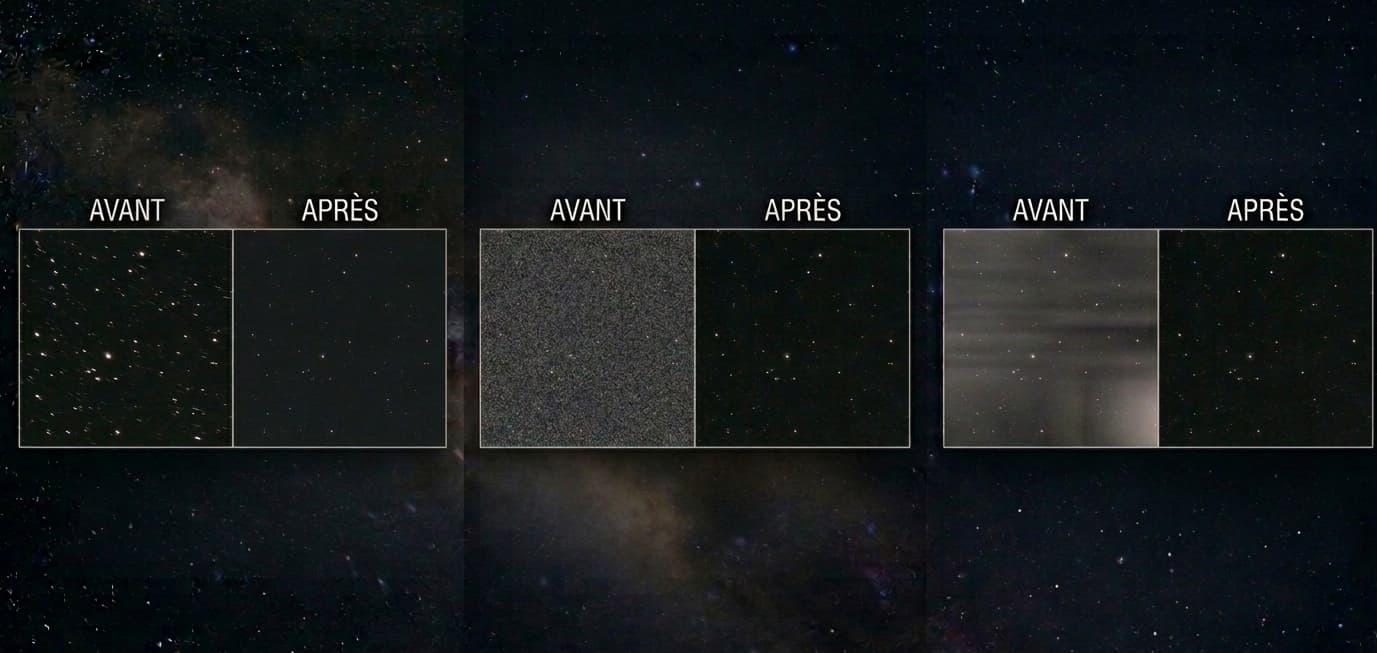
On processing, the dominant issue is highlight management. M31's bulge is pushed to an almost flat white plateau while DSS still shows structure in the same place, and several bright stars have lost their chromatic gradient. It is one and the same cause: a non-linear stretch with no highlight protection. The background, for its part, betrays the 4h of integration under Bortle 7, with subtle chroma mottling in the lower corners.
The good news: nothing here forces a redo. The core and the stars can be recovered in reprocessing if the linear data is kept, and the mechanical defects are a matter of adjustment, not failure.
Priority actions
- Redo the stretch while protecting highlights (GHS or HDRMultiscaleTransform) to restore the structure and creamy tint of M31's bulge
- Add a series of short 10-60s exposures and blend them as HDR to recover the core and the blown-out bright stars
- Check and evenly retighten the imaging train (adapters, 80ED focuser tension) to reduce the FWHM spread between opposite zones
- Redo polar alignment and run a PHD2 guiding assistant to bring central elongation back toward the field floor
- Raise integration to 8-10h under this Bortle 7 and apply targeted chroma noise reduction on the background