Astrophotography diagnosis of M33: Residual vignetting, backfocus error and 3 others
Master22×300s30 oct. 2026
The Doc examined this image of M33 (master, 22×300s). Estimated overall technical quality: 6/10. 5 defects found: Residual vignetting (severity 3/5), Backfocus error (severity 2/5), Noise / underexposure (severity 2/5), Bad seeing (severity 2/5), Background chroma noise (severity 1/5).

Info
- Cible
- M33
- Date
- 30 oct. 2026, 19:12
- Position
- 1h33m52s · +30°39'36"
A tough night moon-wise: waning gibbous at 76% illumination, which hurts on a broadband galaxy like M33 where no narrowband filter can help you. The measured sky background is still fairly dark (e_margin 2.03, very low median), so the moon did not flood the background, but it did eat contrast on the low surface brightness spiral arms. The background shows no significant oriented gradient (plane amplitude 4%, R²=0.01), so light pollution is not the limiting factor here. For M33, aim for a lunar window below 30% illumination: on a target this diffuse, the contrast gain far exceeds what any processing can recover.
Setup
- Type d'image
- Master
- Télescope
- On-Step
- Caméra
- Poseidon_C
- Exposition
- 22×300s
- Phase de lune
- Waning gibbous (76 %)
- FOV
- 50.5'
A coherent setup, but oversampled for this night. At 1600 mm with 3.76 µm pixels you sit at 0.485"/px over a 0.84° field, which frames M33 (about 70') somewhat tightly: the galaxy fills the sensor nicely and the framing works, but there is little room for the outer extensions. More importantly, 0.485"/px is far beyond what the seeing allows (measured FWHM of 4.3"), so you spread the signal over far too many pixels and pay dearly in SNR. A 2×2 bin would bring you to about 0.97"/px, matched to the seeing, doubling signal to noise. Gain 125 and offset 25 at -15°C are healthy, though the offset would benefit from a small bump to remove the 1.2% shadow clipping.
The diagnosis in detail
The mechanics are sound: getting 1.08 central elongation and 30° PA scatter on 300s subs at 1600 mm points to clean guiding, with no readable drift or periodic error. The mount is not the problem; the issues are optical and photometric.
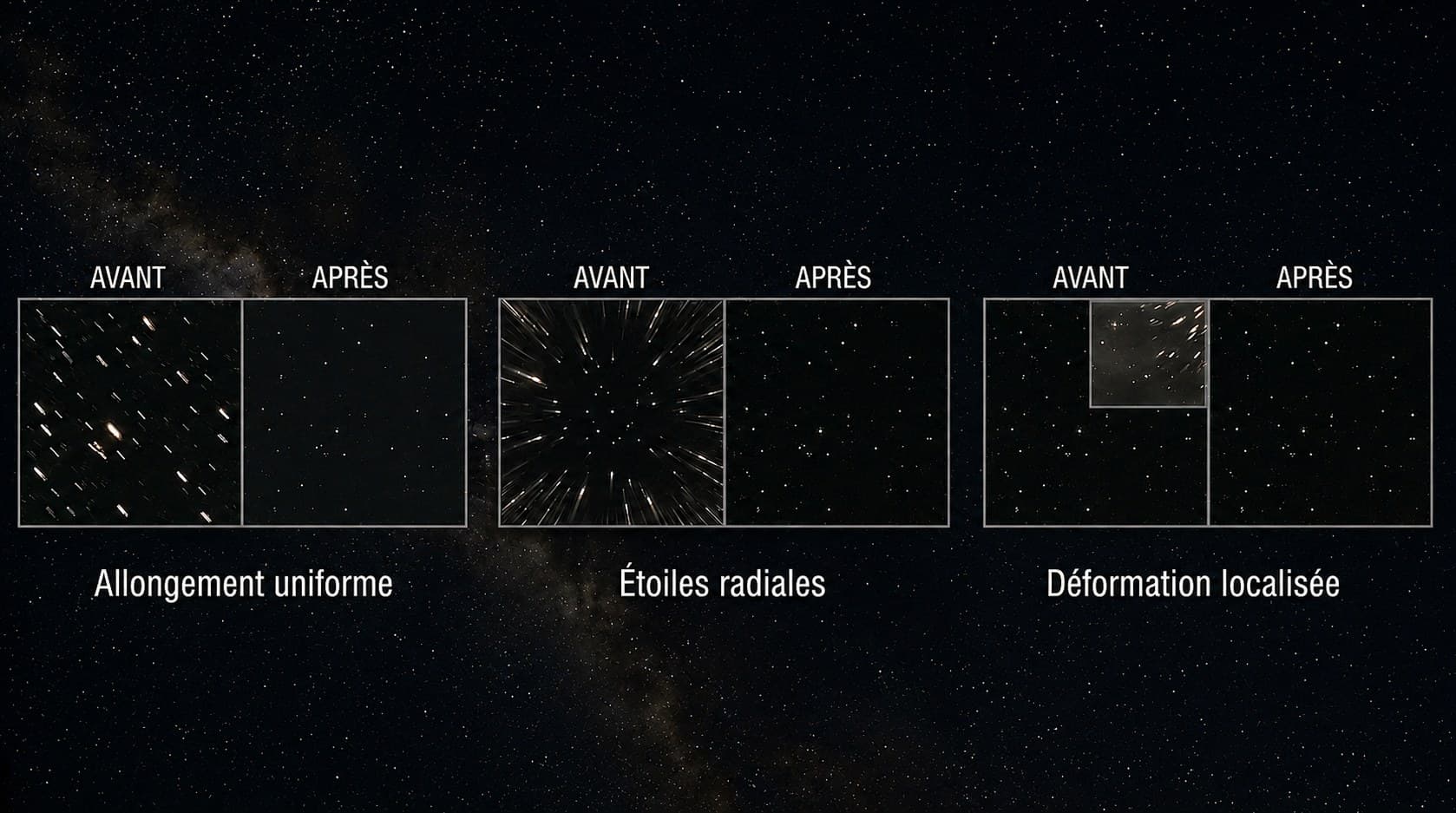
Optically, FWHM traces a classic bowl: minimum at center at 8.87 px, then rising symmetrically toward the corners up to 11.5 px in the bottom right, a ratio of 1.27. Corner PSFs stay round and simply broadened, with no radial comma or orthogonal cross, which rules out coma and astigmatism and points to residual field curvature or out-of-tolerance backfocus. The 0.22 horizontal asymmetry shows the right side suffering more than the left: a slight non-flatness overlays the backfocus issue. Worth fixing with spacers before the next session.
On signal, two effects compound. The 29% vignetting shows flat calibration did not do its job, and it is very smooth and perfectly radial, so instrumental rather than tied to M33. And with only 1h50 accumulated on a diffuse galaxy under a 76% moon, the background stays grainy and the outer arms sit at the noise limit. The logical order is therefore: redo the flats, fix the backfocus, then extend integration.
Priority actions
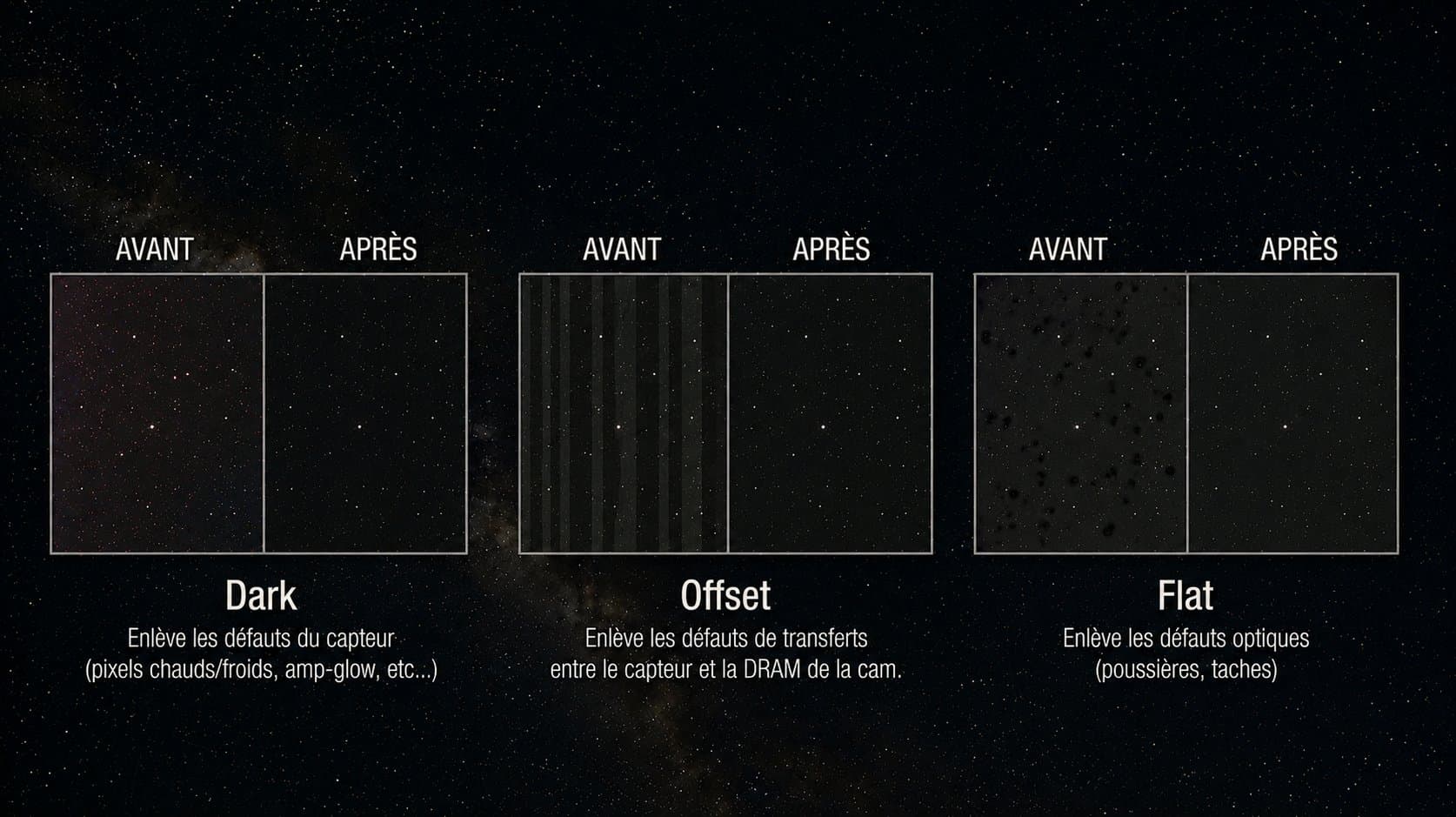
- Shoot a complete new flat set with matching dark-flats without disturbing the optical train, then re-integrate: the fastest lever on the 29% vignetting
- Adjust corrector-to-sensor spacing in 0.5 mm steps to bring corner/center FWHM ratio below 1.15, and check squareness on the right side
- Add 5 to 10 more hours on M33, avoiding gibbous-moon nights
- Switch to 2×2 binning to match sampling (0.97"/px) to the real seeing and double SNR
- Raise the offset slightly to eliminate the 1.2% shadow clipping and preserve the shadows