Astrophotography diagnosis of M45: Over-denoising, dark halos around stars and 2 others
ProcessedL150 * 60s
The Doc examined this image of M45 (processed, L, 150 * 60s). Estimated overall technical quality: 6/10. 4 defects found: Over-denoising (severity 3/5), Dark halos around stars (severity 2/5), Dust donuts (severity 2/5), Posterization (severity 2/5).
&w=1920&q=75)
Info
- Cible
- M45
- Site
- Bortle 4 · transition rural/banlieue (saisi)
Favourable conditions, well used: a 2 percent crescent, so no lunar contribution to worry about, and Bortle 4 leaving a reasonably dark background for broadband. That is exactly the context M45 needs, a reflection target whose blue nebulosity is broadband and gains nothing from a narrowband filter. The background map shows no instrumental or light pollution gradient either: the measured variation follows the object itself. With this sky, the room for improvement is on total integration time rather than conditions.
Setup
- Type d'image
- Traitée
- Télescope
- diy114 F4.5
- Caméra
- sv605mc
- Filtre
- L
- Monture
- diy
- Exposition
- 150 * 60s
- Phase de lune
- Premier croissant (2 %)
- Notes
- starless
A 114 at F/4.5 on an SV605MC comfortably covers the Pleiades, with framing well centred on the cluster core and the Merope and Maia veils fully inside the field. In luminance on a reflection nebula, the L filter is the right call: this is continuum light, a narrowband filter would be counterproductive here. On exposure, the measured histogram gives a background to black point margin of e_margin=1.05, well below the 5-10 benchmark, with a Bowley skew of 0.62 and no dark clipping: 60s subs in broadband stay short of the sky limited regime. Moving to 120-180s per sub, if the mount allows, would gain useful SNR with no saturation risk.
The diagnosis in detail
The diagnosis here is entirely on the processing side, not acquisition. The PSF panel could only fit a single residual star (zone T, FWHM 15.8/3.3), and on a starless image that elongated residual is a star removal artifact, not a usable tracking or optics measurement: so I draw no conclusion on star shape, and the stars and tracking axes stay unrated.
What the image does show is a classic chain: a 150x60s luminance integration, so decent but not comfortable SNR with short subs, then a strong stretch to bring out the Pleiades veils, then denoising that wipes out all the grain. The result is that painted look, with filaments resembling brush strokes, and gradients breaking into steps where there is no longer enough noise to smooth transitions. The dark halos around removed stars come from the same chain: StarXTerminator digs into the nebulosity under the brightest stars.
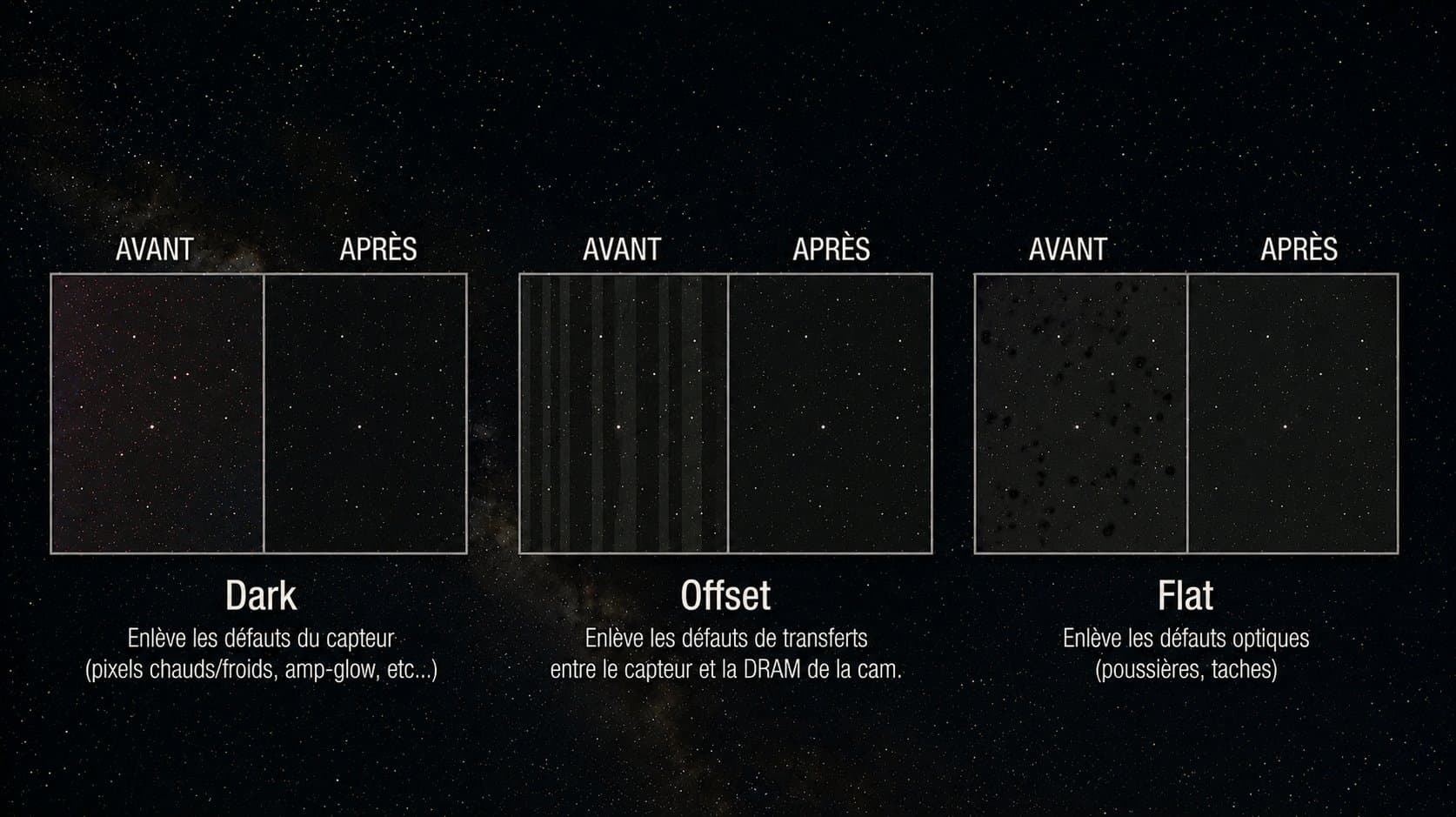
Beyond that, two minor instrumental points: optical ghosts caused by the cluster's very bright stars, and dust rings in the lower right quarter that the flats did not correct.
Priority actions
- Redo processing from the master with denoise strength cut by half or two thirds, applied in the linear stage and masked to the background
- Lengthen subs to 120-180s to reach a sky limited regime and gain real SNR rather than smoothing
- Retake a flat set at the end of the session, without disassembling the optical train, to remove the dust rings
- Soften StarXTerminator settings to remove the dark halos around bright stars
- Work in 32 bit until the final export to eliminate the stepping in gradients