Astrophotography diagnosis of Milky Way: Backfocus error, noise / underexposure and 1 other
Processed5x120
The Doc examined this image of Milky Way (processed, 5x120). Estimated overall technical quality: 5/10. 3 defects found: Backfocus error (severity 3/5), Noise / underexposure (severity 3/5), Background chroma noise (severity 2/5).
&w=1920&q=75)
Info
- Cible
- Milky Way
Waxing Moon at 20%: weak influence, not the limiting factor here. At that illumination the sky background is mostly driven by local transparency and ground lighting, clearly visible at the bottom of the frame above the ridge. For a broadband Milky Way field these conditions are workable: you can extend the session without fearing significant lunar veiling. The real gain will come from a darker site or a less polluted southern horizon, and above all from a total duration far beyond the current 10 minutes.
Setup
- Type d'image
- Traitée
- Exposition
- 5x120
- Phase de lune
- Waxing Moon (20%)
The wide field suits the target well: the galactic band crosses the frame diagonally and the foreground gives scale. However the star degradation toward the corners (FWHM x2) shows the optics are not flat across the sensor, which is the hardware priority. On the capture side, 5x120 s is not enough: the measured histogram shows a decent background-to-black-point margin but a positive skew and 1.3% shadow clipping, a sign of a marginal exposure and a slightly low offset. Increase the number of subs rather than their length if tracking is limited.
The diagnosis in detail
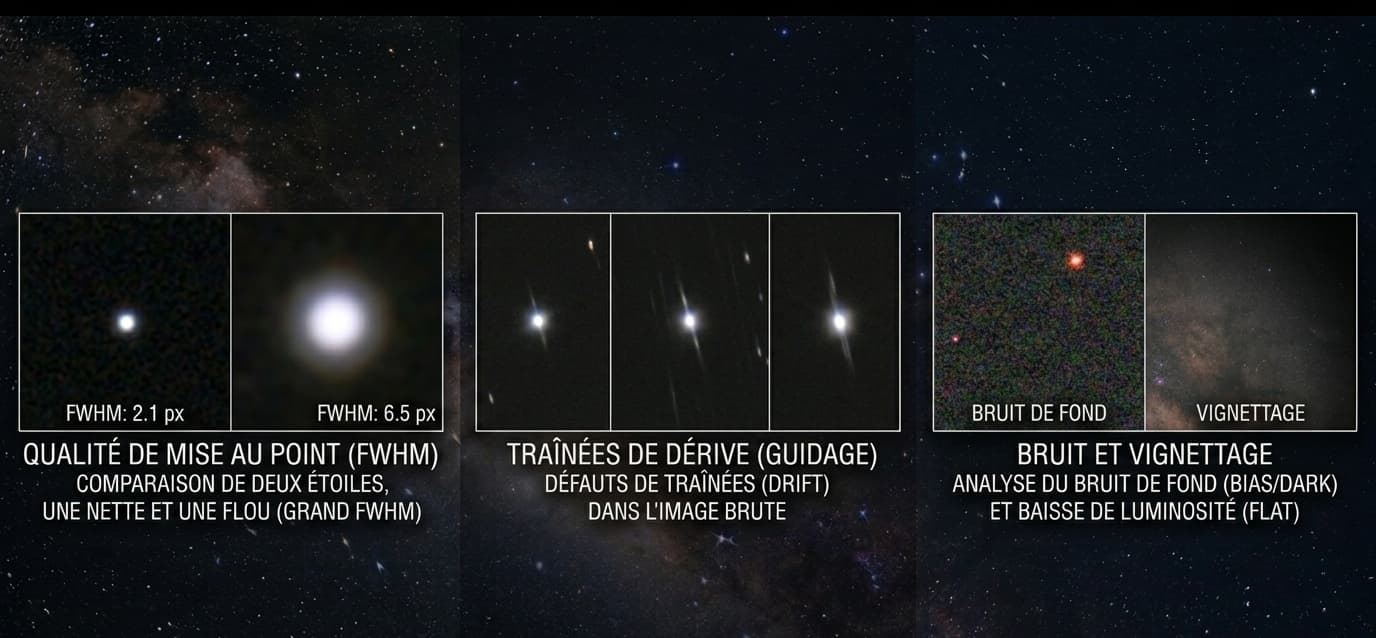
The main diagnosis is optical. The Moffat measurement gives 7.2 px FWHM at center against 14.6 px in the upper right corner, a factor of 2, with a rise that follows the radius and oval rather than comet-shaped stars. That is the signature of a spacing error or uncorrected field curvature, not tilt: the degradation stays broadly symmetric and the center is the sharpest point. Elongation stays low everywhere (1.06 to 1.16, except the BR corner at 1.34 measured on few stars), which clears the tracking: the mount held well over 120 s.
The second axis is signal. Ten minutes total is very little for a Milky Way field: the background is grainy, faint extensions stay buried, and subtle colored mottling appears in the dark areas. The histogram confirms a marginal exposure with slight shadow clipping.
In practice the two problems are fixed separately: spacing is set once and for all, integration is bought with time. Nothing here is unrecoverable, the field and composition are good.
Priority actions
- Correct the corrector backfocus distance and revalidate with an aberration panel
- Multiply total integration by 6 to 12 (aim for 1 to 2 hours) to clean up the background
- Raise the offset slightly to remove the 1.3% shadow clipping
- Apply gentle chroma noise reduction on the background rather than a global denoise