Astrophotography diagnosis of NGC 6888: Backfocus error
RawL2s28 oct. 2026
The Doc examined this image of NGC 6888 (raw, L, 2s). Estimated overall technical quality: 4/10. 1 defect found: Backfocus error (severity 3/5).

Info
- Cible
- NGC 6888
- Date
- 28 oct. 2026, 18:19
- Lune
- Croissant croissant 9.5% (4.2° d'alt., 97.8° de la cible)
- Site
- Bortle 4 · transition rural/banlieue (VIIRS)
- Position
- 20h12m07s · +38°21'24"
Conditions are good and are not the limiting factor here. The lunar context gives a crescent at only 9.5%, 4.2 degrees above the horizon and 97.8 degrees from the target: negligible contribution, no lunar pollution to expect. The Bortle 4 sky is comfortable, even for broadband luminance, and the background map confirms it with a plane gradient of only 3% amplitude and R squared of 0.03, so nothing structured. In other words, you have a sky that allows long exposures without saturating the background: that is exactly what this 2 s sub lacks. Use that window to increase sub duration rather than to pile up very short frames.
Setup
- Type d'image
- Brut
- Télescope
- Celestron C11 2800@F\10.0
- Caméra
- PlayerOne CCD Poseidon-M PRO
- Filtre
- L
- Exposition
- 2s
- Phase de lune
- Gibbeuse décroissante (92 %)
- FOV
- 45.8'
The C11 at F/10 on NGC 6888 is a questionable match: with a 0.76 degree field, the Crescent, which spans about 20 arcminutes, barely fits in frame and leaves no margin. The 0.879"/px sampling is oversampled for typical seeing, which dilutes the signal of an already faint target on a slow focal ratio. On settings, gain 125 is reasonable on the Poseidon-M, but offset 20 is too low (44.8% dark clipping) and a 2 s sub makes no sense on an emission nebula at F/10. Sensor temperature at 0 Celsius is also too high: go down to -10/-20 Celsius to control dark current. A 0.63x reducer would give back field and speed.
The diagnosis in detail
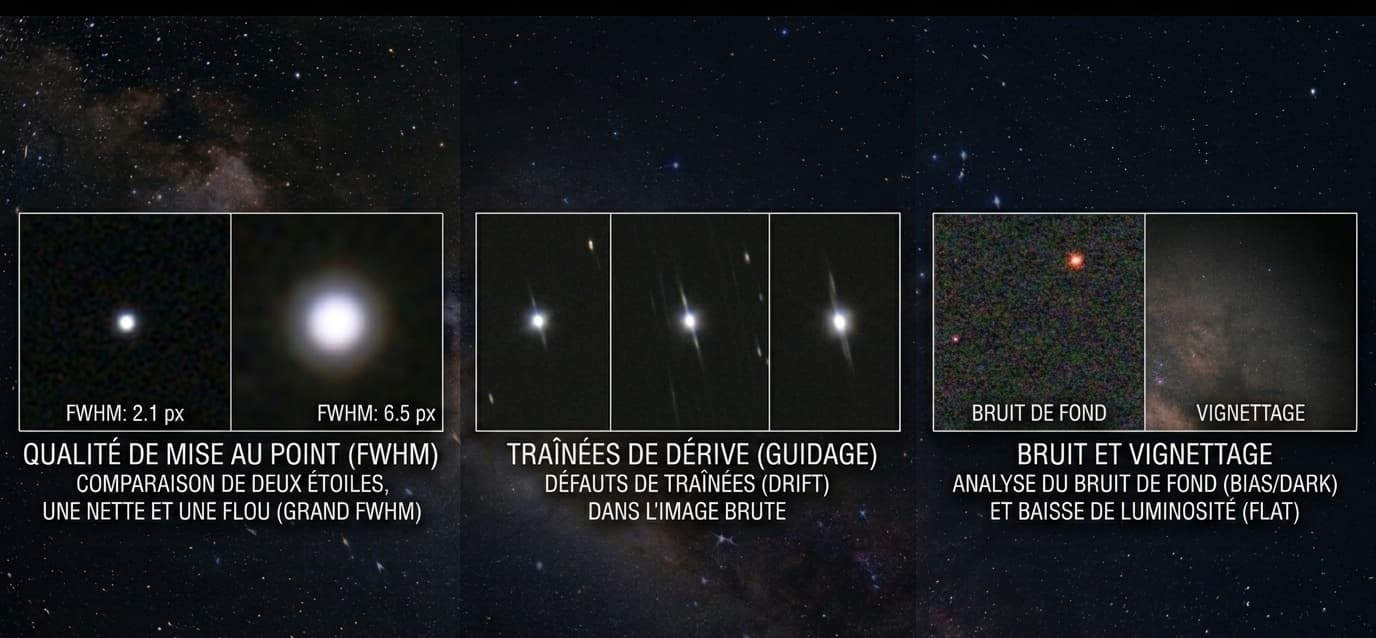
Two independent problems overlap on this sub. The first is optical and structural: the PSF panel shows a very decent center, FWHM 2.8/2.2 px, and a clear radial degradation toward the edges, up to 6.2 px at TL and 6.0 px at BR, a corner/center ratio of 2.37. The distribution stays broadly symmetric across all four corners, which points to field curvature or a mis-set backfocus rather than sensor tilt. The BR corner is the most pronounced (elong 1.70), worth watching if the backfocus adjustment does not fully even things out.
The second is an exposure problem, and it is the one that makes the frame unusable as it stands. A 2 s sub at F/10 behind an L filter leaves the background pinned to the black point: zero median, 44.8% of pixels clipped at the bottom, e_margin of 2.02. In that regime read noise completely dominates sky photon noise, and no reasonable stacking will recover the shortfall. The Crescent Nebula, although in frame, does not appear at all.
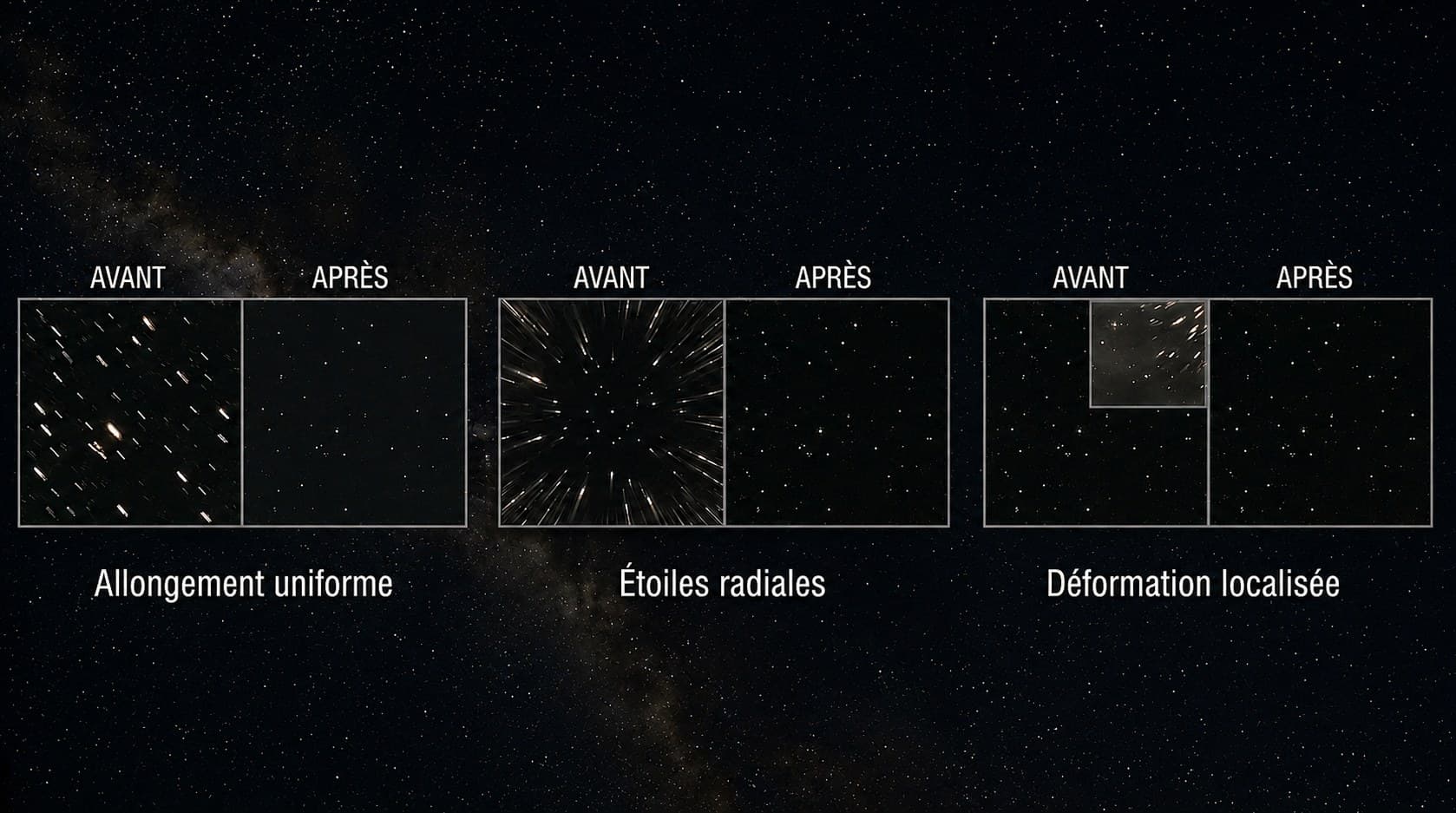
The good news is that tracking is healthy: the 49 degree PA dispersion and the absence of coherent elongation at center rule out drift or periodic error. But at 2 s, that duration tests nothing of the mount.
Priority actions
- Increase sub exposure substantially (at least several tens of seconds at F/10) until the background median clears the black point
- Raise the offset above 20 to eliminate the 44.8% dark clipping
- Adjust backfocus in 0.5 to 1 mm steps and re-shoot an aberration panel at each step to equalize center and corner FWHM
- Lower sensor temperature to -10/-20 Celsius instead of 0
- Switch to an Ha filter on NGC 6888, an emission target, rather than broadband luminance