Astrophotography diagnosis of ngc281: Sensor tilt, clipped stars and 1 other
ProcessedL-pro23x300s
The Doc examined this image of ngc281 (processed, L-pro, 23x300s). Estimated overall technical quality: 6/10. 3 defects found: Sensor tilt (severity 3/5), Clipped stars (severity 2/5), Background chroma noise (severity 2/5).

Info
- Cible
- ngc281
- Position
- 0h53m10s · +56°37'23"
Moon at 0%, so no lunar contribution to the sky background: conditions were favorable for this target. NGC 281 is an Ha-rich emission nebula, which makes it tolerant of a moderate sky background, and the L-Pro filter properly limits streetlight contribution. The measured background however stays close to the black point (margin 0.98), a sign that useful signal is still thin: that is not a sky issue but a total-time issue. On a moonless night the best lever is simply stacking more hours, or switching to a dual-band if the site is heavily light polluted.
Setup
- Type d'image
- Traitée
- Télescope
- C8 réducteur 6,3
- Caméra
- ZWO ASI294MC Pro
- Filtre
- L-pro
- Monture
- AM3
- Exposition
- 23x300s
- Phase de lune
- 0%
- FOV
- 50.6'
The combination is coherent: with a 0.84 degree field, NGC 281 fills the frame without being cut off, the framing is comfortable. The C8 at f/6.3 remains demanding on flatness and backfocus, and that is exactly where it fails here: the reducer requires a precise spacing and a rigid connection, otherwise you get the measured tilt. The ASI294MC Pro at f/6.3 gives fine sampling that forgives little in tracking and optics, but the central stars remain decent. The L-Pro is a good broadband compromise; on an emission target like this one, a dual-band would add contrast if the site is polluted. 23x300s, under 2 hours, is short for this focal ratio.
The diagnosis in detail
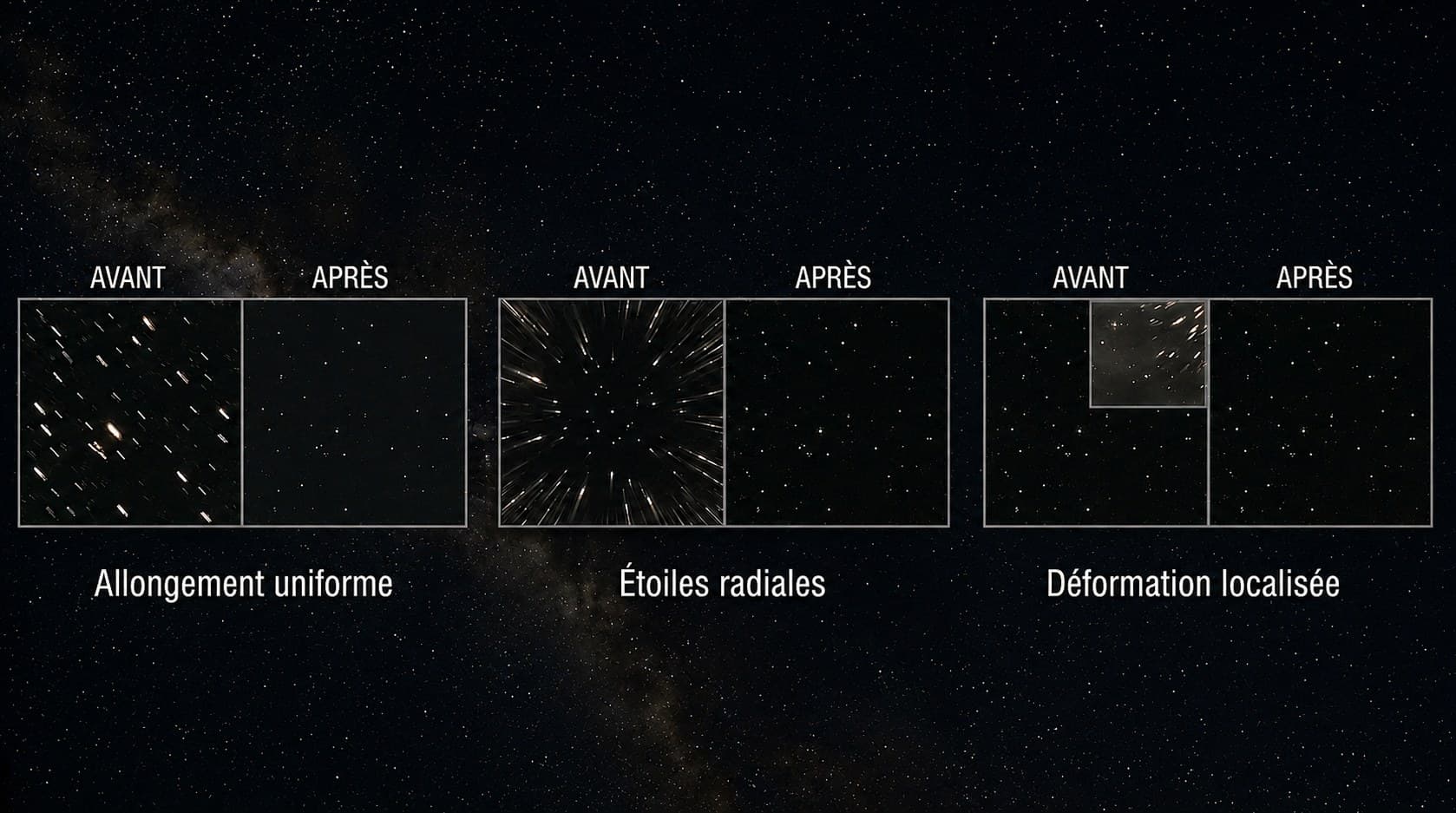
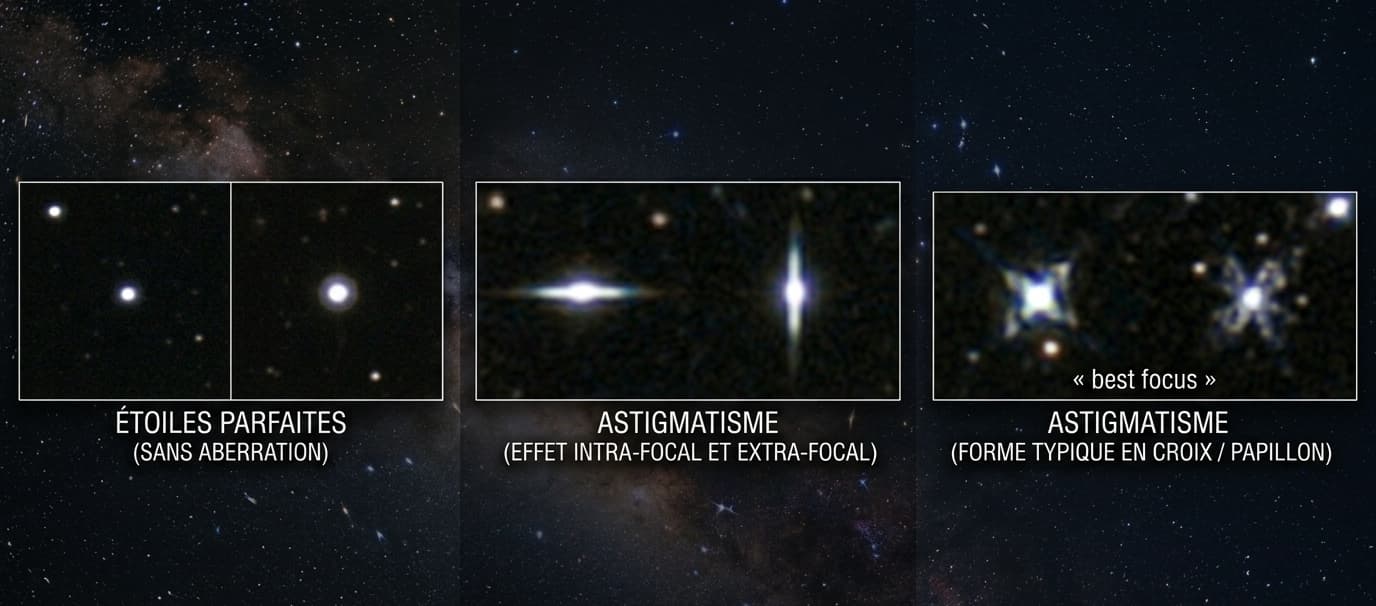
The main diagnosis is instrumental. The PSF measurements show a decent center and unevenly degraded corners: the top-left corner reaches a FWHM of 4.94 px for an elongation of 1.43, the bottom-right 4.66 px for 1.35, while the top and bottom edges stay around 3.4 px with nearly round stars. This asymmetry along a single diagonal, with a corner/center ratio of 1.55, is the signature of a tilted focal plane rather than a simple spacing error, which would degrade all four corners symmetrically.
The rest follows from total exposure time. Under two hours at f/6.3 on a color sensor leaves a background barely lifted off the black point, which forces a firm stretch: background chroma noise becomes visible in the dark areas along the left edge, and the cores of the brightest stars end up clipped to pure white while the DSS still retains structure there.
Comparison with the DSS reference is reassuring on everything else: the nebulosity, dark lanes and Bok globules sit at the same place and scale, nothing artificial in the signal. Processing is generally well controlled, with no dark halos or plastic smoothing.
Priority actions
- Fix the optical train flatness (adjustable tilt plate, verify the 105 mm spacing of the f/6.3 reducer) and iterate with the Aberration Inspector until the four corner FWHM values match
- Raise total integration to 4-6 h to lift the background off the black point and cut chroma noise
- Add a short-exposure set to rebuild bright star cores in HDR
- Apply targeted background chroma noise reduction with a mask protecting the nebula