Astrophotography diagnosis of SH2-131: Residual vignetting and noise / underexposure
ProcessedANTLIA tri band RGB Ultra 230x240s
The Doc examined this image of SH2-131 (processed, ANTLIA tri band RGB Ultra 2, 30x240s). Estimated overall technical quality: 5/10. 2 defects found: Residual vignetting (severity 3/5), Noise / underexposure (severity 3/5).
&w=1920&q=75)
Info
- Cible
- SH2-131
- Site
- Bortle 7 · périurbain pollué (saisi)
Clearly unfavourable conditions. A 95% Moon combined with a Bortle 7 sky pushes the background very high, and the measurement shows it: a background to black point margin of only 1.81, with the nebula signal barely lifted. SH2-131 is an emission nebula, so your ANTLIA tri-band is the right choice to limit the damage, but a tri-band still passes part of the continuum and cannot offset a near full Moon on such a faint target. With this sky, the right window is first or last quarter, ideally with the Moon below the horizon. On a target this faint, moving the session beats doubling the exposure time.
Setup
- Type d'image
- Traitée
- Télescope
- skywatcher 80ED avec reducteur 0.85x
- Caméra
- ZWO ASI2600MC AIR
- Filtre
- ANTLIA tri band RGB Ultra 2
- Monture
- MLAStro SAL-33
- Exposition
- 30x240s
- Phase de lune
- 95%
A coherent, well tuned combination. The 80ED reduced to 0.85x gives a wide field suited to SH2-131, an extended nebula, and the ASI2600 sampling at this focal length stays comfortable for typical seeing. The measurements confirm it: FWHM around 2.9 px, round stars right into the corners, no tilt or backfocus signature, meaning your backfocus distance behind the reducer is correct. The 240s subs suit narrowband work. One hardware caveat: the reducer increases vignetting, which makes flats non optional, and that is precisely where things went wrong here.
The diagnosis in detail
The diagnosis splits cleanly in two. On one side, everything optical and mechanical is healthy: the PSF panel shows nine homogeneous zones, elongation between 1.05 and 1.08 against a field floor of 1.05, PA dispersion of 7.6 degrees and a corner to center FWHM ratio of 1.10. In other words, no tilt, no backfocus error, no residual coma, and tracking that holds 240s without readable drift. On a reduced 80ED, that is a clean result.
On the other side, both problems relate to background and calibration. The 33% residual vignetting is pronounced and purely radial (plane to radial dominance 0.03), so instrumental: it is the reducer, and the flat did not do its job. This residual hurts twice, because it also distorts any gradient removal applied afterwards and rules out an aggressive stretch without lifting the corners.
On top of that, integration is short for this target and these conditions. Two hours on SH2-131 under a 95% Moon in Bortle 7 is not enough to pull the nebula out of the noise, as confirmed by the very faint trace at upper left. Fix calibration first, then accumulate time on a moonless night: the optical foundation is already good, only clean signal is missing.
Priority actions
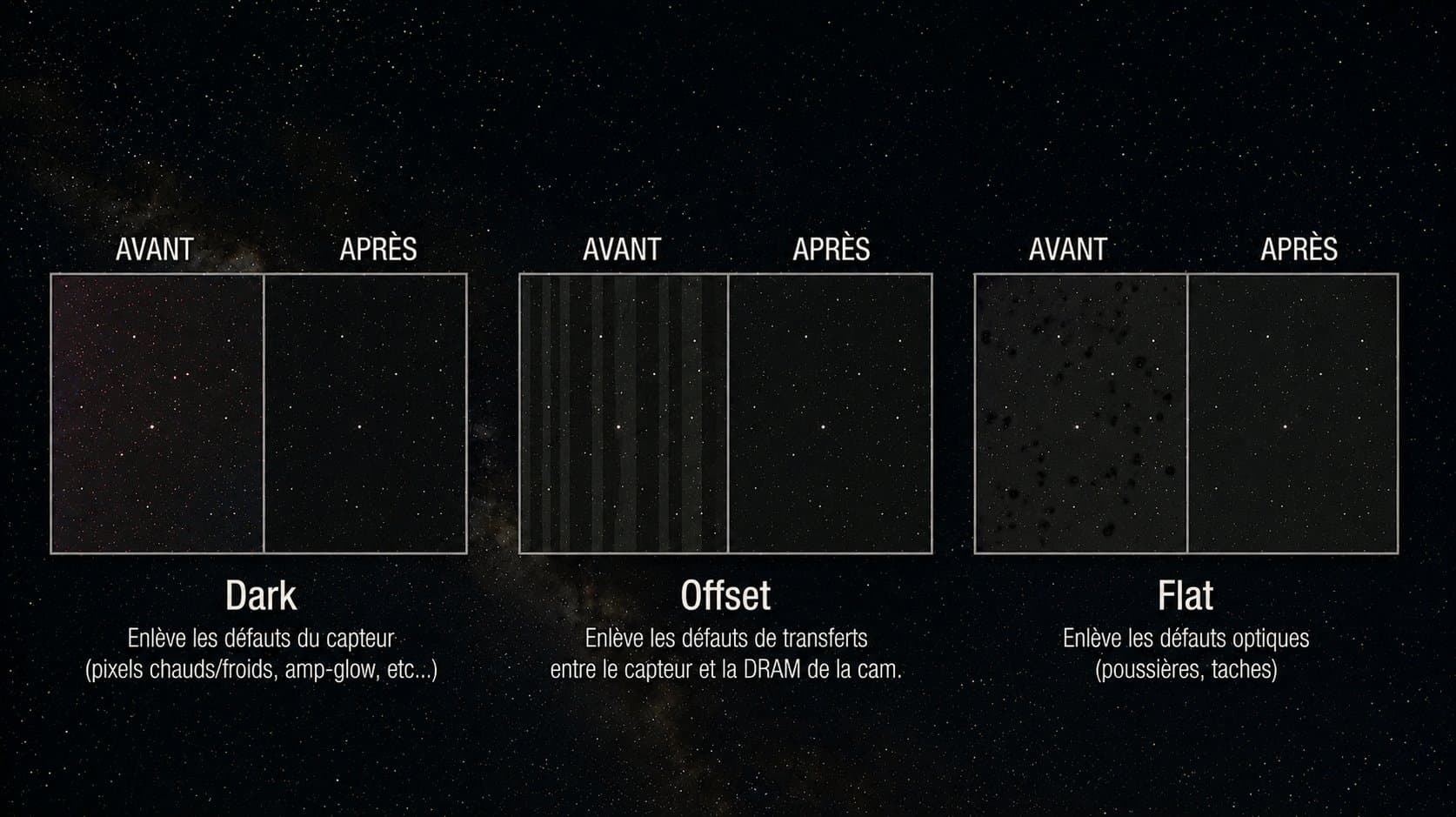
- Reshoot a set of flats on the exact optical train (reducer, filter, camera rotation unchanged) and recalibrate the stack
- Reschedule SH2-131 away from full Moon and aim for at least 8h of total integration
- After recalibration, run a background extraction in division mode (GraXpert or DBE) to absorb the radial residual
- Stretch more decisively once SNR is gained, rather than compensating for missing signal with noise reduction