Astrophotography diagnosis of SH2-131: Light pollution gradient and background chroma noise
ProcessedANTLIA tri band RGB Ultra 230x240s
The Doc examined this image of SH2-131 (processed, ANTLIA tri band RGB Ultra 2, 30x240s). Estimated overall technical quality: 7/10. 2 defects found: Light pollution gradient (severity 3/5), Background chroma noise (severity 2/5).
&w=1920&q=75)
Info
- Cible
- SH2-131
- Site
- Bortle 7 · périurbain pollué (saisi)
- Position
- 21h39m07s · +57°27'30"
Tough conditions, partly offset by the filter. A 95% Moon under a Bortle 7 sky is the worst possible combination for background sky: the background level rises, faint extension contrast collapses and a gradient sets in. Choosing a tri-band filter on an emission target like SH2-131 is exactly the right counter, and it is what saves the image: the Ha signal comes through properly. It can do nothing, however, about the continuum scattered by the Moon, hence the 61% measured gradient. On nights like this, extend integration (2h is short for narrowband under a Moon) or save the faint areas for a moonless night.
Setup
- Type d'image
- Traitée
- Télescope
- skywatcher 80ED avec reducteur 0.85x
- Caméra
- ZWO ASI2600MC AIR
- Filtre
- ANTLIA tri band RGB Ultra 2
- Monture
- MLAStro SAL-33
- Exposition
- 30x240s
- Phase de lune
- 95%
- FOV
- 2.45°
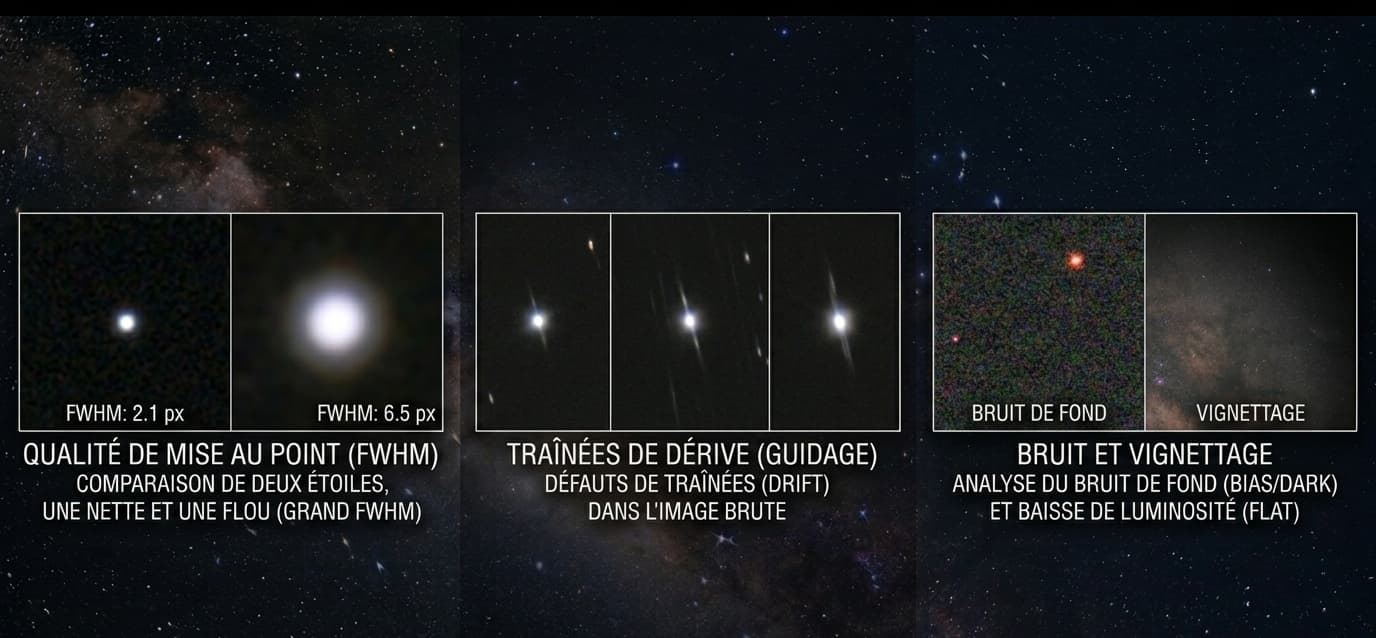
Coherent, well-mastered setup for this target. The 80ED reduced at 0.85x gives a 2.45 degree field, framing the whole IC 1396 area comfortably with the Elephant Trunk at bottom right and margin all around: nothing is cut off. Sampling translates into stars at 2.1-2.5 px FWHM, a very good result indicating careful focus and clean tracking from the SAL-33, with no detectable drift or oscillation. The Antlia tri-band suits an HII region and fully justifies shooting under a Moon. On exposure, 240s per sub is reasonable, but the measured background-to-black-point margin (1.48) shows a background barely lifted after processing: be careful not to crush the black point too hard in the stretch, you lose faint extensions that way.
The diagnosis in detail
The optical verdict is excellent and worth stating up front: the PSF panel shows round, tight stars everywhere, FWHM between 2.05 and 2.47 px, center elongation at 1.10 against a field floor of 1.06, corner/center ratio of 0.97 and horizontal and vertical asymmetries below 0.03. In other words, no tilt, no backfocus error, no residual coma, and tracking that leaves no directional signature (PA dispersion of 35.6 degrees, so no preferred direction). The optical train and the mount are doing their job.
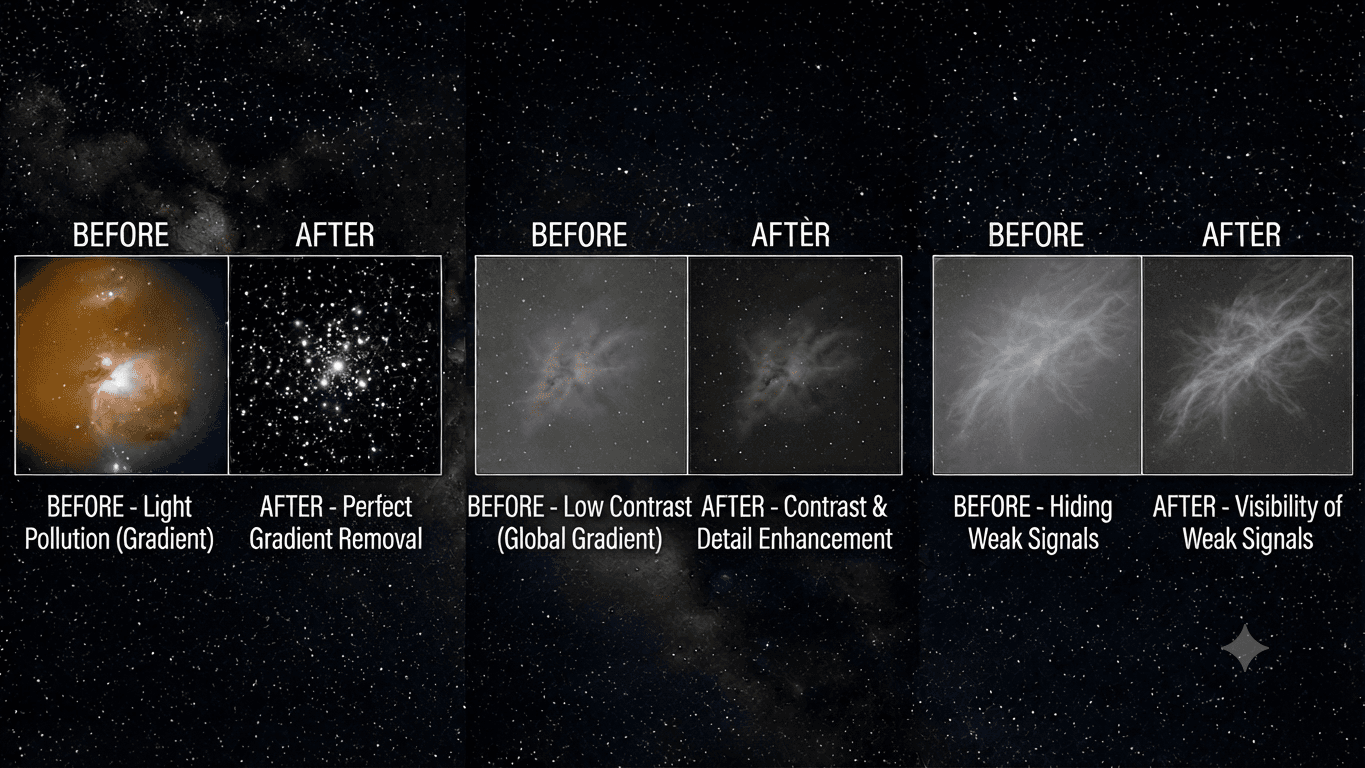
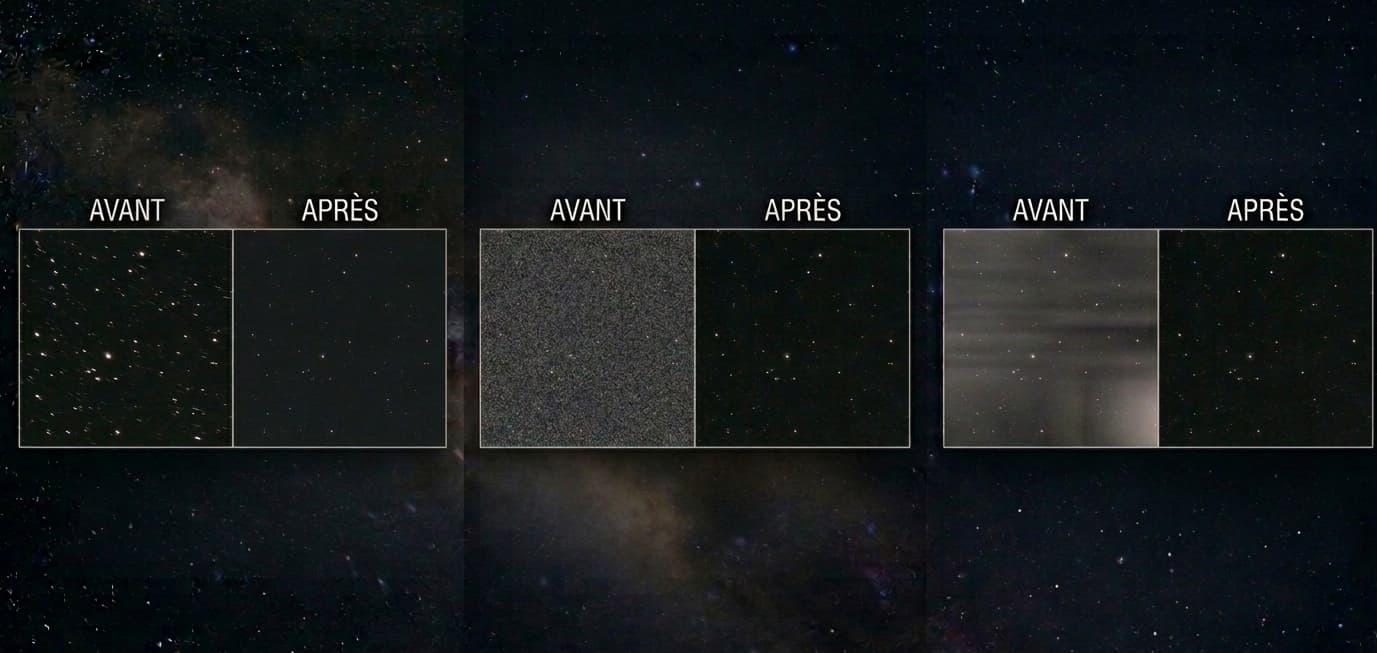
Everything left to fix happens in the background, and both reported defects share one root cause: a night with a 95% Moon under Bortle 7. The 61% linear gradient at 354 degrees is the direct signature of that stray light, and its strong dominance over the radial component (factor 6.6) confirms it is oriented pollution rather than poorly corrected vignetting. The chroma noise in the dark areas follows from the same problem: with such a high background, the SNR of faint extensions collapses and the stretch pulls up colored granulation.
The good news is that all of this is recoverable in post-processing, with no change to acquisition. A careful gradient extraction on the linear data, then separate chrominance treatment, will add noticeable depth.
Priority actions
- Redo gradient extraction on the linear image with GraXpert or DBE, placing samples outside the nebulosity
- Treat background chroma noise separately from luminance, using a mask that protects the nebula
- Extend integration beyond 2h, ideally on a moonless night, to strengthen faint extensions
- Raise the black point slightly in the stretch to preserve the background margin measured at 1.48