Astrophotography diagnosis of SH2-131: Light pollution gradient, background chroma noise and 1 other
ProcessedANTLIA tri band RGB Ultra 230x240s
The Doc examined this image of SH2-131 (processed, ANTLIA tri band RGB Ultra 2, 30x240s). Estimated overall technical quality: 7/10. 3 defects found: Light pollution gradient (severity 3/5), Background chroma noise (severity 2/5), Clipped stars (severity 2/5).
&w=1920&q=75)
Info
- Cible
- SH2-131
- Site
- Bortle 7 · périurbain pollué (saisi)
- Position
- 21h39m05s · +57°27'58"
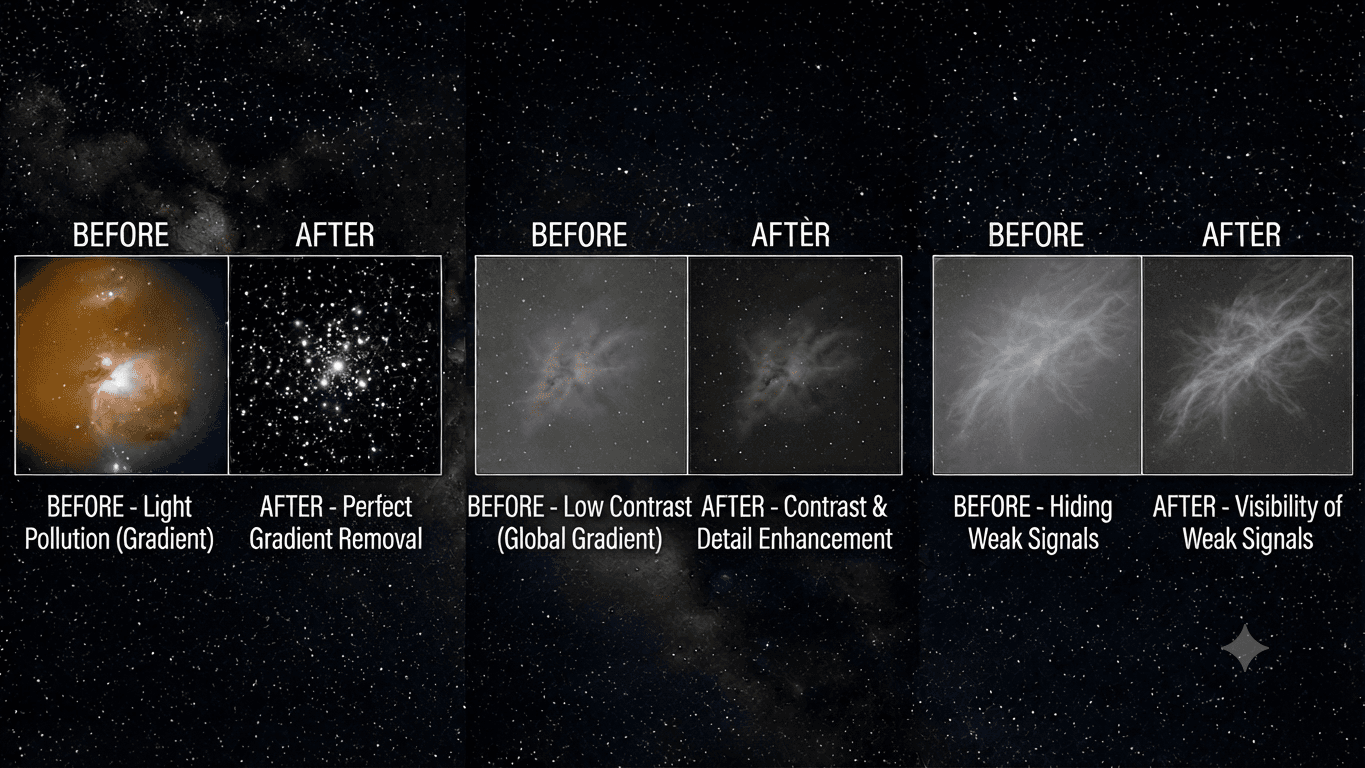
Tough conditions: Bortle 7 plus a 95% moon is the worst mix for broadband work. The Antlia tri-band filter saves the session by passing only Ha, OIII and Hb, which is why the nebula still comes through, but the background stays loaded and the measurement confirms a 27% gradient. The background-to-black-point margin of 2.21 shows the sky is already well lifted under this bright sky, so the 240s exposure is sound. On an emission target like SH2-131 this trade-off is defensible; for more contrast and cleaner color, aim for nights with a faint moon or none at all, which will cut the gradient you have to correct.
Setup
- Type d'image
- Traitée
- Télescope
- skywatcher 80ED avec reducteur 0.85x
- Caméra
- ZWO ASI2600MC AIR
- Filtre
- ANTLIA tri band RGB Ultra 2
- Monture
- MLAStro SAL-33
- Exposition
- 30x240s
- Phase de lune
- 95%
- FOV
- 2.11°
A coherent combination. The 80ED reduced at 0.85x gives 2.11 degrees of field, comfortably framing all of IC 1396 with its trunk at lower right and margin around it: a good match for this very large target. The ASI2600 at this focal length samples finely, and the measured 2.8 px FWHM confirms that the optics and the SAL-33 mount keep up without penalizing oversampling. The tri-band is the right filter for the lunar context. The only real lever: 30x240s, about 2h, stays short for a Bortle 7 sky with a moon; doubling integration would do more for background cleanliness than any setting change.
The diagnosis in detail
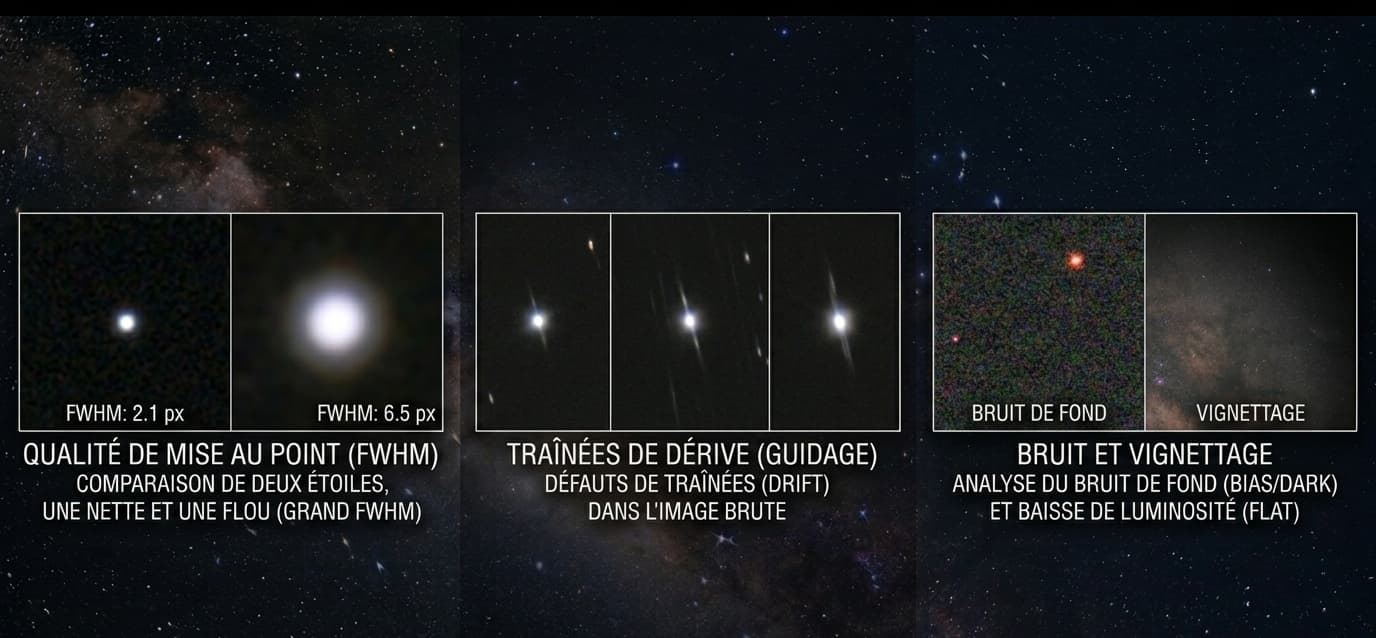
On the acquisition side there is nothing to fault. The aberration inspector reports FWHM from 2.72 to 2.94 px across the nine zones, a corner/center ratio of 1.063 and a peak elongation of 1.08 against a field floor of 1.04: stars are round everywhere, backfocus is correct, the sensor is flat and tracking leaves no trailing. That is all the more impressive on 240s subs.
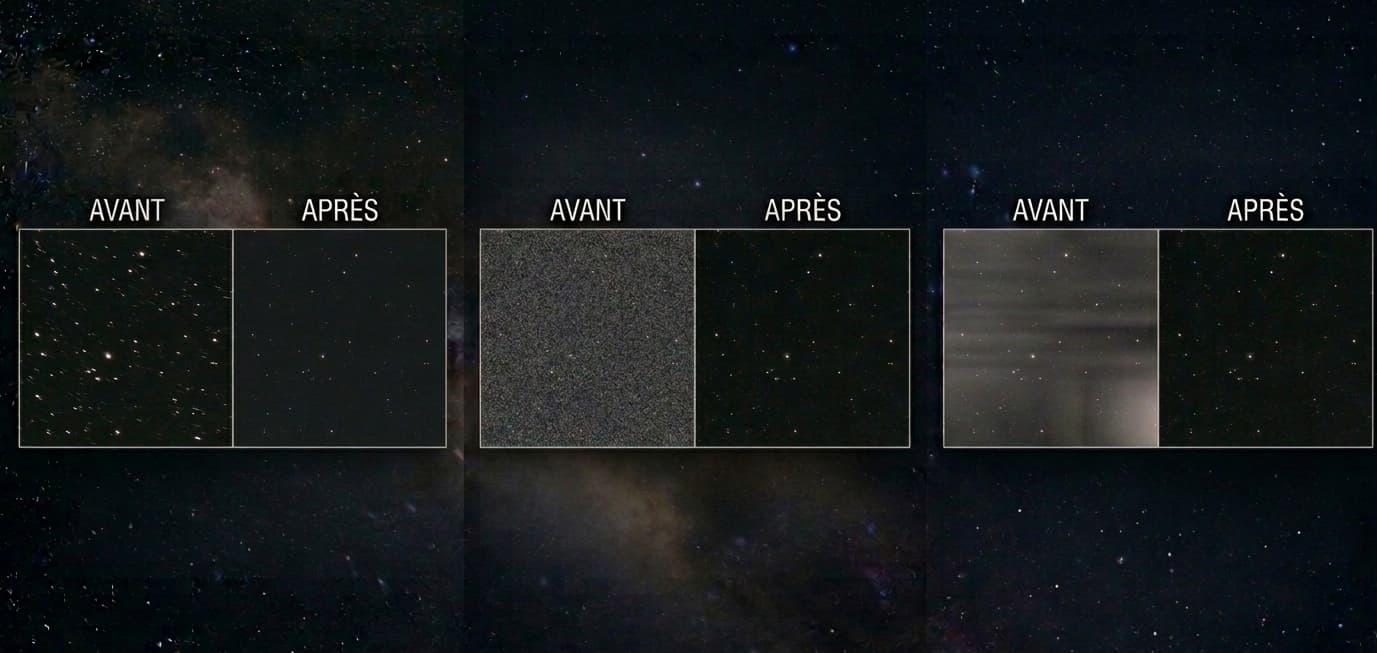
Everything left to fix comes from the sky background and how it was rendered. The background map measures a plane of 27% amplitude oriented at 358 degrees, strongly dominant over the radial component, the signature of light pollution reinforced by the 95% moon. Comparison with the DSS confirms the region's nebulosity is real, but this overall ramp is not. On that poorly flattened background, the stretch brings up patchy chroma mottling in the dark areas, and the greenish-brown background tint follows directly from it.
The priority is therefore simple: extract the gradient cleanly first, and color balance and perceived noise will settle on their own. The clipped star cores are a secondary point, fixable at the stretch stage.
Priority actions
- Redo gradient extraction on the linear image (GraXpert or DBE) with samples placed away from nebulosity
- Rerun color calibration and background neutralization after gradient removal
- Apply targeted noise reduction on the background chrominance
- Protect star cores with a star mask during the stretch
- Add subs, ideally under a faint moon, to double the current 2h integration