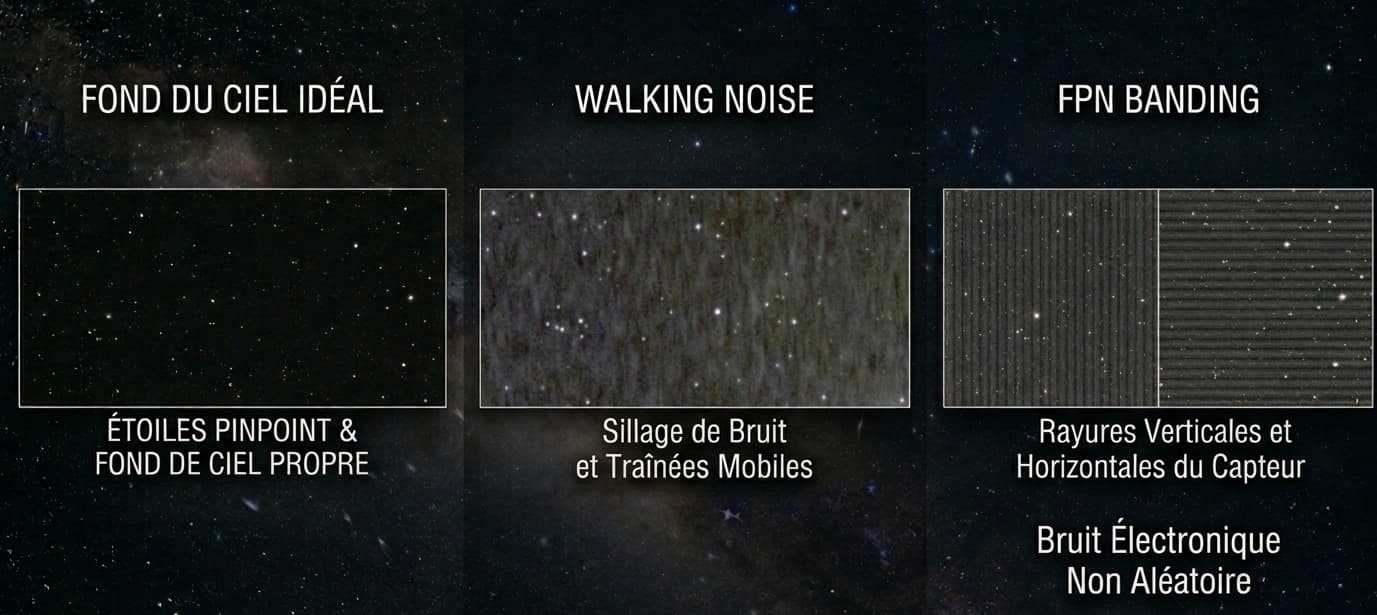
You spend hours imaging the sky, stack your frames carefully, and then... grainy streaks and ugly bands show up in your final image. These are walking noise and FPN banding, and they can ruin entire nights of work. The good news: there are concrete solutions to get rid of them for good.
In this article, the Doc explains exactly what happens between your image sensor and your mount, why these defects appear after stacking, and how to eliminate them with dithering and proper calibration practices.
Key takeaways |
|---|
1. FPN (fixed pattern noise) is a static pattern in your sensor (banding, dark structure) that always stays in the same position and emerges by contrast after stacking. |
2. Walking noise is not an FPN that moves: it is the fixed pattern that begins to drift across the aligned image because the sky shifts slowly and directionally from frame to frame. Statistical rejection cannot eliminate it, and it spreads into diagonal streaks. |
3. Dithering at acquisition is the solution: it makes those displacements random instead of directional. Calibration (darks, flats) and post-processing complement dithering, but cannot replace a solid acquisition workflow. |
What is walking noise and fixed pattern noise (FPN)?
Definition of FPN (Fixed Pattern Noise)
Fixed pattern noise, or FPN, refers to the systematic and repeatable signal variations between pixels of a digital sensor. Unlike random noise, FPN always occupies the same position on the sensor: that immobility is precisely what makes it problematic.
It manifests in two main forms:
Dark signal non-uniformity (DSNU): pixel-to-pixel variations in dark current (hot pixels, dark structure)
Photo response non-uniformity (PRNU): unequal sensitivity of pixels to light
Added to these is readout FPN, tied to the sensor's readout electronics: it produces horizontal and/or vertical bands and columns of unequal brightness, also a static pattern. The visual result: structured streaks that pollute shadow areas. Not to be confused with amp glow, another sensor artifact that appears as a luminous halo in a corner of the image.
Why do astrophotographers talk about walking noise?
Here is the point that many articles get backwards. Walking noise is not an FPN moving across the sensor. The fixed pattern never moves: it is tied to the pixels.
What moves is the sky image. If your mount drifts slowly (polar alignment imperfect, drift, guiding without dithering), the field gradually shifts on the sensor from one frame to the next. During registration, your software aligns the stars, therefore the sky. Mechanically, this registration then slides the residual fixed pattern (poorly calibrated hot pixels, dark structure, correlated noise) within the aligned reference frame.
Because the drift is slow and directional, not random, this residue always moves in the same direction through the stack. Statistical rejection cannot eliminate it: instead of disappearing, it spreads into streaks or directional grain, often diagonal, the characteristic worm-like trails. That is what distinguishes walking noise from static banding. Walking noise affects both CMOS and CCD sensors, monochrome and color alike: it is not a defect specific to any brand, although some sensors make it more visible.
Why banding and walking noise only appear after stacking
The role of stacking in revealing FPN
In a single sub-frame, banding is often invisible, buried in random noise. It is image stacking that reveals it.
When you stack your images, random noise drops by the square root of the number of frames: the background becomes smooth. FPN, identical in every image, is not averaged out: its absolute amplitude does not change, but since the random noise that masked it has collapsed, the fixed pattern emerges by relative contrast. The banding does not grow as you stack more frames: it is the background around it that recedes and lets it show through.
The impact of tracking and frame registration
You sometimes read that precise autoguiding is catastrophic for FPN. That is inaccurate: good guiding is not the cause of walking noise. The real trigger is residual drift (imperfect polar alignment, flexure) combined with the absence of dithering.
When the sky drifts slowly frame after frame and you register on the stars, the fixed pattern begins sliding coherently in the aligned stack. Without randomization, this directional displacement escapes statistical rejection and walking noise becomes obvious after stacking. Conversely, clean guiding paired with dithering is exactly the combination to aim for. Not sure what you are seeing in your image? Submit your stack to DocStellar to confirm whether it is walking noise.
The main causes of walking noise: residual dark pattern, DSNU, and PRNU
Dark signal non-uniformity (DSNU)
DSNU (dark signal non-uniformity) is the pixel-to-pixel non-uniformity of the dark signal, caused by variations in thermal current between pixels. It produces hot pixels and structured grain even in the absence of light. It is this residual dark pattern, poorly calibrated, that most often feeds walking noise when it begins to drift.
Sensor temperature plays a major role: the hotter the sensor, the higher the dark current and DSNU. That is why long exposures on warm nights produce more hot pixels and residuals. Be careful not to confuse this with read noise, which is random and independent of exposure duration: it is duration and temperature that drive up dark current, not read noise.
Photo response non-uniformity (PRNU)
PRNU (photo response non-uniformity) affects sensitivity to light. Each pixel responds slightly differently, creating variations in bright areas. The dynamic range of the sensor influences how visible this becomes.
Flat-field correction effectively corrects PRNU, but not walking noise, which is an acquisition-stage drift problem. Dead pixels and areas of aberrant sensitivity can contribute to the residual pattern that drifts.
How to eliminate walking noise with dithering
Dithering principle: randomly offsetting the framing position
Dithering consists of introducing a random offset in the framing position between each sub-exposure. In practice, your autoguiding software nudges the mount by a few pixels in a randomly chosen direction between frames.
This is precisely what neutralizes walking noise: instead of always drifting in the same direction (directional drift), the fixed pattern ends up at a random position in each image. After star registration and stacking, that residue becomes indistinguishable from random noise and statistical rejection can eliminate it. Dithering also helps with static banding by decorrelating it from sky structures. The key point: all of this happens at acquisition; you cannot recover from walking noise in post-processing.
Recommended settings: dithering amplitude and frequency
Here are rough guidelines for dithering, to be adapted to your setup:
Parameter | Recommended value | Notes |
|---|---|---|
Amplitude | 10 to 15 pixels (rough starting point) | Adjust based on your pixel scale and the amplitude of your drift. Some imagers dither more aggressively. |
Frequency | Ideally every frame | For long narrowband exposures (200s+), dithering every 2 to 3 subs remains very effective and saves settling downtime |
Settling | ~5 to 10 seconds | Stability criterion (return below an RMS error threshold), not a blind timer; depends on your mount |
Dithering works with PHD2, NINA, or any other guiding software. A good polar alignment remains very useful: it reduces drift and makes registration easier. Watch out for the reverse misconception: dithering does not create drift; it is a pre-existing drift (imperfect polar alignment) that, without dithering, produces walking noise.
Dark frames and flat-field: essential calibration to reduce FPN
Dark frames capture the thermal signal and dark pattern of your sensor under the same conditions as your light frames. Subtracting them eliminates a large share of the static fixed pattern noise, hot pixels, and DSNU, thereby depriving walking noise of the residue that feeds it. Be careful, though: a poorly applied dark (wrong temperature, different duration) can actually inject additional noise.
A few rules for effective dark frames:
Same exposure time and gain/ISO as your light frames
Same sensor temperature (critical for DSNU)
At least 20 to 30 darks stacked to reduce their own residual noise
Flat-field correction corrects vignetting and PRNU. Combined with dark frames and, above all, dithering, it forms the foundation of a solid calibration pipeline for astrophotography.
Software noise-reduction solutions for correcting residual banding
Even after dithering and calibration, some residual static banding may persist. Image processing with specialized tools then takes over. Keep in mind: these tools address static banding and background noise, not directional walking noise, which must be handled at acquisition.
Useful software for residual banding and background noise:
PixInsight: for horizontal banding from Canon DSLRs, the CanonBandingReduction script is specific and effective. Not to be confused with GradientCorrection, which handles gradient removal (light pollution, vignetting), not banding.
Siril: free, with effective background noise processing and rejection algorithms (sigma clipping), most useful in combination with dithering
DeepSkyStacker: pixel rejection via sigma clipping helps during stacking, but without dithering it cannot save a coherent directional walking noise pattern
Post-processing cannot replace a solid acquisition. AI-based denoising modules (such as GraXpert's denoising module or NoiseXTerminator) address random background noise: they do not remove structural banding or FPN, and may actually lock it in. For fixed structures, rely on dithering at acquisition and dedicated scripts.
FAQ: Walking Noise, FPN, and Banding in Astrophotography
What is walking noise in astrophotography?
Walking noise is not an FPN moving across the sensor: the fixed pattern always stays in the same place. It is the sky image that drifts slowly (mount, imperfect polar alignment, no dithering); during star registration, the residual fixed pattern begins to slide in the aligned stack, always in the same direction. Because this drift is directional, statistical rejection cannot eliminate it, and it appears as streaks or grain, often diagonal. It affects both CMOS and CCD sensors.
Why does banding appear mainly after stacking?
Stacking drives random noise down by the square root of the number of frames, so the background becomes smooth. FPN, identical in every image, is not averaged out: its amplitude does not grow, but it emerges by relative contrast now that the noise masking it has receded. Without dithering, walking noise compounds this effect.
Is dithering enough to completely eliminate walking noise?
Dithering is the primary method against walking noise, because it makes previously directional displacements random. Combined with dark frames, flat-field correction, and good statistical rejection, it eliminates virtually the entire problem. Software processing (PixInsight, Siril) can clean up residual static banding, but not walking noise that was allowed to build up for lack of dithering.
Which sensors are most affected by FPN banding?
Readout banding and walking noise are not limited to any brand or format: they are an acquisition and stacking phenomenon that affects CMOS and CCD, monochrome and color alike. Some sensors (including certain APS-C DSLRs) make it more visible, but none are entirely immune. You can compare your image against typical cases in the DocStellar diagnostic gallery to precisely identify your defect.
Do dark frames eliminate walking noise?
Dark frames remove the static FPN, hot pixels, and DSNU, so they reduce the fixed-pattern residue that feeds walking noise. But since walking noise comes from that residue sliding (drift plus registration), darks alone are not enough: dithering remains essential to neutralize it.
What dithering amplitude should I choose to suppress banding?
An amplitude of 10 to 15 pixels is a good starting point, to be adjusted based on your pixel scale and the amplitude of your drift; some imagers dither more aggressively. The key is to dither regularly (every frame, or every 2 to 3 subs for long exposures) and let the guider settle back below its RMS error threshold before the next exposure.
Conclusion
Walking noise and FPN banding are among the silent enemies of the astrophotographer. Invisible frame by frame, they sabotage the final result after hours of stacking. But once you understand that the fixed pattern does not move and that it is the sky that drifts, they become entirely manageable.
The winning recipe starts at acquisition: enable dithering tonight, nail your polar alignment to minimize drift, calibrate your images with matching dark frames and flat frames, and reserve PixInsight or Siril for residual static banding only. If you are still unsure about the origin of a defect visible in your image, run a DocStellar diagnostic to identify it in a few seconds. Your next stack will thank you.