Astrophotography diagnosis of C12: Residual vignetting and sensor tilt
Master7680sN/A
The Doc examined this image of C12 (master, 7680s). Estimated overall technical quality: 6/10. 2 defects found: Residual vignetting (severity 3/5), Sensor tilt (severity 3/5).
&w=1920&q=75)
Info
- Cible
- C12
- Date
- N/A
- Site
- Bortle 6 · banlieue dense (VIIRS)
- Position
- 20h34m53s · +60°08'60"
Decent conditions for a galaxy: Moon absent (0 illumination), so no lunar pollution to fear, and the measured background stays clean despite Bortle 6. In Bortle 6 the urban light gradient and SNR ceiling mainly limit the faint spiral-arm extensions of NGC 6946, a low surface brightness target. Nothing prohibitive here, but pulling the galaxy out will require many cumulative hours and good background extraction; a darker sky would immediately pay off on this target.
Setup
- Type d'image
- Master
- Télescope
- Skywatcher 200/800
- Caméra
- FUJIFILM XT-3
- Monture
- EQ6R
- Exposition
- 7680s
- Phase de lune
- 0
- Seeing
- 0,62"
- FOV
- 48.0'
Coherent but demanding setup. The 200/800 Newtonian (f/4) offers good light grasp for a small galaxy, and NGC 6946 (~11') fits comfortably in the 0.80 deg field, well centered, flawless framing. However the 0.489''/px sampling is clearly oversampled: under typical seeing you would gain by binning x2 (near 1''/px) to improve SNR with no real loss of detail. The f/4 is very sensitive to tilt and backfocus: the measured residual confirms that mechanical care on the optical train and coma corrector is decisive here.
The diagnosis in detail
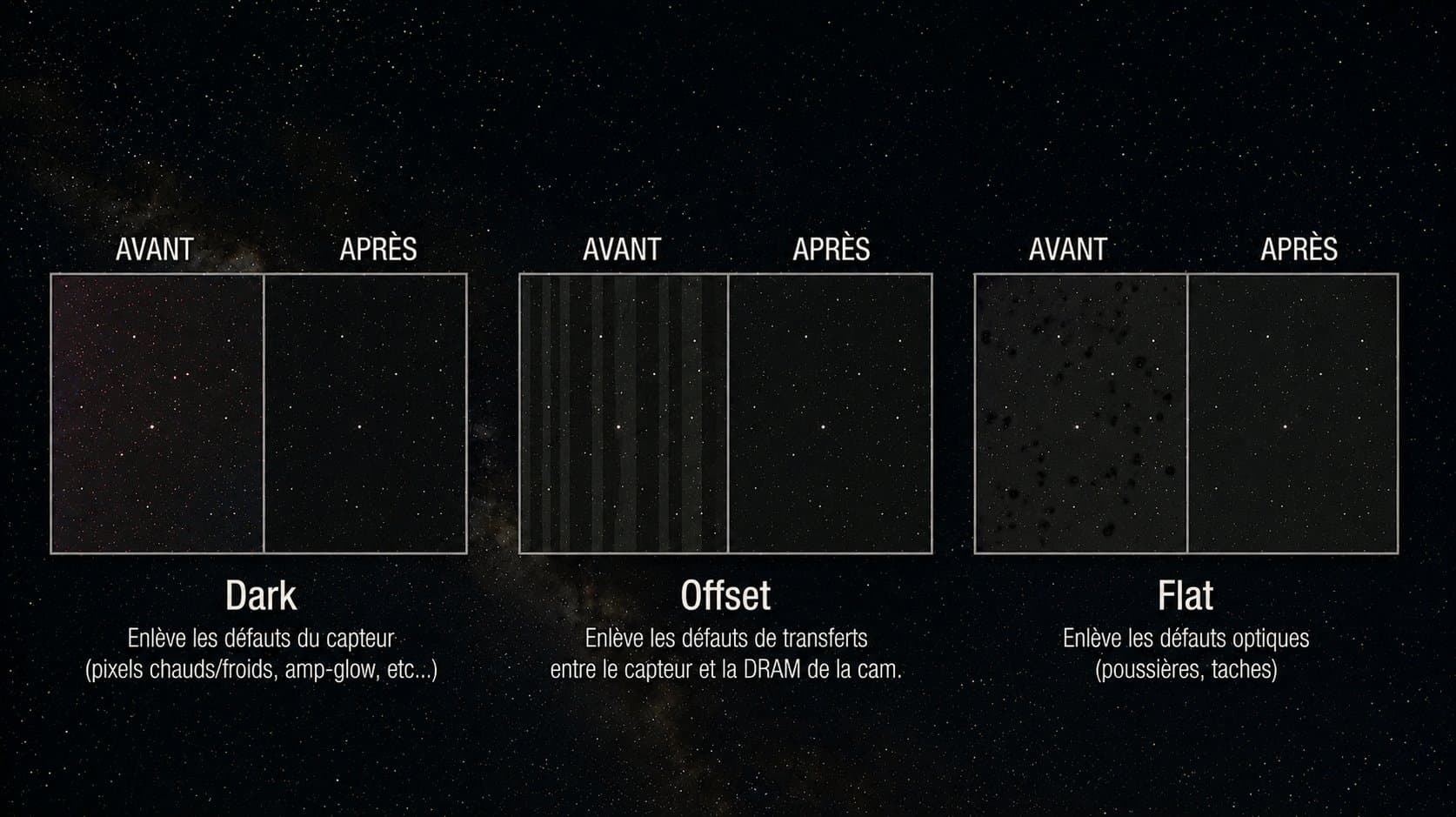
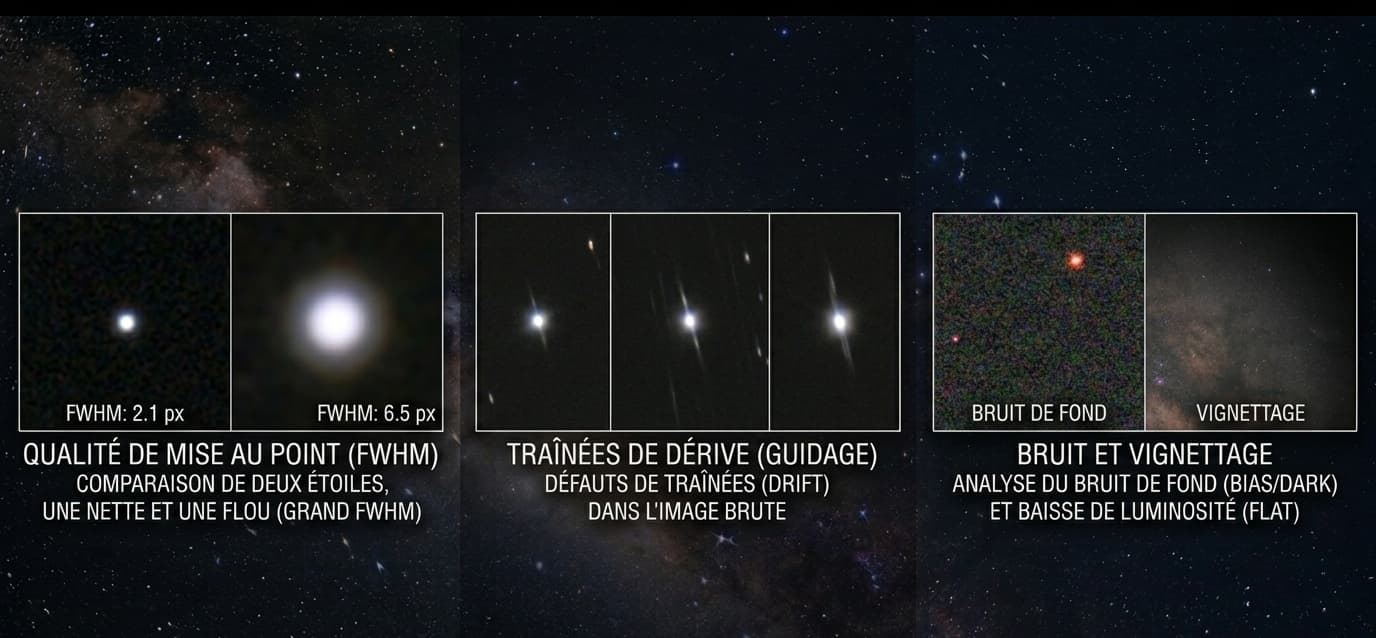
On the background, the measurement is decisive: a 22% radial falloff with rotational symmetry (plane/radial dominance 0.03, anisotropy 0.02), corners filled with pure sky that the DSS confirms has no nebulosity. So this is uncorrected instrumental vignetting, not IFN nor an oriented gradient. The concrete priority is therefore flat-field calibration, otherwise a simple background extraction (GraXpert/DBE) will flatten the master.
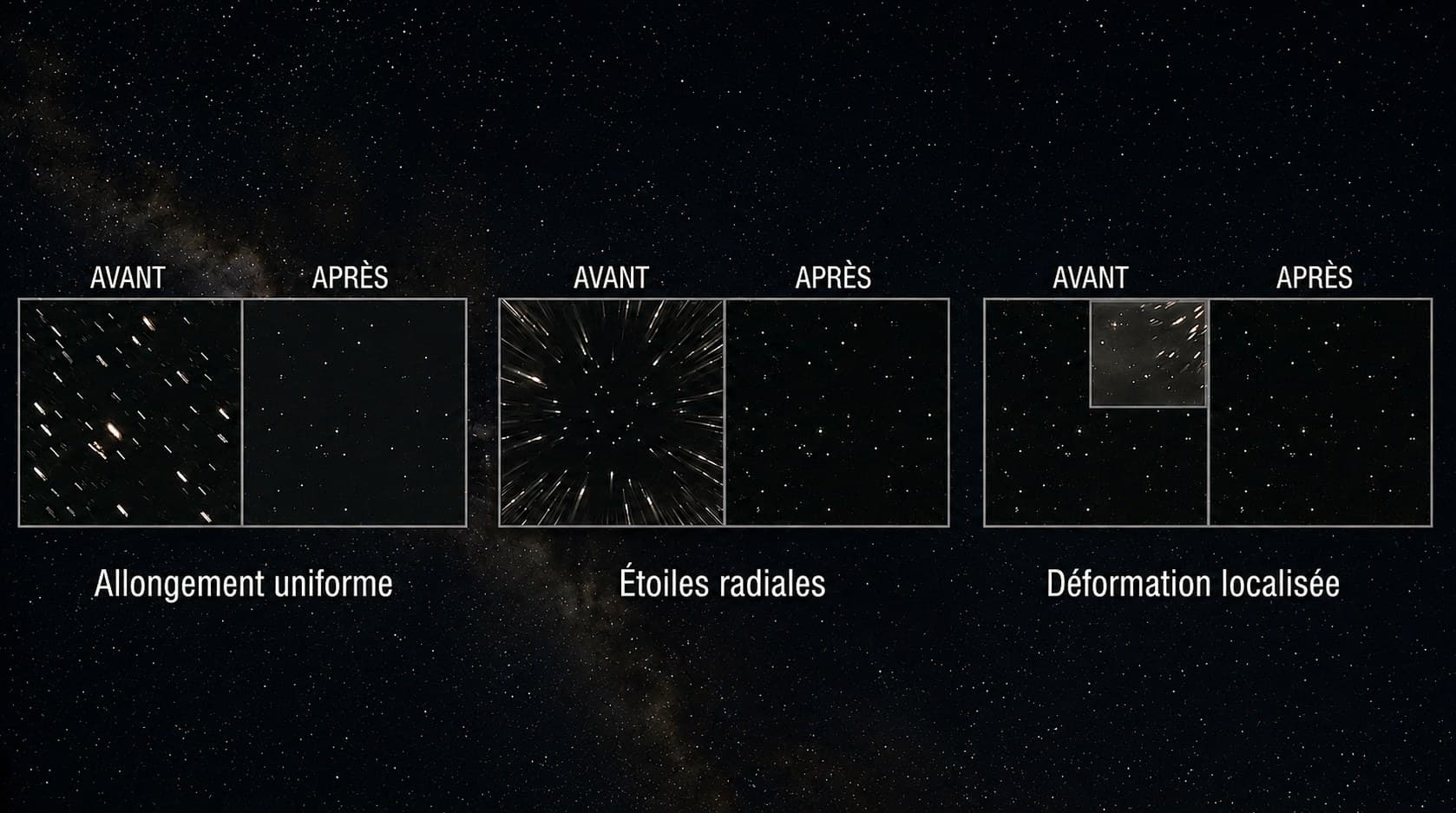
On the stars, the PSF panel is clear: round center (elong 1.12, at the field floor 1.10), so neither tracking nor global focus issues, the EQ6R mount and guiding do their job. But the TL/BR diagonal corners climb to 1.57 elongation while the other diagonal stays near 1.22, with a corner/center ratio of 1.28: the signature of a focal-plane tilt rather than symmetric backfocus. On an f/4 Newtonian this defect is common and is fixed mechanically.
The rest is healthy: no walking noise, no FPN or banding, no obvious residual calibration patterns. The real remaining lever after tilt and flats is integration: the background is barely lifted (e_margin 2.24) and the galactic signal faint, so stacking more subs will markedly strengthen the final result.
Priority actions
- Reshoot matched flats (identical config, 30-50% ADU, with flat-darks) and re-integrate to remove the 22% vignetting
- Diagnose and mechanically correct the focal-plane tilt (optical train, corrector backfocus, possible tilt plate) on this f/4 Newtonian
- Accumulate more integration to better lift the background and bring out the arms of NGC 6946
- Consider x2 binning (~1''/px) to improve SNR, as the current sampling is oversampled