Astrophotography diagnosis of IC 5070: Backfocus error
Raw300s12 juin 2026
The Doc examined this image of IC 5070 (raw, 300s). Estimated overall technical quality: 6/10. 1 defect found: Backfocus error (severity 3/5).
&w=1920&q=75)
Info
- Cible
- IC 5070
- Date
- 12 juin 2026, 21:57
- Lune
- Gibbeuse croissante 92.5% (sous l'horizon)
- Site
- Bortle 2 · rural typique (VIIRS)
- Position
- 20h53m07s · +44°28'47"
Excellent conditions: Bortle 2 and the Moon (waxing gibbous 92.5%) below the horizon, so no influence on this sub. For an emission target like the Pelican in Hα this is ideal, minimal background gradient and SNR limited mainly by total integration time, not the sky. No lunar or urban pollution correction to anticipate here; the low background e_margin is normal in narrowband and does not indicate underexposure.
Setup
- Type d'image
- Brut
- Télescope
- EQMod Mount
- Caméra
- ZWO ASI585MM Pro
- Exposition
- 300s
- Phase de lune
- Dernier croissant (6 %)
- FOV
- 1.70°
Coherent setup for IC 5070. At 375 mm focal length, the 1.70° field frames the Pelican head well with room for the surrounding nebulosity. Sampling at 1.595"/px is comfortable and well matched to typical seeing, neither over- nor under-sampled. Gain 252 is high but consistent with a mono camera in narrowband (300s), offset 15 with no dark clipping (0%), sensor well cooled at -18.5°C. The only hardware caveat: the optical train needs a backfocus adjustment to tighten the corners.
The diagnosis in detail
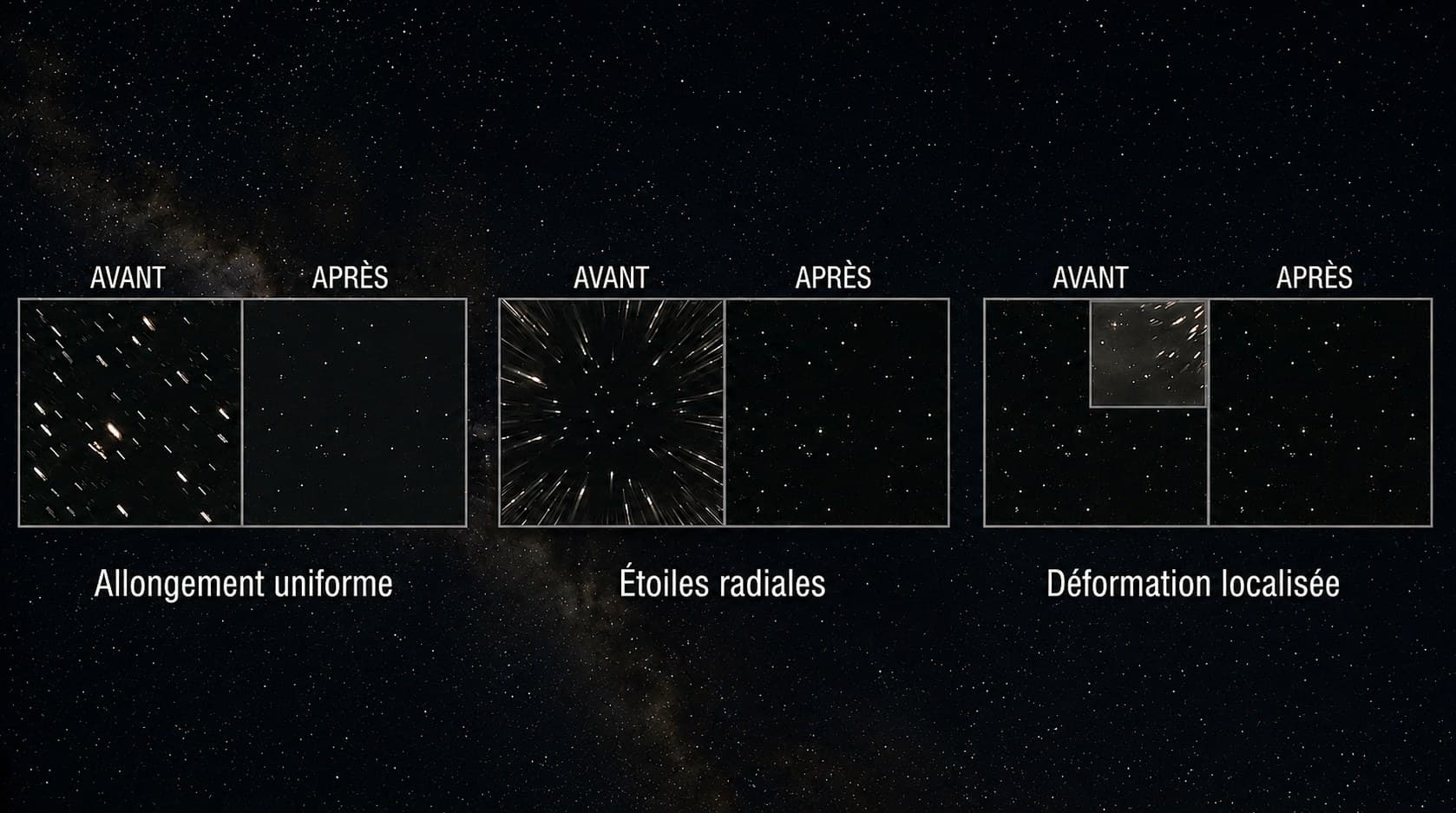
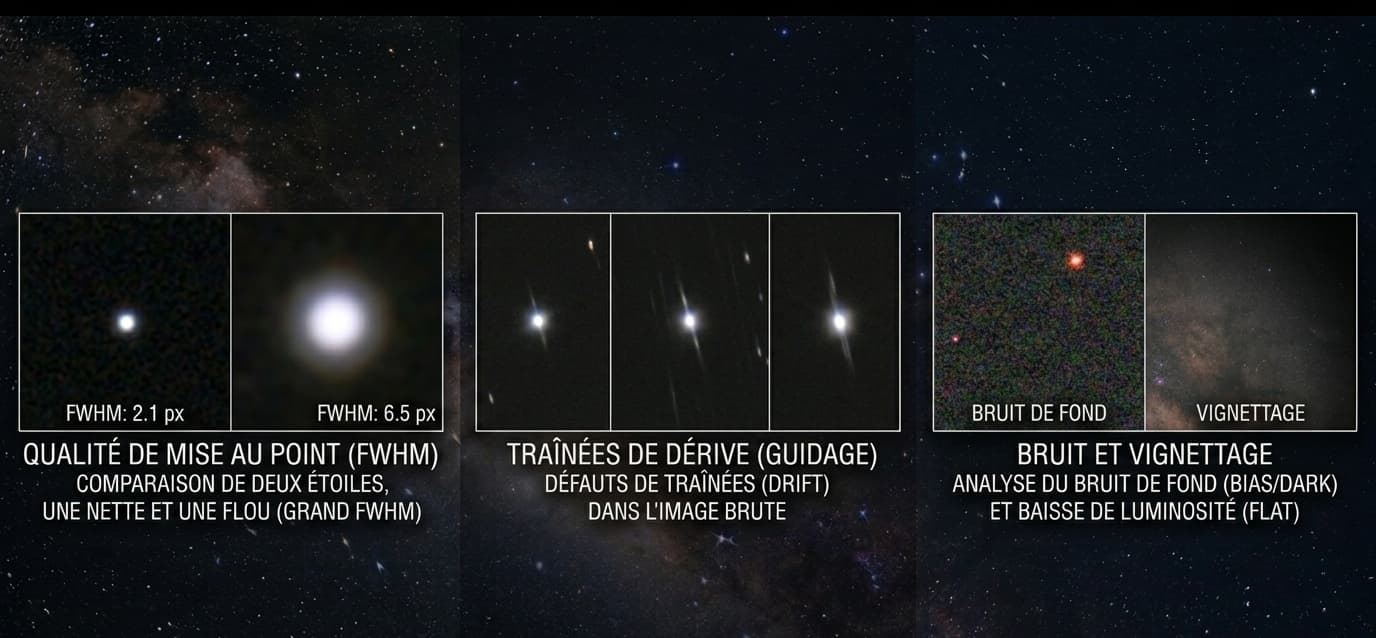
On axis and tracking, this sub is very healthy: the center shows FWHM 4.47/3.49 px (elong 1.28) matching the field floor, and the moderate PA dispersion (31°) with no uniform directional elongation rules out mount drift, PE or guiding oscillation. Tracking over 300s is well controlled.
The single defect is symmetric edge degradation: FWHM goes from 4.47 px at center to ~6 px in the corners (ratio 1.27) with oval stars, elongation up to 1.97 in TL and 1.91 in BL. The symmetric distribution across all four corners, with no pure radial comet shape and no diagonal asymmetry, points to backfocus/field curvature rather than tilt or coma. It is mechanical and fully recoverable with a spacer adjustment.
The sky background matches the target: the +26% variation is real Hα nebulosity confirmed by the DSS, not a gradient or vignetting, so nothing to fix on the calibration side at this stage. The sub is fully usable for stacking.
Priority actions
- Adjust the optical train backfocus (tune the spacer in 0.5-1 mm steps) to tighten the corners
- Re-check corner balance with an aberration inspector after each test
- Keep acquiring to build up signal, since conditions are ideal