Astrophotography diagnosis of IC 1805_askarB: Tracking drift and backfocus error
Raw300s21 août 2026
The Doc examined this image of IC 1805_askarB (raw, 300s). Estimated overall technical quality: 7/10. 2 defects found: Tracking drift (severity 3/5), Backfocus error (severity 2/5).
&w=1920&q=75)
Info
- Cible
- IC 1805_askarB
- Date
- 21 août 2026, 23:18
- Lune
- Croissant décroissant 33.1% (sous l'horizon)
- Site
- Bortle 2 · rural typique (VIIRS)
- Position
- 2h33m03s · +61°31'50"
Excellent conditions, well used. Bortle 2 and the Moon below the horizon (only 33%, 138° from the target): no lunar pollution is possible and the sky background is naturally very dark, confirmed by the background measurement showing no significant oriented gradient (plane amplitude 17% but R2 of 0.1, so no real plane). On an emission target like IC 1805 in Ha you are in the best possible case: you can stack for a long time without fearing gradients, and even consider broadband from this site. Make the most of it by accumulating integration rather than filtering further.
Setup
- Type d'image
- Brut
- Télescope
- EQMod Mount
- Caméra
- ZWO ASI585MM Pro
- Exposition
- 300s
- Phase de lune
- Gibbeuse croissante (64 %)
- FOV
- 3.36°
A coherent setup for the target. At 190mm focal length the 3.36° field fully contains the Heart with Melotte 15 at center and NGC 896 top left, framing is a success. Sampling at 3.15"/px is however clearly undersampled: stars are only 1.8 to 2.7 px FWHM, which makes PSF fitting fragile and leaves little margin against tracking errors. On settings, gain 220 on an ASI585MM is high but consistent for narrowband, offset 15 with no dark clipping (0%) is sufficient, and -20°C is healthy. The background to black point margin of 1.45 is low but that is normal in Ha under Bortle 2: the sky is simply very dark, no need to lengthen the exposure.
The diagnosis in detail
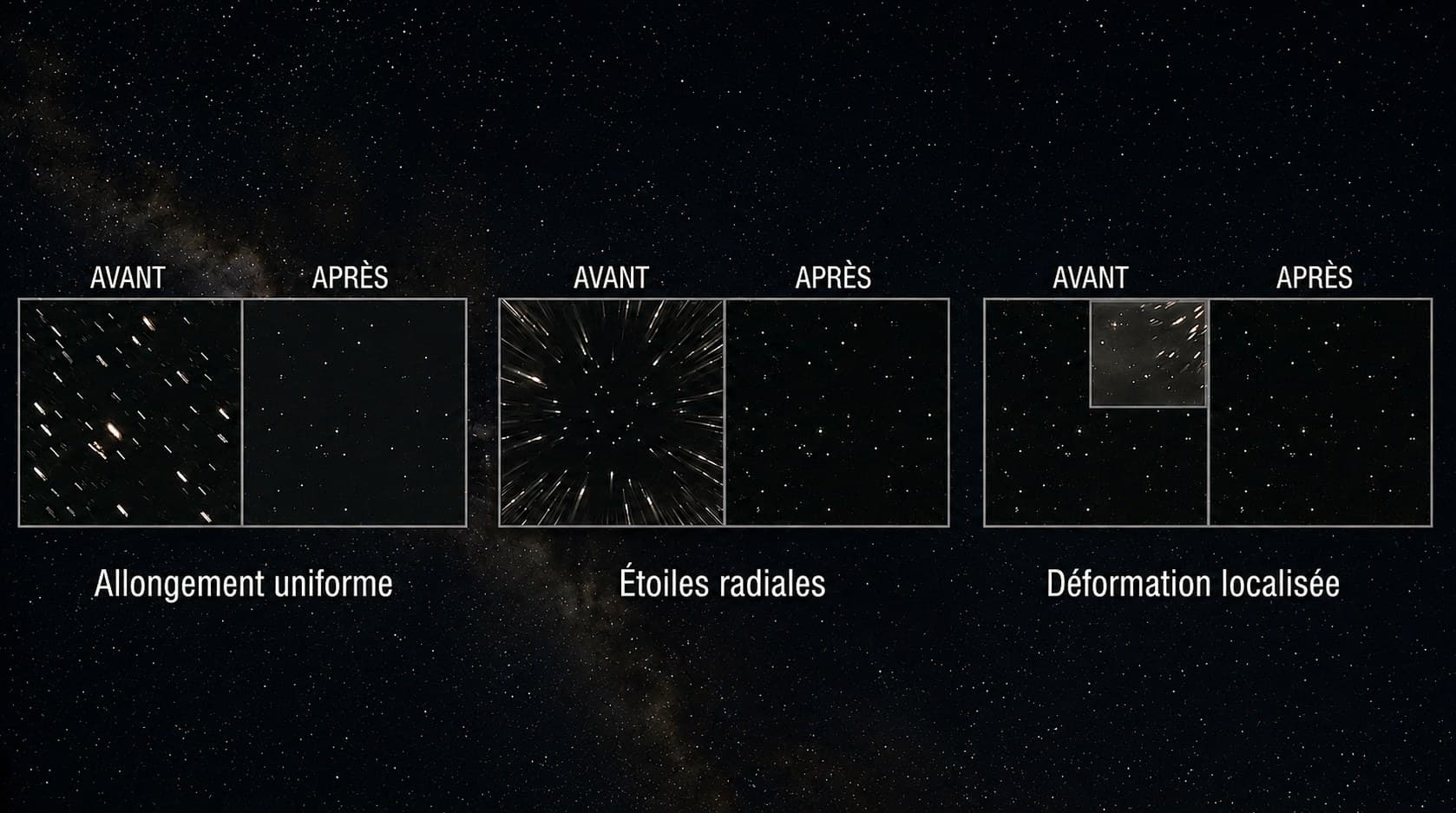
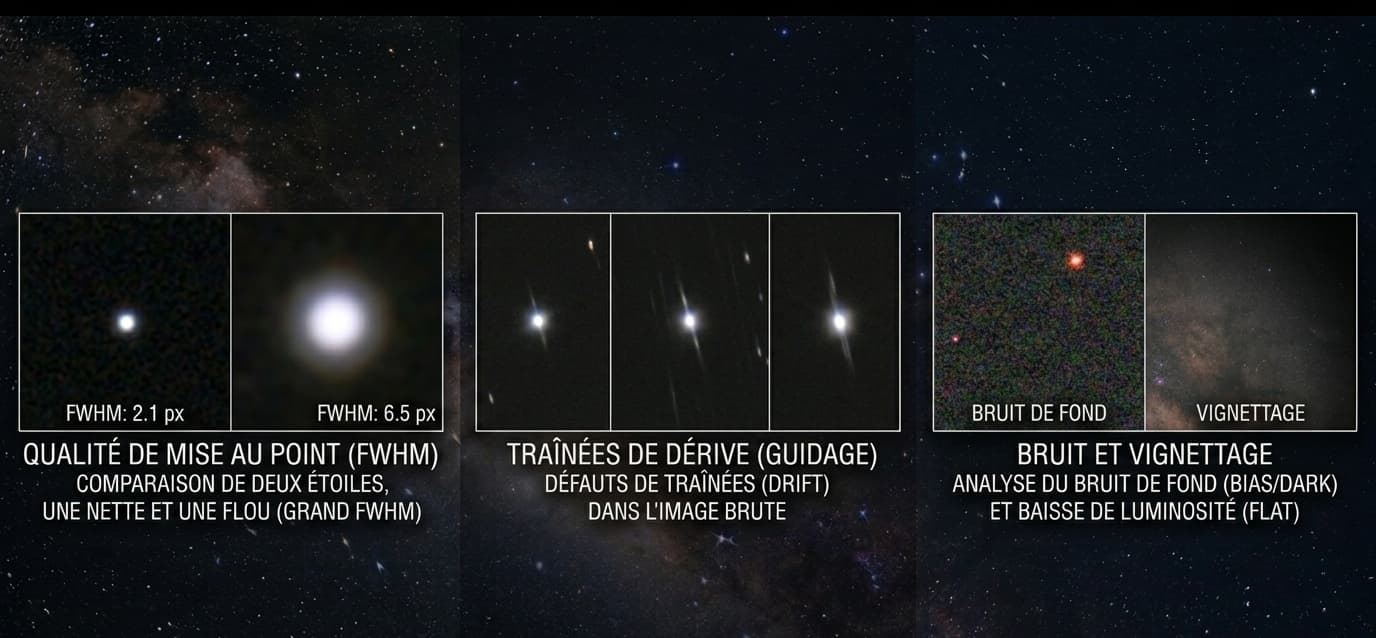
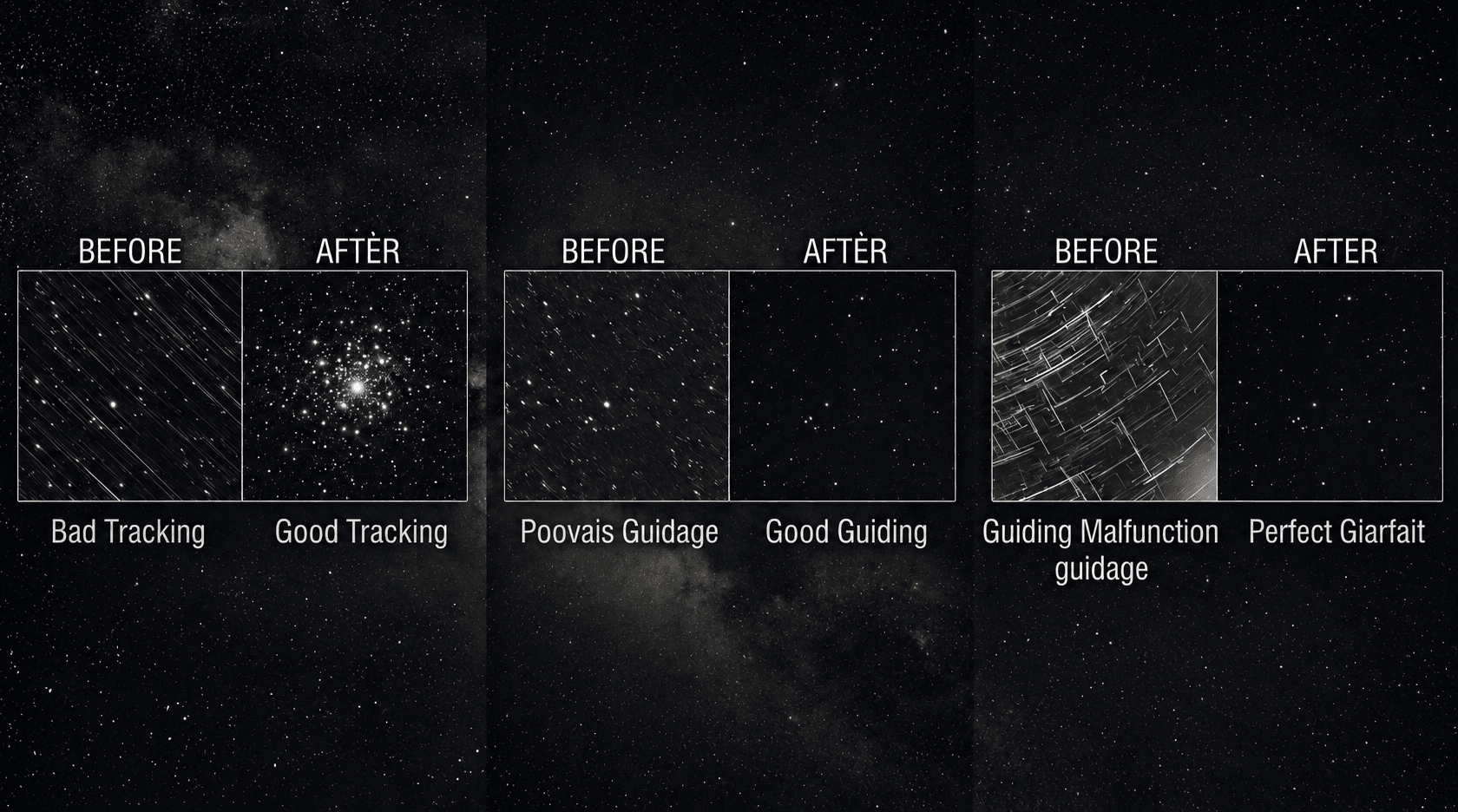
The diagnosis comes down to one dominant cause and one secondary. The measured elongation at field center (1.33 against a 1.28 mono floor) is the key discriminant: a field aberration always leaves the center clean, so whatever deforms stars at center comes from the mount. Direction consistency across all nine zones (PA spread of just 8.3°) confirms steady drift rather than guiding oscillation or a wind gust. Over 300s at 3.15"/px, drift visible despite this undersampling represents several arcseconds of cumulative displacement.
Layered on top is a purely optical component: FWHM goes from 1.81 px at center to 2.2-2.7 px in the corners, a factor of 1.39, spread roughly symmetrically across the four angles. That is the signature of field curvature or imperfect backfocus spacing, not of tilt (corner-to-corner asymmetry stays under 0.10). The right-hand corners are slightly more affected, worth watching but not enough to conclude otherwise.
Otherwise there is nothing to report: the background follows a moderate rotational symmetry with no oriented gradient, no calibration pattern, no pervasive hot pixels or trails, and the nebulosity overlays the DSS exactly.
Priority actions
- Fix tracking first: refine polar alignment then rerun PHD2 autoguiding with the guiding assistant
- Rerun an aberration test after tracking is fixed, to isolate the genuinely optical share of the corner spread
- Adjust backfocus spacing in 0.5 to 1mm steps if the corner FWHM rise persists
- Take advantage of Bortle 2 and no Moon to accumulate a long integration on this target