Astrophotography diagnosis of IC 5070biss: Backfocus error
Raw300s20 juin 2026
The Doc examined this image of IC 5070biss (raw, 300s). Estimated overall technical quality: 6/10. 1 defect found: Backfocus error (severity 3/5).
&w=1920&q=75)
Info
- Cible
- IC 5070biss
- Date
- 20 juin 2026, 00:17
- Lune
- Gibbeuse décroissante 69.9% (sous l'horizon)
- Site
- Bortle 2 · rural typique (VIIRS)
- Position
- 20h51m12s · +43°59'42"
Excellent sky: Bortle 2 and the Moon below the horizon (waning gibbous 69.9% but at 123 and not risen), so no lunar pollution is possible on this sub. The background stays dark (median 0.13, black point 0.06) with a sky/black-point margin e_margin of 2.13, low but perfectly normal for 300s narrowband under such a dark sky: background signal is intrinsically low in narrowband. No reason to push exposure further as long as read noise stays buried; these conditions are ideal for stacking faint signal on IC 5070.
Setup
- Type d'image
- Brut
- Télescope
- EQMod Mount
- Caméra
- ZWO ASI585MM Pro
- Exposition
- 300s
- Phase de lune
- Premier croissant (24 %)
- FOV
- 1.71°
Coherent for the target. At 374 mm focal length the 1.71 field frames the Pelican region well and the 1.6"/px sampling is comfortable, neither over- nor under-sampled under current seeing (center FWHM 3.1 px ~ 2.5", fine). The ASI585MM Pro at -14C is thermally healthy. Gain 252 is high for this camera: the 0.43% saturated pixels come mainly from bright stars, worth watching but acceptable on faint signal. The main hardware lever remains setting the corrector/flattener backfocus to recover sharp corners.
The diagnosis in detail
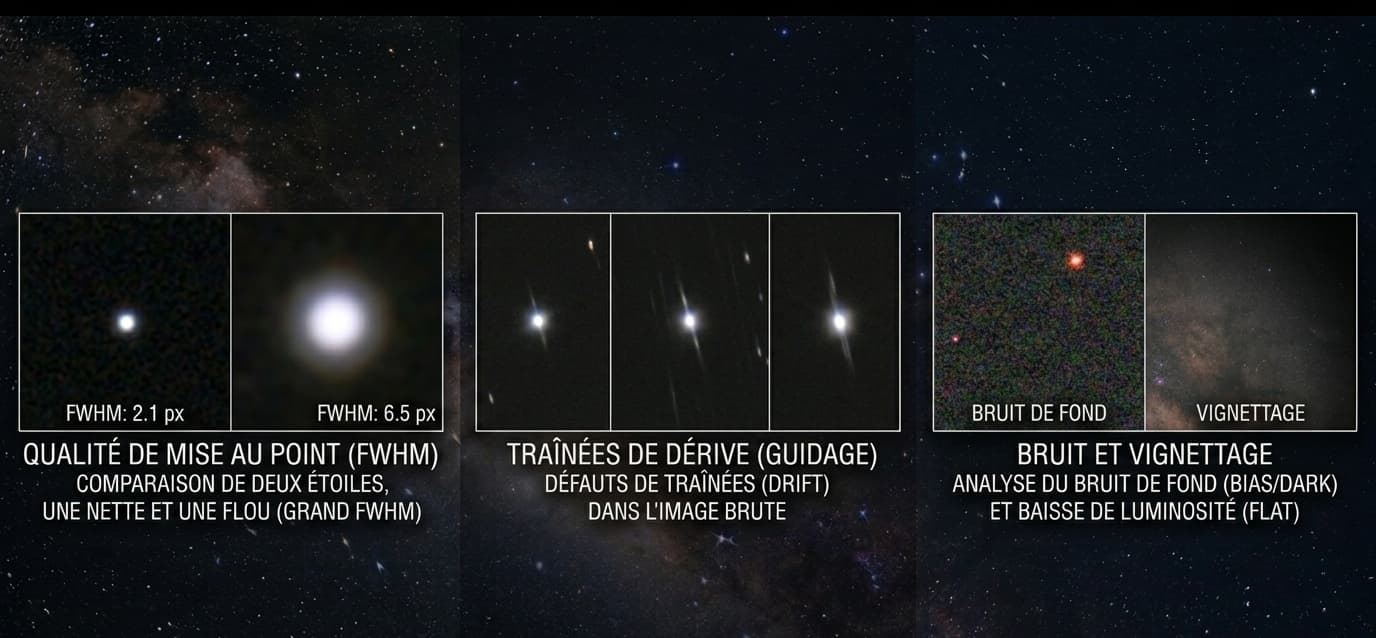
This single sub is technically sound on the essentials. The field core is sharp (FWHM 3.1/2.8 px, elong 1.13 right at the measured floor), and the moderate PA dispersion (32.6) confirms there is no coherent directional elongation: tracking over 300s shows no drift, periodic error, or guiding oscillation. That is a good result for such a long exposure.
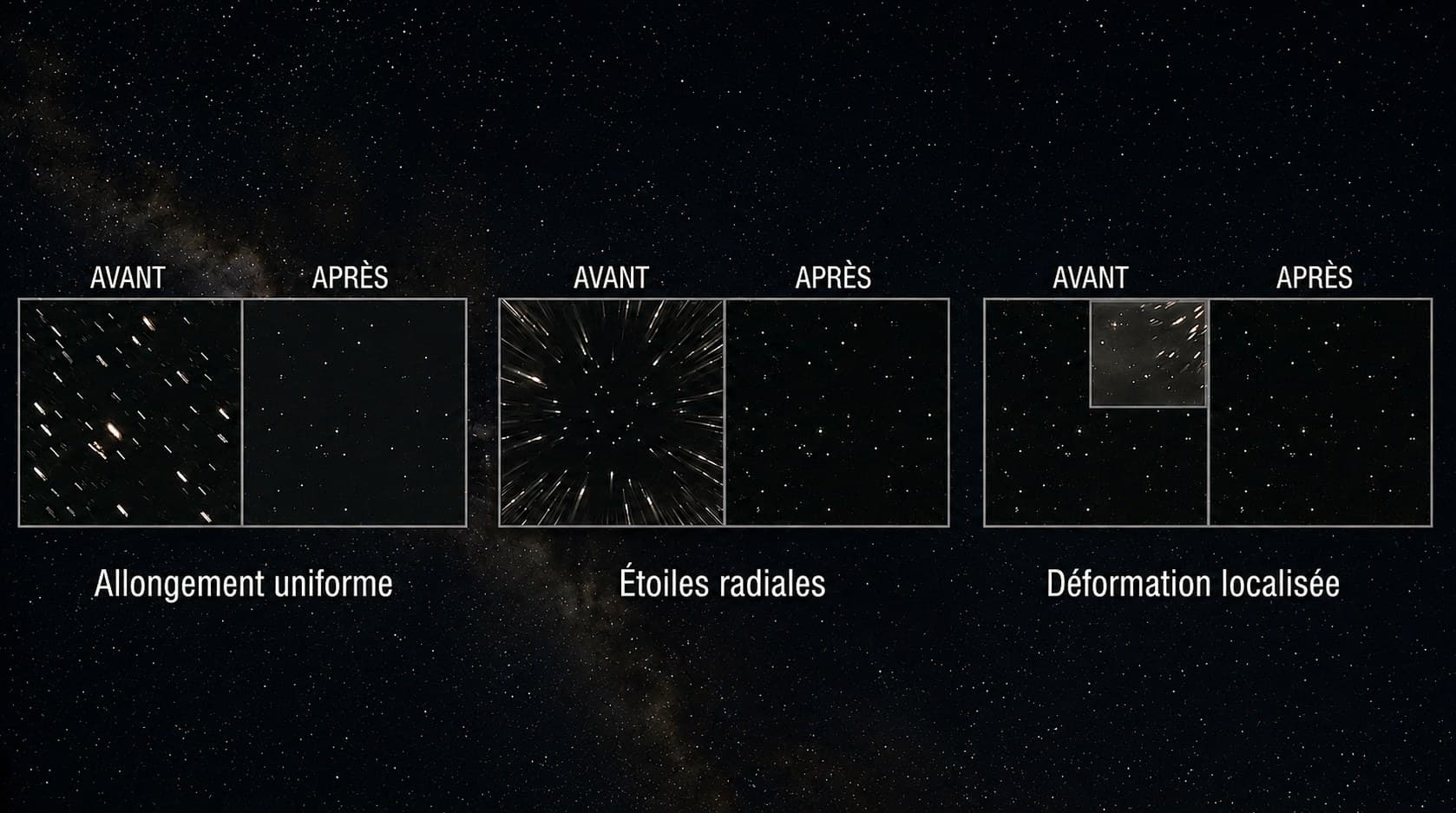
The only real optical defect is field curvature / backfocus error. The diagnosis is unambiguous: elongation and FWHM increase radially and symmetrically at all four corners (elong 1.26 to 1.45, corner/center FWHM ratio 1.565) while the center stays round. The absence of clear diagonal asymmetry rules out tilt, and oval rather than pure comet-shaped stars rule out coma: this is a sensor-to-corrector spacing to adjust.
On sky and calibration, nothing to flag at this stage: the diffuse brownish nebulosity is IC 5070, verified on the DSS, so not a gradient or haze. The edge darkening (+39%) is the normal optical vignetting of a raw sub, which flats will correct. Calibration, color, and processing axes are not assessable here (raw mono, pre-calibration).
Priority actions
- Set the corrector/flattener backfocus (calibrated spacers to nominal distance) to make the corners sharp
- Iterate in tenths of a mm while checking corner elongation on a test sub
- Verify optical train orthogonality to exclude a residual tilt component
- Apply flats at integration to correct the optical edge vignetting