Astrophotography diagnosis of IC 5070biss: Sensor tilt and satellite trail
Raw300s19 juin 2026
The Doc examined this image of IC 5070biss (raw, 300s). Estimated overall technical quality: 6/10. 2 defects found: Sensor tilt (severity 3/5), Satellite trail (severity 1/5).
&w=1920&q=75)
Info
- Cible
- IC 5070biss
- Date
- 19 juin 2026, 23:15
- Lune
- Gibbeuse décroissante 70.4% (sous l'horizon)
- Site
- Bortle 2 · rural typique (VIIRS)
- Position
- 20h51m12s · +43°59'42"
Excellent context: Bortle 2 gives you very dark skies, ideal for the faint diffuse nebulosity of IC 5070. The 70% gibbous Moon is below the horizon and 123 degrees from the target, so no lunar pollution is possible: the low background lift (e_margin 2.14) is not Moon-related. In mono at 300s on an emission region, this low background is expected and not penalizing. Conditions are broadly optimal for stacking deep signal.
Setup
- Type d'image
- Brut
- Télescope
- EQMod Mount
- Caméra
- ZWO ASI585MM Pro
- Exposition
- 300s
- Phase de lune
- Premier croissant (24 %)
- FOV
- 1.71°
Setup is coherent for the target. At 374mm and 1.6"/px the sampling is comfortable and well matched to the seeing: the central FWHM of 3.5px (~5.6") stays decent. The 1.71 degree field frames a portion of the Pelican region, a valid compositional choice. Gain 252 is high for the ASI585 but consistent with a short-focal/300s strategy; watch bright-star saturation. Offset 15 with no dark clipping (0%) and sensor at -14C: healthy settings. The real hardware lever remains correcting the tilt.
The diagnosis in detail
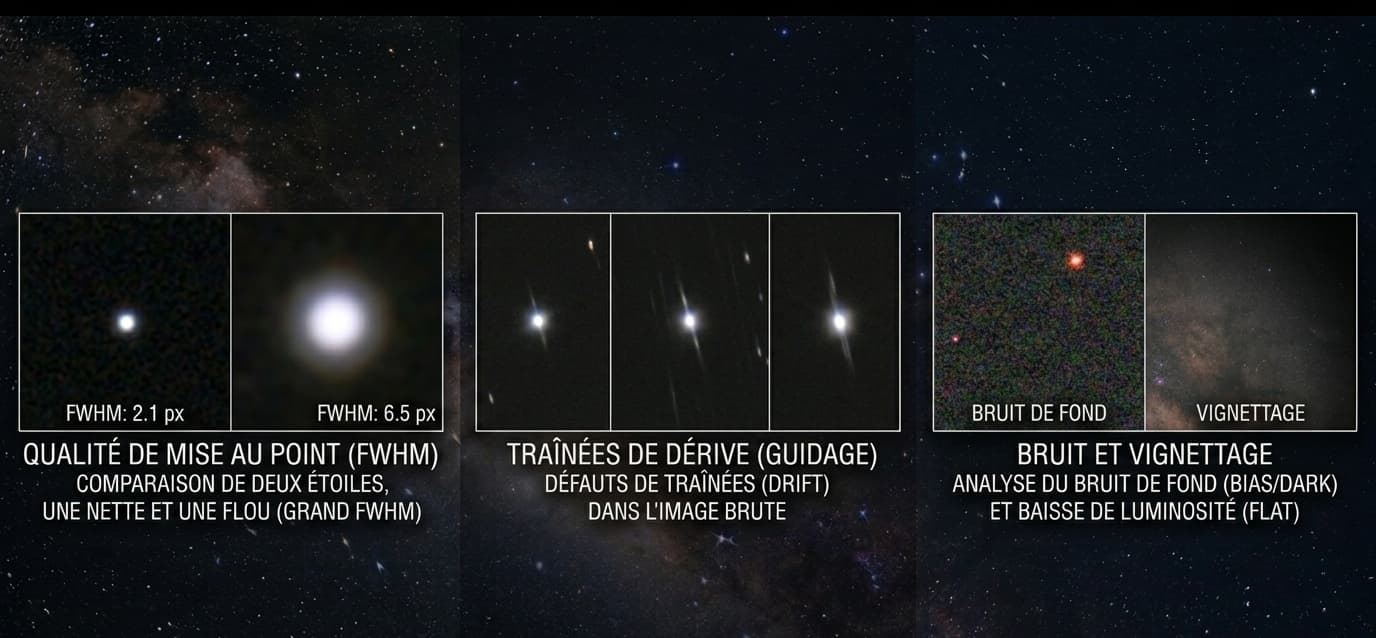
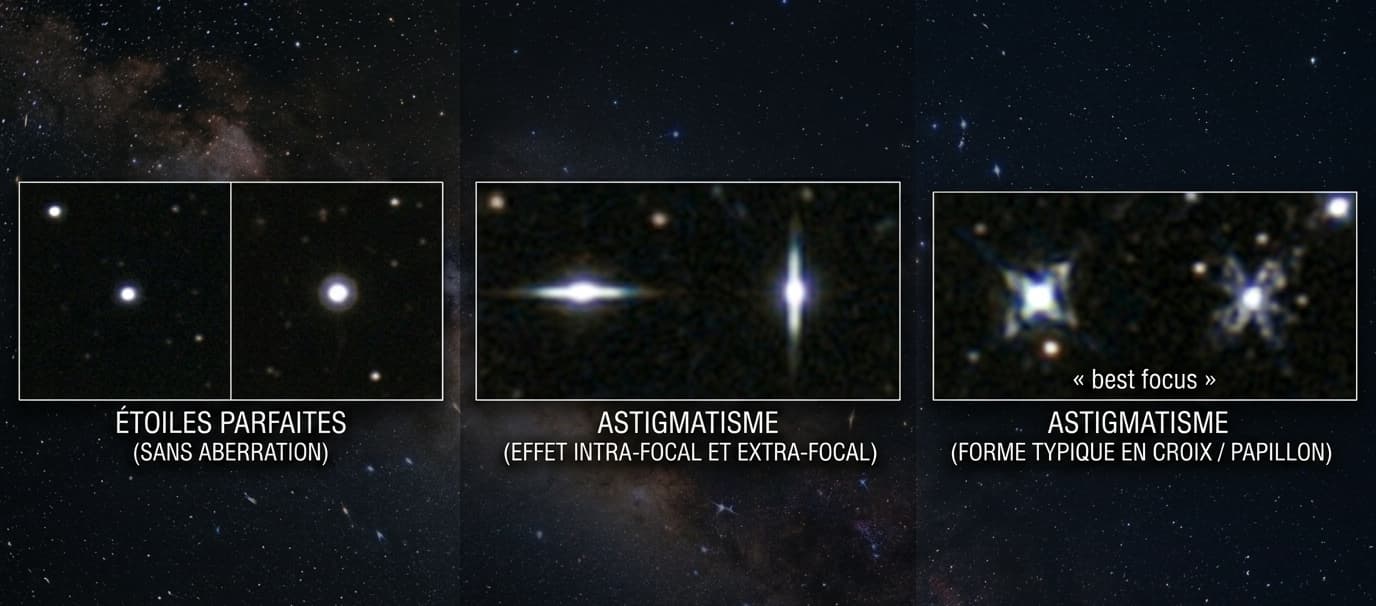
On the tracking/optics side, the PSF panel is unambiguous: the center C is round (elong 1.12, at the field floor 1.11) and the moderate PA dispersion (34 degrees) rules out global mount drift. Tracking is therefore good. However, degradation is distributed asymmetrically: the left edge L (FWHM 5.5, elong 1.31) and the right corners TR/BR stretch markedly while R and BL stay clean. This single-axis asymmetry between opposite zones, with a corner/center ratio of 1.45 and vertical asymmetry (0.185) well above horizontal (0.073), is the signature of a tilted sensor, not symmetric field curvature nor a bad backfocus (which would degrade all 4 corners evenly).
The background map shows a 38% radial falloff (optical vignetting) with no oriented gradient, perfectly normal on a sub before flats: it is not a defect at this stage, your flats will correct it. The low background and the noise of this single sub are expected at 300s in mono; stacking and calibration will resolve them.
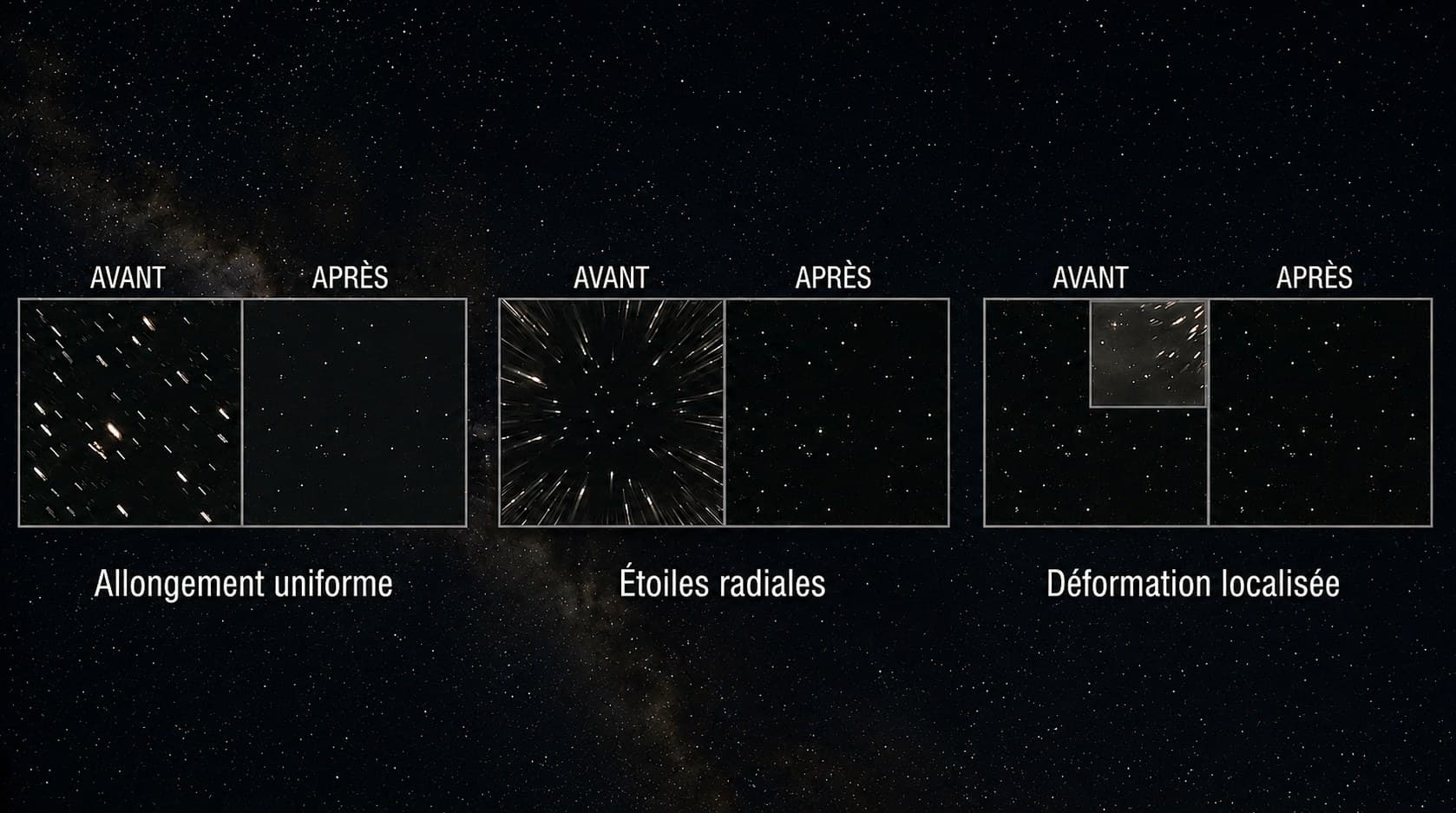
The only contamination is a satellite trail in the top-right corner, removed by statistical rejection once you have enough subs. The clear priority is mechanical: fix the tilt to even out the edges before committing a whole night.
Priority actions
- Correct sensor tilt (equalize FWHM across the 4 corners with a tilt plate, target corner/center ratio < 1.2)
- Shoot a set of flats to correct optical vignetting (38% radial falloff) at integration
- Stack enough subs (10+) so sigma rejection erases the satellite trail and drops the noise