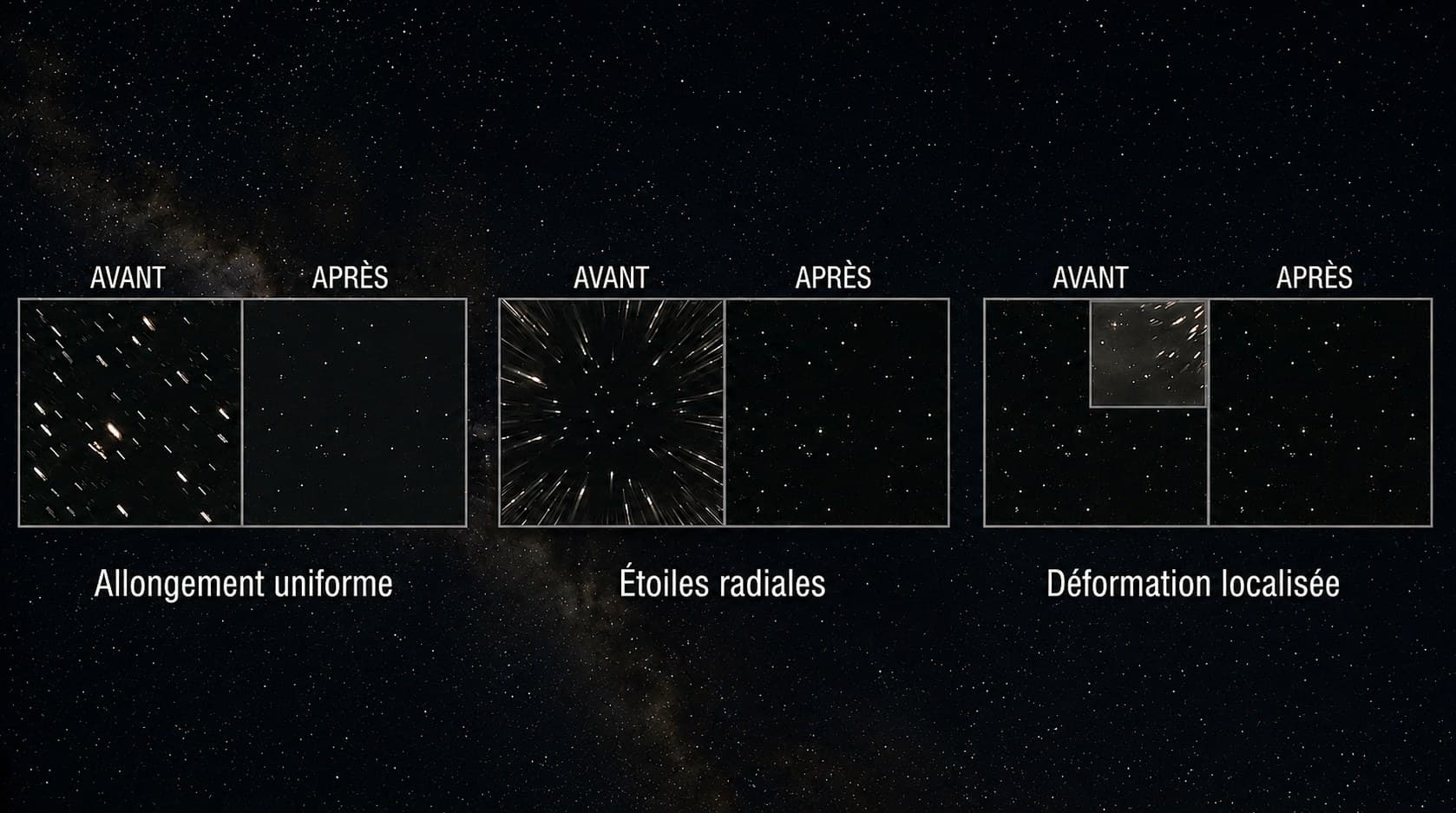
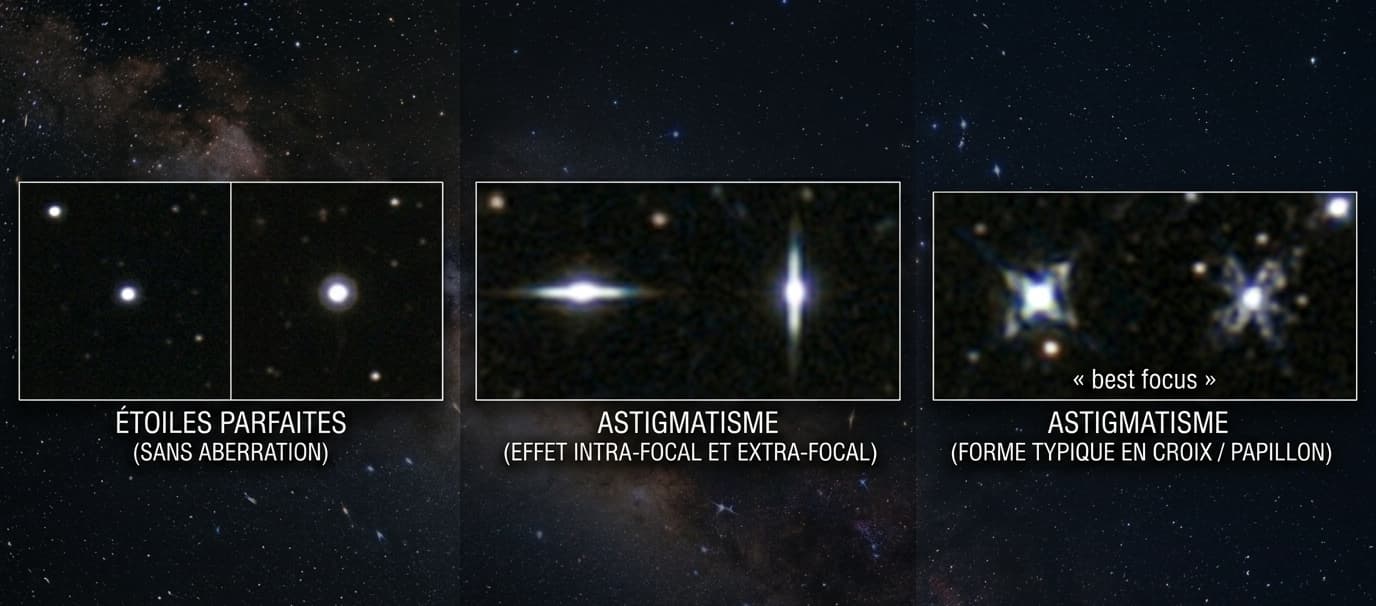
Astrophotography diagnosis of IC1396_Askar50P: Astigmatism
Raw300s13 août 2026
The Doc examined this image of IC1396_Askar50P (raw, 300s). Estimated overall technical quality: 7/10. 1 defect found: Astigmatism (severity 2/5).
&w=1920&q=75)
Info
- Cible
- IC1396_Askar50P
- Date
- 13 août 2026, 21:31
- Lune
- Pleine lune 98.2% (sous l'horizon)
- Site
- Bortle 2 · rural typique (VIIRS)
- Position
- 21h41m21s · +58°09'59"
Excellent conditions. Bortle 2 and the Moon below the horizon despite a 98 % phase, the 113° separation being irrelevant since it lights nothing: no lunar gradient expected, and the background map confirms it (plane amplitude of only 6 %, R² 0.05, so no significant oriented gradient). On IC 1396, an extended Ha emission target, you are in the best possible case: the sky background is dark and most of the signal comes from the nebula itself. You can therefore extend integration without fear of saturating the background, and aim for several hours to bring out the faint extensions of the complex.
Setup
- Type d'image
- Brut
- Télescope
- EQMod Mount
- Caméra
- ZWO ASI585MM Pro
- Exposition
- 300s
- Phase de lune
- Nouvelle lune (0 %)
- FOV
- 3.36°
Setup is coherent in framing, debatable in sampling. At 190 mm focal length, the 3.36° field comfortably encloses IC 1396 with the Elephant Trunk well placed: successful composition. On the other hand, 3.15"/px is heavily undersampled: stars sit at 1.2 to 1.5 px FWHM, below the Nyquist criterion. You lose fine detail and shape measurement becomes unstable, but in exchange you gain signal per pixel, a defensible choice on an extended nebula. On settings, gain 150 on an ASI585MM, offset 15 with no dark clipping and sensor at -13 °C: all healthy. The background-to-black-point margin of 1.69 is low but that is NORMAL in narrowband under Bortle 2 with a very dark sky, do not lengthen exposure for that.
The diagnosis in detail
This sub is well made. Moffat measurements give FWHM between 1.2 and 1.5 px across the nine zones, with a corner/center ratio of 1.00: no radial degradation, hence no field curvature or backfocus error. Tracking holds flawlessly over 300 s, and the 62° PA dispersion indicates incoherent elongation directions from zone to zone, which rules out any drift or periodic error (those would impose a common direction).
The only technical point is the elongation rising at the edges (up to 1.41 at the top) without any FWHM increase, retained as mild field astigmatism. Take it together with the undersampling: at 3.15"/px, a star with 1.3 px FWHM is described by only 2 or 3 pixels, and one extra pixel on one axis is enough to show 1.3 elongation. Confidence therefore stays moderate, and only a measurement on the stacked master, where noise fades, will settle it.
The DSS comparison validates everything else: the dark clouds, globules and trunk structure appear at the same positions in both images. Nothing you see in this background is an artifact.
Priority actions
- Stack the series then re-run the shape measurement on the master to confirm or rule out edge astigmatism
- Check optical train tightening and make sure the filter is not pinched before the next session
- Accumulate several hours of integration: the Bortle 2 sky and absent Moon are an ideal context for IC 1396