Astrophotography diagnosis of NGC 7000: Astigmatism
Raw300s07 juil. 2026
The Doc examined this image of NGC 7000 (raw, 300s). Estimated overall technical quality: 7/10. 1 defect found: Astigmatism (severity 2/5).

Info
- Cible
- NGC 7000
- Date
- 07 juil. 2026, 04:28
- Lune
- Croissant croissant 43.6% (1.4° d'alt., 59.1° de la cible)
- Site
- Bortle 3 · rural peu pollué (VIIRS)
- Position
- 21h01m09s · +44°18'52"
Favorable conditions. Bortle 3 is a quality sky for an emission nebula like NGC 7000, and the Moon at 43.6% sits only 1.4 degrees above the horizon, so its contribution to the background is negligible despite a 59 degree separation. The measurements confirm it: no significant oriented gradient (plane amplitude 5%, R squared 0.02), background falloff is purely radial and therefore optical, not atmospheric. With this sky you can stay broadband on this target without penalty and aim for long integration rather than more aggressive exposures. The 4:28 time slot at the end of the night fits a stable sky.
Setup
- Type d'image
- Brut
- Télescope
- ZWO AM5N
- Caméra
- ZWO ASI533MC Pro
- Exposition
- 300s
- Phase de lune
- Last quarter (48 %)
- FOV
- 2.17°
Coherent combination for this target. At 299mm, the 2.17 degree field frames NGC 7000 in full with the Cygnus Wall well placed, which is the right format. Sampling at 2.594 arcsec/px is strictly undersampled, but that is a deliberate trade on wide field and explains a 2 px FWHM, which leaves no margin for judging star shape finely. On settings: gain 100 (unity on the ASI533) and offset 70 are sound, though 1.7% dark clipping suggests you could raise the offset a bit. The background to black point margin of 1.89 shows a weakly sky-limited exposure, logical in Bortle 3 broadband; 300s remains appropriate, no need to lengthen. Sensor at -5C: going to -10C would further reduce dark current.
The diagnosis in detail
The main finding is positive: on a single 300s sub, stars hold a FWHM of 1.9 to 2.3 px across every zone, with a corner/center ratio of 0.995, meaning no radial degradation at all. That points to an imaging train well set in backfocus and an AM5N mount doing its job, with no readable drift or oscillation.
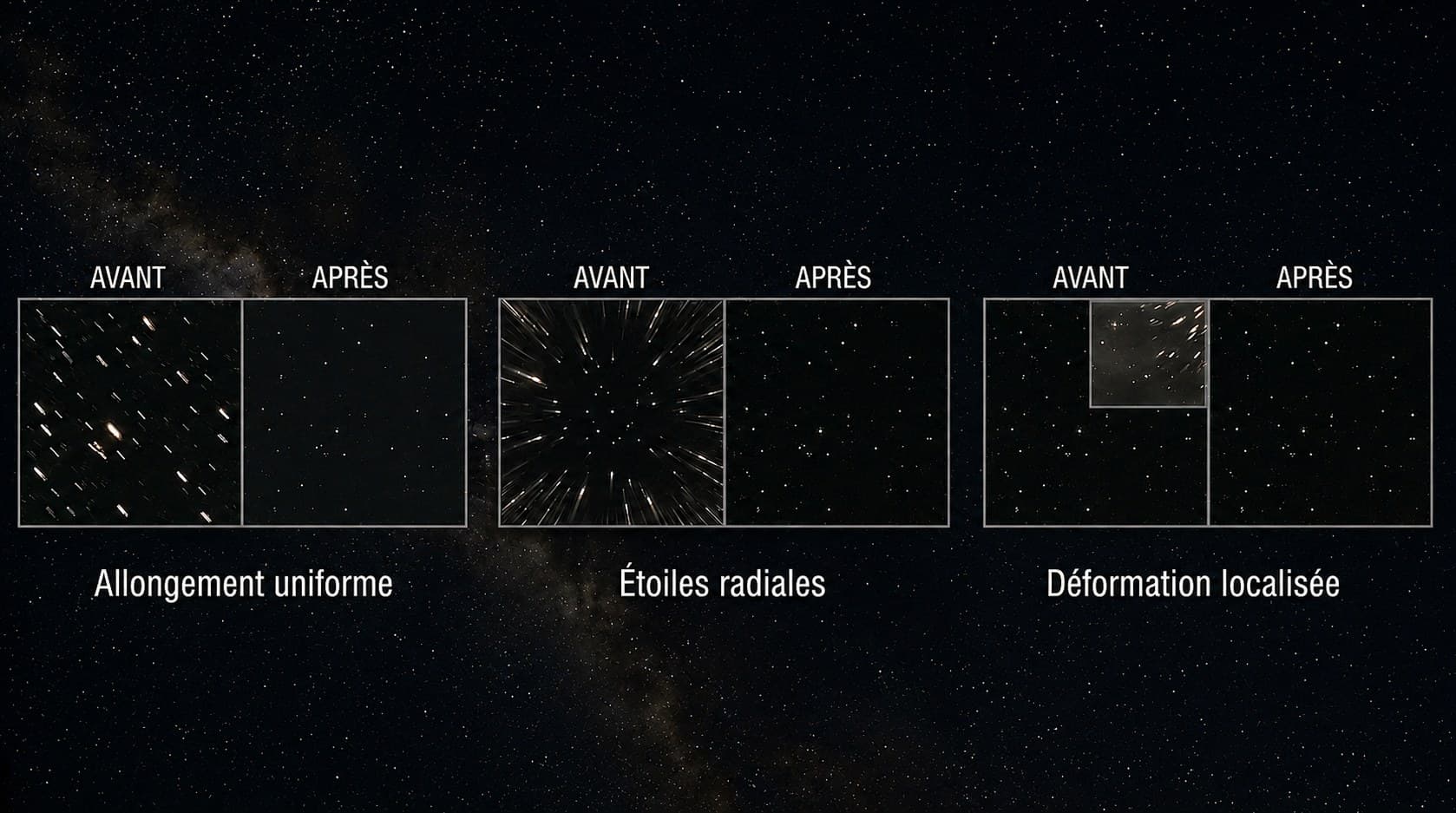
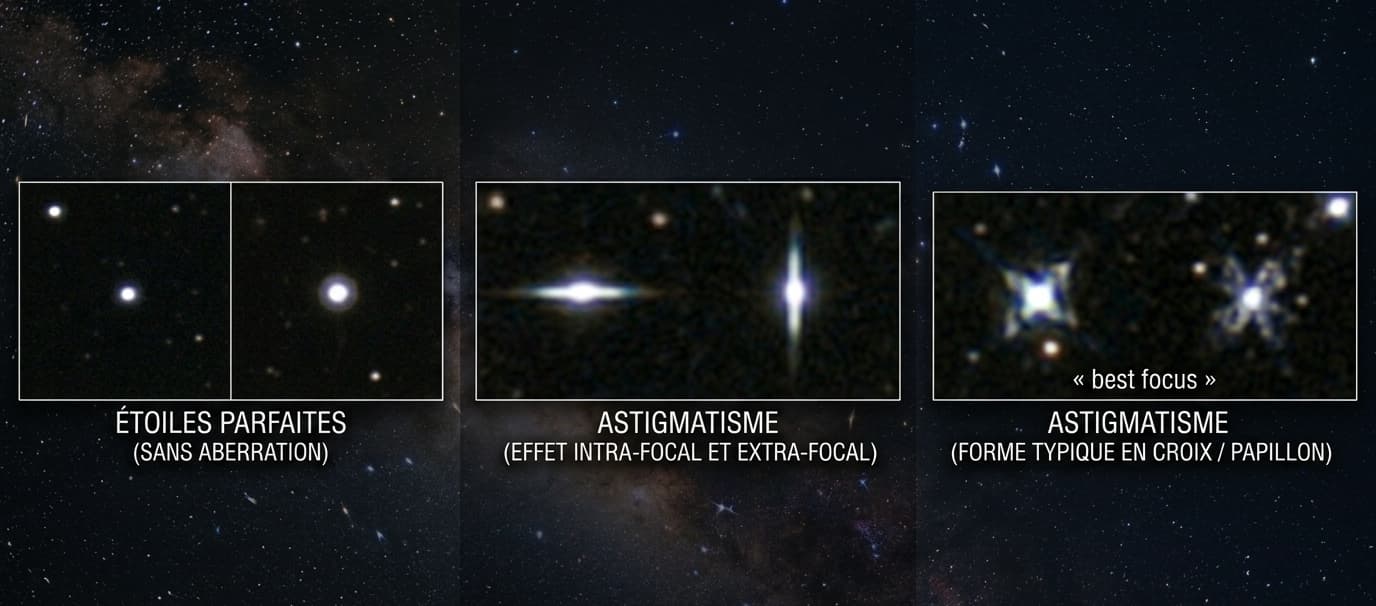
The point to watch is elongation. It rises at the edges and in two corners (1.42 to 1.53) while FWHM stays flat, and position angles scatter over 35 degrees. This decoupling of elongation from FWHM, with orientations rotating from zone to zone, is typical of field astigmatism rather than field curvature or coma. The center itself sits at 1.34 against a floor of 1.11, so part of that stretch is present on axis, which points more toward mechanical strain in the train than a pure edge aberration. I did not retain the tilt proposed at 39%: it lacks the clear diagonal asymmetry between opposite corners that characterizes it.
At 2.6 arcsec/px the effect stays subtle and stacking many subs will partly smooth it. It is not a blocker for this session.
Priority actions
- Check corrector backfocus with calibrated spacers and confirm no filter or adapter is pinched
- Raise offset from 70 to around 90 to remove the 1.7% dark clipping
- Lower the cooling setpoint to -10C to reduce dark current
- Keep accumulating broadband integration, the Bortle 3 sky and low Moon impose no filter constraint here