Astrophotography diagnosis of LDN43: Backfocus error and tracking drift
Raw300s17 sept. 2026
The Doc examined this image of LDN43 (raw, 300s). Estimated overall technical quality: 5/10. 2 defects found: Backfocus error (severity 3/5), Tracking drift (severity 2/5).

Info
- Cible
- LDN43
- Date
- 17 sept. 2026, 11:17
- Lune
- Gibbeuse décroissante 63.7% (35.1° d'alt., 11.4° de la cible)
- Site
- Bortle 8 · centre-ville (saisi)
- Position
- 16h35m20s · -15°32'05"
Clearly unfavorable conditions for this target. LDN 43 is a dark nebula: its whole appeal rests on the contrast between dust and the stellar background, hence on sky background level. You are under Bortle 8 with a 63.7% gibbous Moon 35.1 degrees above the horizon and, worse, only 11.4 degrees from the target. That is the worst case: the lunar halo lands straight on the field and crushes the very contrast you are after. No filter saves this, an absorption nebula works in broadband. The measured background margin (e_margin 2.6) confirms an already raised background. The right call is to move this target to a Moon-free slot, late in a waning lunation or at new Moon.
Setup
- Type d'image
- Brut
- Télescope
- ZWO FF130
- Caméra
- ZWO ASI2600MC Pro
- Monture
- ZWO AM5N
- Exposition
- 300s
- Phase de lune
- Waxing crescent (29 %)
- FOV
- 1.35°
The setup is mechanically coherent but poorly matched to LDN 43. At 994 mm and 0.78 arcsec/px you are oversampled relative to typical seeing: the 2.63 px central FWHM works out to about 2 arcsec, so you pay in signal per pixel what you do not gain in resolution. A 1.35 degree field is also very tight for an extended dust region like this one; a shorter focal length, or software 2x2 binning, would give better return. On settings, gain 100 (unity) and offset 50 are healthy, with no dark clipping and no saturation. The sensor temperature at 0 C is high for an ASI2600MC Pro though: go down to -10 C to cut dark current and keep the dark library reliable.
The diagnosis in detail
Two distinct signatures overlap on this frame, and the PSF panel separates them cleanly. The first is optical: FWHM is minimal at center (2.63 px) and rises almost identically across the eight peripheral zones, between 3.70 and 4.26 px. This rotational symmetry, with no diagonal asymmetry between opposite corners and no radial comet-shaped stars, rules out both tilt and coma and points to a backfocus error or residual field curvature. The 1.57 ratio is well above the 1.25 threshold: this is the first thing to fix, and it is fixable simply with spacers.
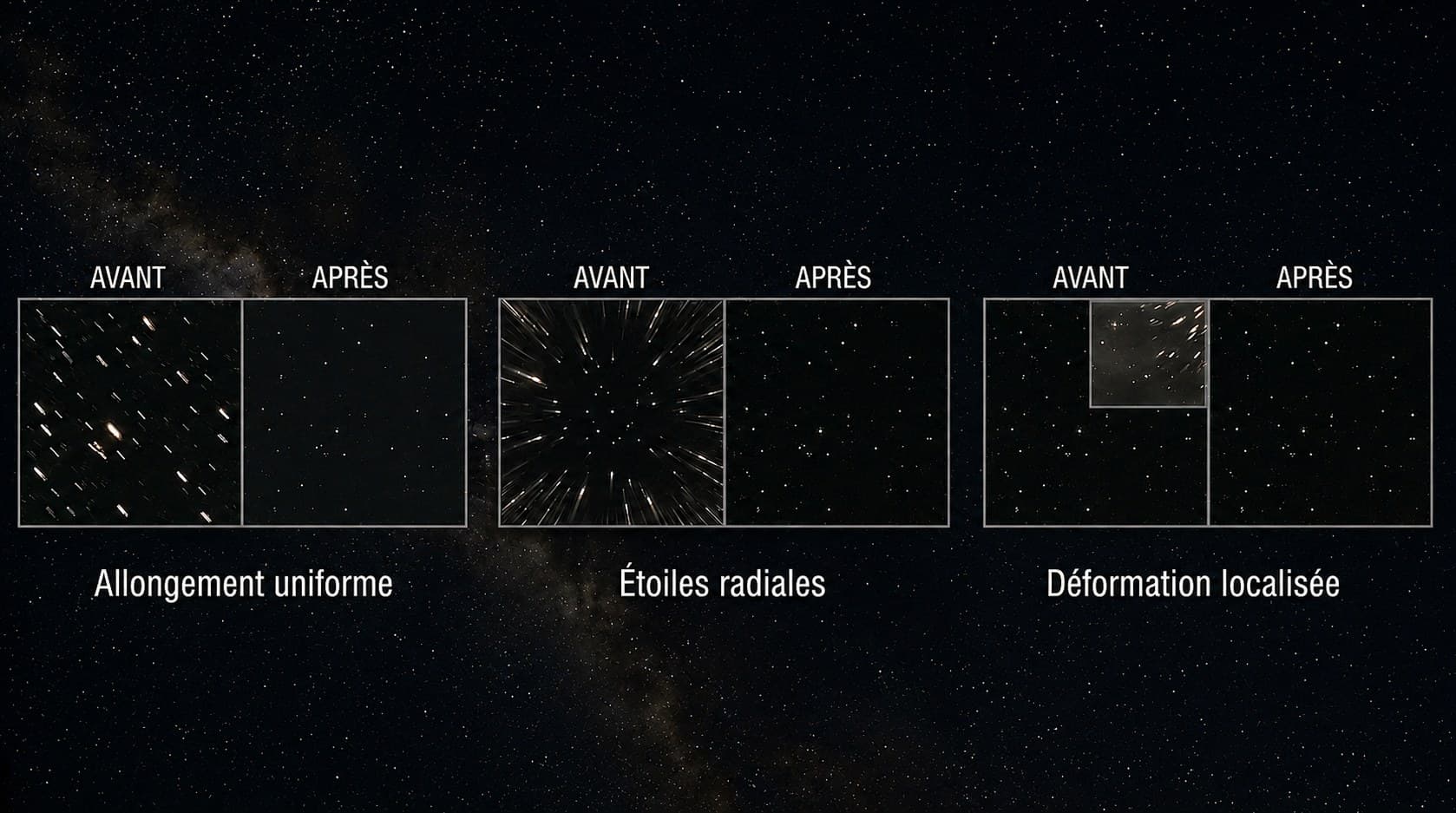
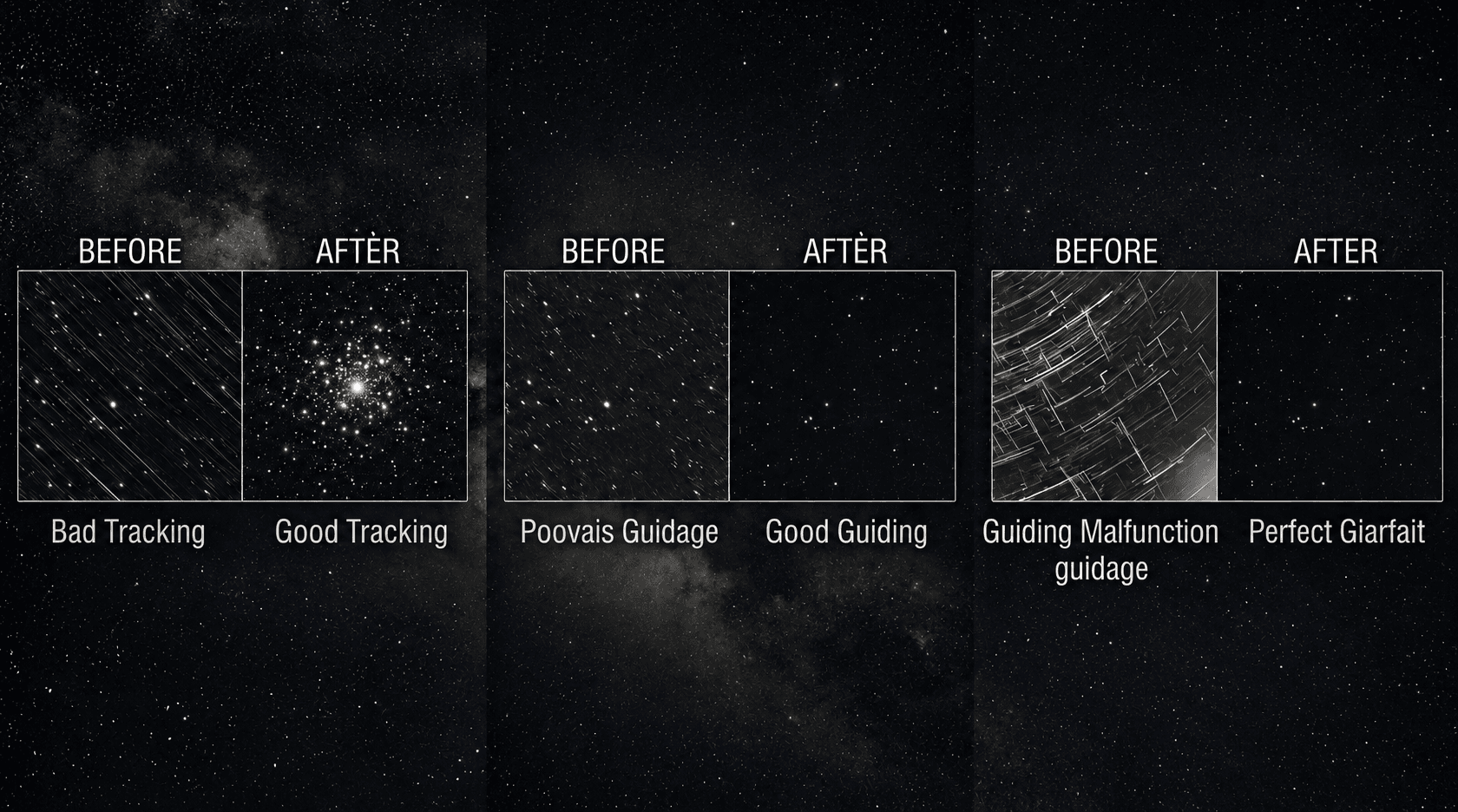
The second is mechanical: the 1.16 elongation measured at center exceeds the field floor (1.10), with position angles clustered within 6.5 degrees across all nine zones. A deformation present at center and uniformly oriented cannot come from field optics, it comes from tracking over the 300 s exposure. The amplitude stays modest, hence the limited severity, but at 0.78 arcsec/px the slightest guiding flaw shows up immediately.
Everything else is healthy: no clipping, no saturation, a clean background with no structured noise pattern, no satellite trail. The real limiting factor on this frame is not technical but contextual, it is the Moon 11.4 degrees from a dark nebula.
Priority actions
- Reschedule LDN 43 away from the Moon: at 11.4 degrees from a 63.7% Moon, a dark nebula's contrast is lost before you start
- Check and adjust the FF130 corrector backfocus with fine spacers until the corner/center FWHM ratio drops below 1.25
- Review polar alignment and guiding graphs, targeting a total RMS under 0.6 arcsec at 0.78 arcsec/px
- Lower the camera cooling setpoint to -10 C instead of 0 C
- Consider a shorter focal length or 2x2 binning to better cover this extended dust region