Astrophotography diagnosis of Horsehead and Flame Nebula: Backfocus error, residual vignetting and 1 other
ProcessedL60x60s21 janv. 2025
The Doc examined this image of Horsehead and Flame Nebula (processed, L, 60x60s). Estimated overall technical quality: 7/10. 3 defects found: Backfocus error (severity 2/5), Residual vignetting (severity 2/5), Clipped stars (severity 2/5).
&w=1920&q=75)
Info
- Cible
- Horsehead and Flame Nebula
- Date
- 21 janv. 2025, 00:00
- Position
- 5h40m58s · -2°27'36"
Moon at 30% on 01/21: moderate impact on this largely Ha emission target, the background stays controlled and lunar glow is not the limiting factor here. The Orion B region is rich and red IC 434 stands out well despite partial moonlight. No moon-oriented gradient is diagnosed (plane at 8%, R²=0.03, negligible). To push the faint blue reflection nebulosity around Alnitak and NGC 2023, a moonless night would improve contrast, but the current result is fully acceptable.
Setup
- Type d'image
- Traitée
- Télescope
- Sky-Watcher Evoguide 50ED
- Caméra
- ZWO ASI585MC
- Filtre
- L
- Monture
- Sky-Watcher HEQ5 PRO
- Exposition
- 60x60s
- Phase de lune
- 30%
- Notes
- Logiciels : PixInsight, ASIAIR
- FOV
- 2.50°
The Evoguide 50ED (242 mm focal length) with the ASI585MC gives a 2.5° field that comfortably frames the Flame, the Horsehead and NGC 2023/2024 in the same view, a coherent and well-composed match. Sampling is generous (undersampled at this short focal length), but the HEQ5 tracks it perfectly (FWHM ~1.5 px, low elongation). The 1.31 corner/center FWHM ratio suggests optimizing the corrector backfocus distance to flatten the field across the whole sensor. The broadband L filter suits this emission + reflection mix.
The diagnosis in detail
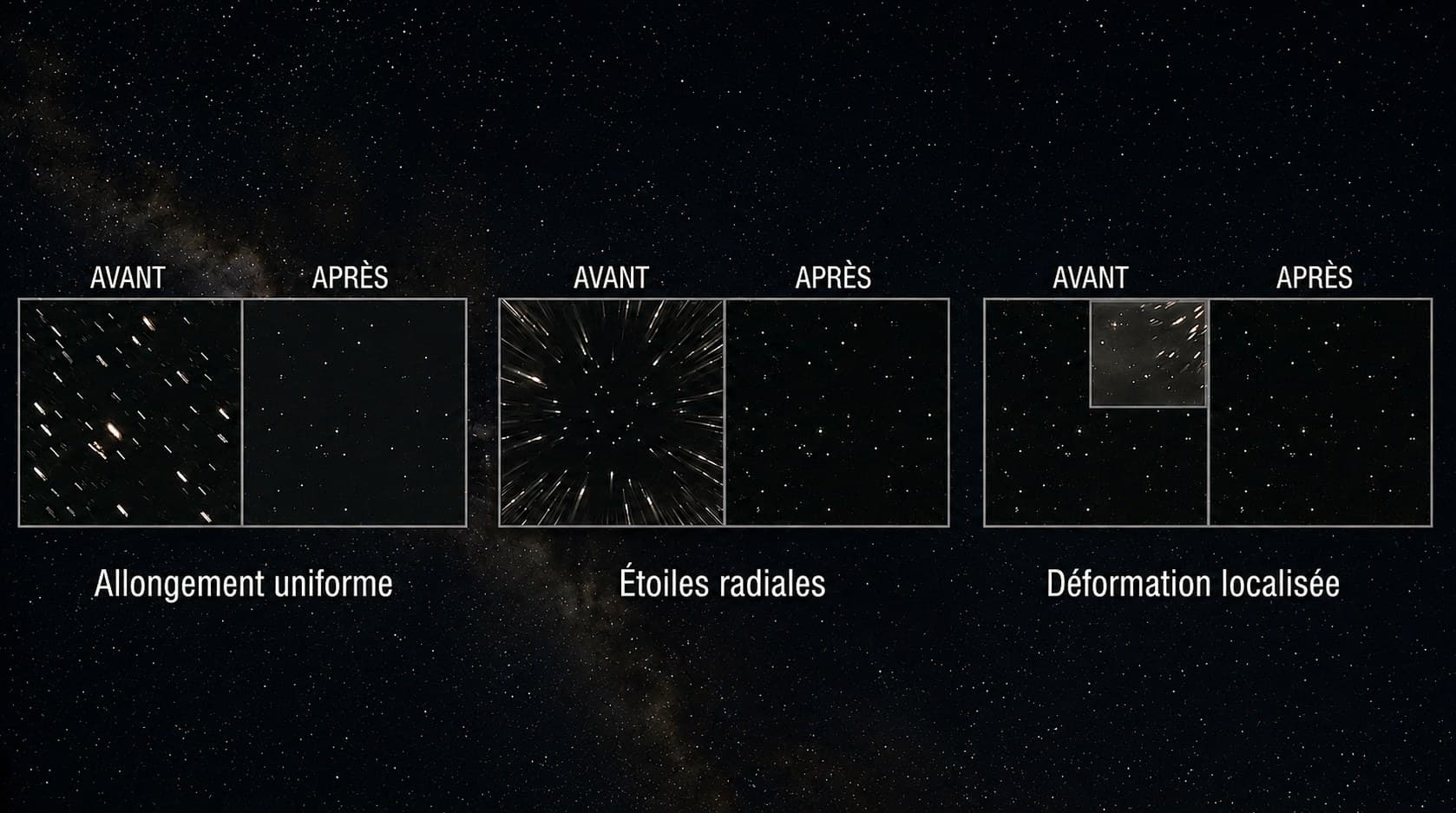
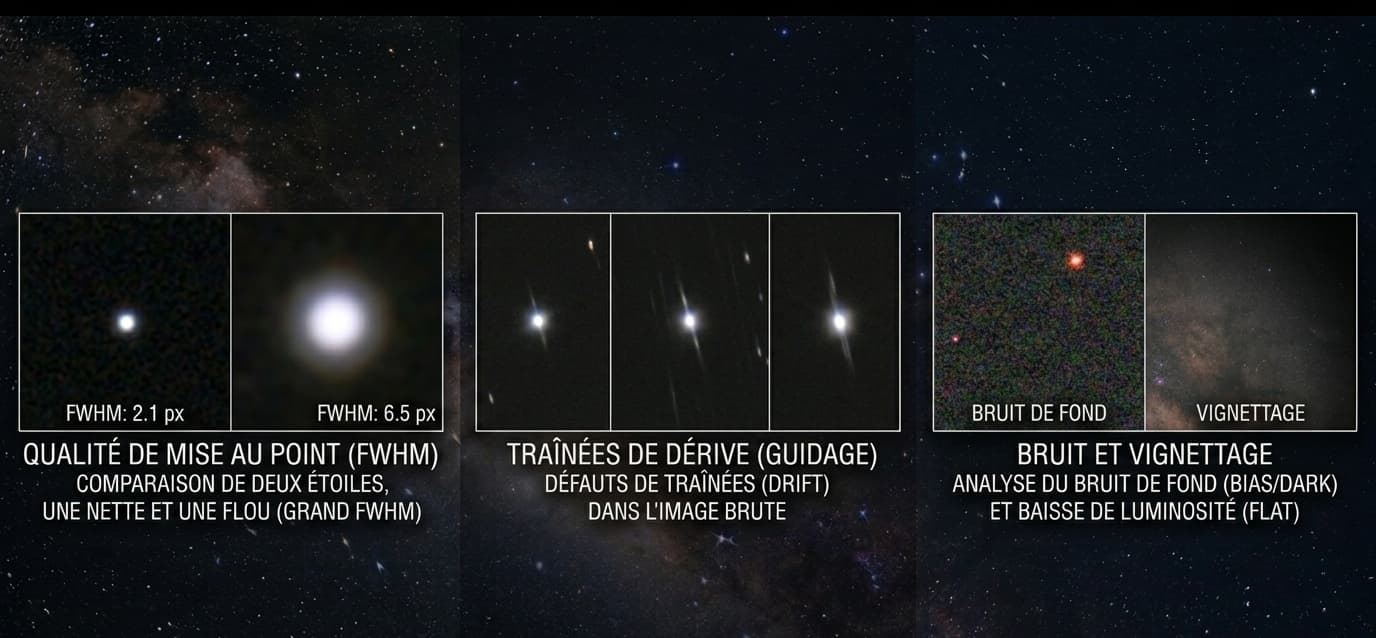
Baseline quality is solid: the PSF panel shows a sharp center (FWHM 1.48/1.26 px, elong 1.18) and a 32° PA dispersion with near-zero FWHM asymmetry (H 0.024, V 0.038), ruling out tilt and tracking as issues. The HEQ5 tracking is excellent, with no coherent directional elongation. The only optical defect is a symmetric radial broadening in all four corners (corner/center ratio 1.31), the classic signature of field curvature or a slightly off backfocus, fixable with spacing.
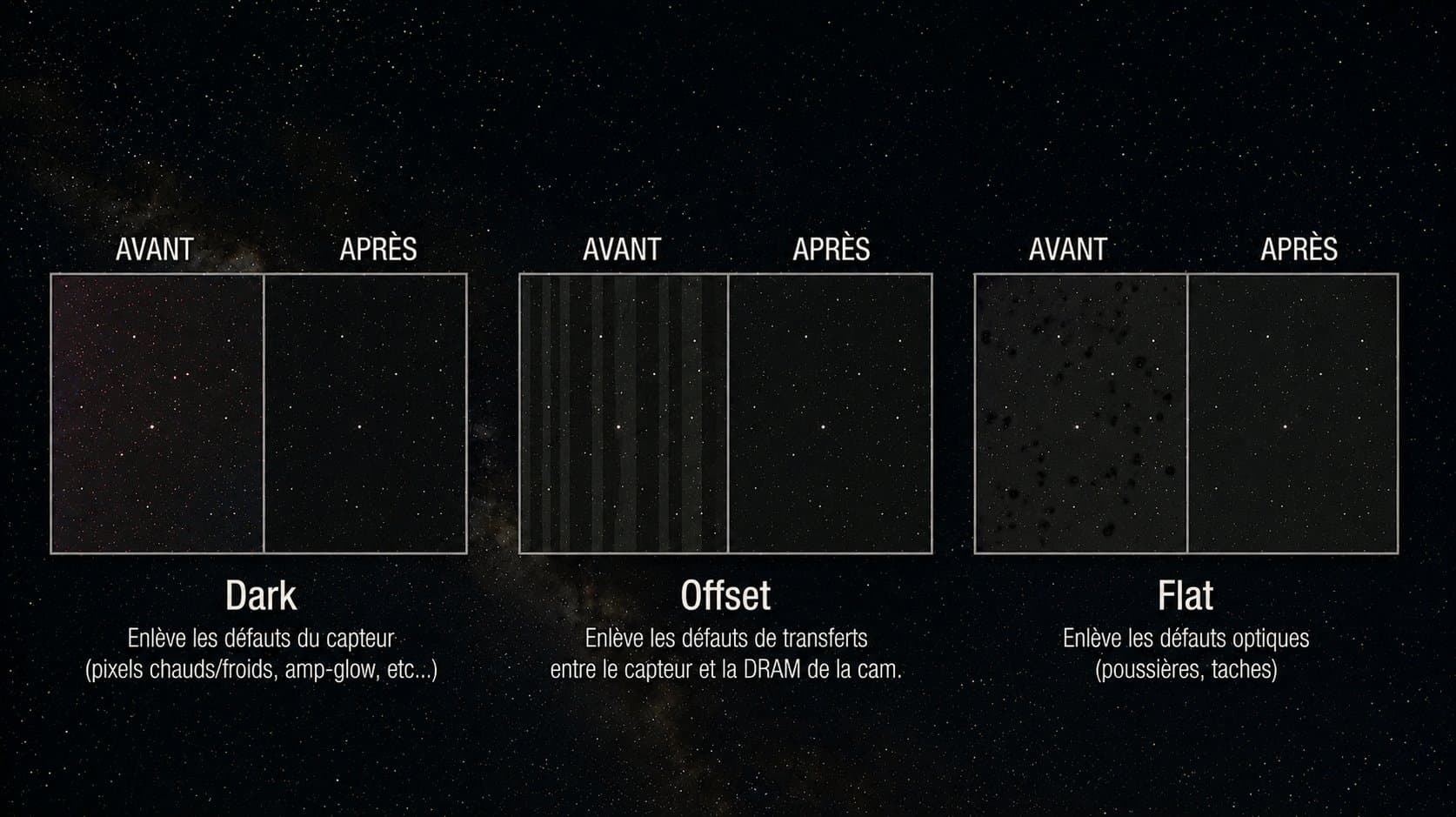
On calibration, the background map measures a pure 45% radial falloff (R²=0.87, anisotropy 0.04), residual vignetting left uncorrected by a flat. This is the most visible flaw on the final image; a clean flat or a background removal will erase it. The oriented plane (8%, R²=0.03) is negligible, not a pollution gradient.
Processing is broadly successful: the red Ha nebulosity (IC 434) and the brown dust of NGC 2024 are real and confirmed by the DSS. A few bright stars like Alnitak have neutral-white clipped cores, with diffraction spikes added in post (aesthetic choice). Worth masking to recover some stellar color.
Priority actions
- Reshoot flats matched to the optical train to remove the 45% residual vignetting
- Adjust the corrector backfocus distance in steps to flatten the corners (target corner/center ratio < 1.15)
- Mask stars during stretch to limit clipping of bright cores like Alnitak