Astrophotography diagnosis of C27 Crescent nebula: Residual vignetting, backfocus error and 1 other
ProcessedHa, OIII, SIIHa 40×300s · OIII 44×300s · SII 44×300s (total ~10.7 h)01 juil. 2026
The Doc examined this image of C27 Crescent nebula (processed, Ha, OIII, SII, Ha 40×300s · OIII 44×300s · SII 44×300s (total ~10.7 h)). Estimated overall technical quality: 7/10. 3 defects found: Residual vignetting (severity 2/5), Backfocus error (severity 2/5), Clipped stars (severity 1/5).
&w=1920&q=75)
Info
- Cible
- C27 Crescent nebula
- Date
- 01 juil. 2026, 00:00
- Site
- Bortle 8 · centre-ville (saisi)
- Position
- 20h11m60s · +38°21'00"
In Bortle 8, choosing narrowband (Ha/OIII/SII) is the right strategy: the Crescent's emission lines come through despite heavy light pollution, and the result proves it with a clean background and good contrast on the filaments. On an emission target like NGC 6888 this very polluted sky is not a major handicap; it would be on broadband RGB or a galaxy. The 10.7h split evenly across three filters give a comfortable SNR. Nothing to fault on the conditions side: narrowband absorbs most of the urban constraint.
Setup
- Type d'image
- Traitée
- Télescope
- Sky-Watcher Black Diamond 200/800
- Caméra
- ZWO ASI294MM Pro
- Filtre
- Ha, OIII, SII
- Monture
- Sky-Watcher HEQ5 PRO
- Exposition
- Ha 40×300s · OIII 44×300s · SII 44×300s (total ~10.7 h)
- Notes
- PixInsight, BlurXTerminator, NoiseXTerminator, StarXTerminator, Nighttime Imaging 'N' Astronomy (N.I.N.A. / NINA), GraXpert
- FOV
- 1.00°
The 200/800 f/4 Newtonian with ASI294MM Pro (2.3µm) samples around 0.6"/px, formally oversampled, but the measured FWHM ~2.4px stays healthy and usable, especially with BlurX tightening things. The 1.0° field frames the Crescent well with room for the surrounding IFN: successful composition. The sensitive point of an f/4 Newtonian is the coma corrector backfocus: the measurements show a slight symmetric FWHM rise at the edges, to refine in 0.5-1mm steps. The flats deserve more care to erase the 27% residual vignetting.
The diagnosis in detail
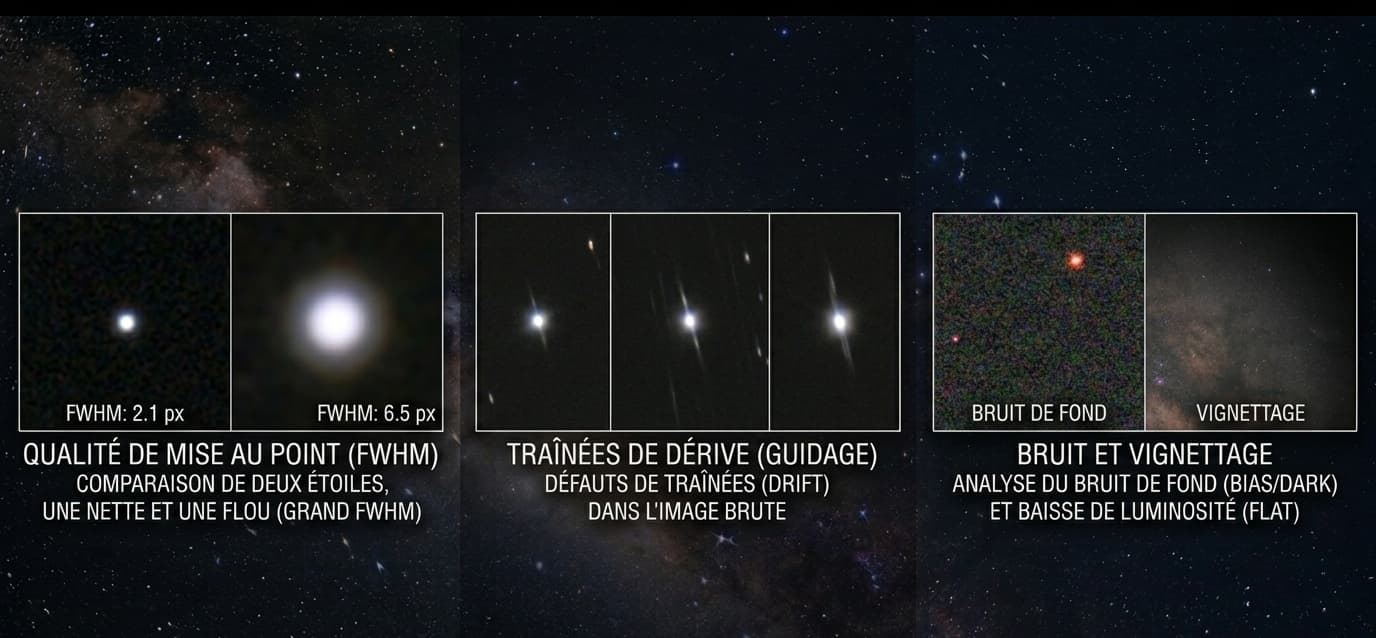
The acquisition is solid: on the PSF plate the center is round (elong 1.05 against a field floor of 1.02) and the angle dispersion stays low, which rules out any tracking, guiding or field-rotation problem. The HEQ5 PRO tracking and focus are thus on point at 300s subs. The two limits are purely instrumental and tied to field optics, not the mount.
The residual vignetting (radial fall-off ~27%, R2=0.91, near-perfect rotational symmetry) is the dominant defect: it signals insufficient flats or too gentle a background correction, not an oriented gradient (the plane component is negligible at 10% R2=0.08). In parallel, FWHM rises symmetrically toward the four corners (ratio 1.21) without radial coma: this is field curvature / mild backfocus typical of an f/4 Newtonian, to distinguish from tilt (no diagonal asymmetry). The right edge is the most affected.
Finally, a few bright-star cores are clipped, cosmetic and easily recovered with a short-exposure sub-layer. The extended reddish background matches the real nebulosity visible in the DSS: don't mistake it for a gradient to flatten out.
Priority actions
- Reshoot careful flats per filter (same optical train) to eliminate the ~27% residual vignetting, then redo the rotationally symmetric background correction
- Fine-tune the coma corrector backfocus in 0.5-1mm steps to equalize the FWHM across the four corners
- Add a few short exposures per filter to rebuild the clipped bright-star cores