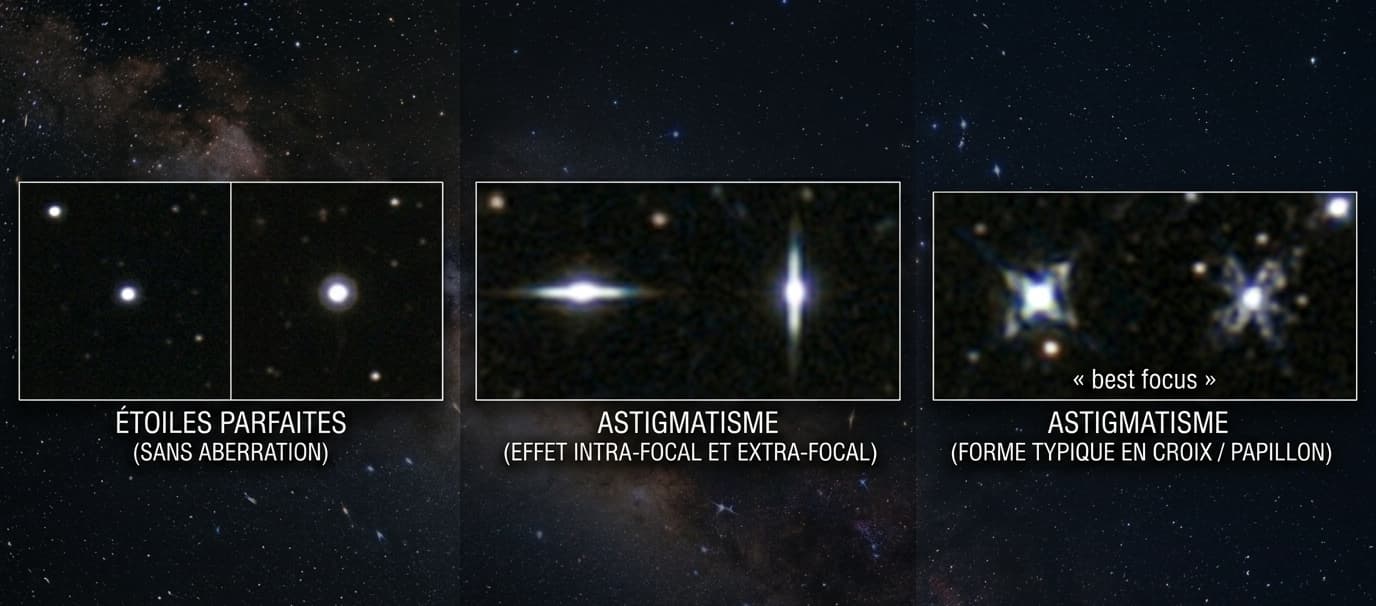
Astrophotography diagnosis of M 16: Astigmatism
RawHa180s12 juil. 2026
The Doc examined this image of M 16 (raw, Ha, 180s). Estimated overall technical quality: 6/10. 1 defect found: Astigmatism (severity 2/5).
&w=1920&q=75)
Info
- Cible
- M 16
- Date
- 12 juil. 2026, 12:31
- Lune
- Gibbeuse croissante 94.7% (sous l'horizon)
- Site
- Bortle 3 · rural peu pollué (VIIRS)
- Position
- 18h18m51s · -13°48'06"
Favorable conditions. The Moon is below the horizon and 161.7 deg from the target, so no lunar contribution is possible on this sub, and the stated Bortle 3 keeps the sky background very low. On M16, an emission nebula shot in Ha, you combine the best of both: a narrowband filter and a dark sky, which explains a very lightly loaded background and the absence of any measured gradient. In that context you can afford long exposures without fear of saturating the background, and most of the SNR will come from total integration time rather than from gradient processing.
Setup
- Type d'image
- Brut
- Télescope
- RC8_R66
- Caméra
- QHYminiCam8M
- Filtre
- Ha
- Monture
- CEM40
- Exposition
- 180s
- Phase de lune
- Waning crescent (8 %)
- FOV
- 34.2'
A coherent but demanding setup. At 1100 mm and f/6 with 2.9 um pixels you sample at 0.544"/px, clearly oversampled against typical seeing: the measured FWHM of about 7 px at center corresponds to roughly 3.8", which reflects seeing and tracking more than optics. Binning 2 in processing would buy SNR with no real loss of resolution. The 0.57 deg field is tight on M16: you frame the Pillars and the core, but the nebula overflows. On the settings side, gain 9 and offset 100 with 180s in Ha give a very low background, normal in narrowband despite the e_margin of 1.08; the sensor at -14.9 C is healthy. You could consider 300s to lift the background further above read noise.
The diagnosis in detail
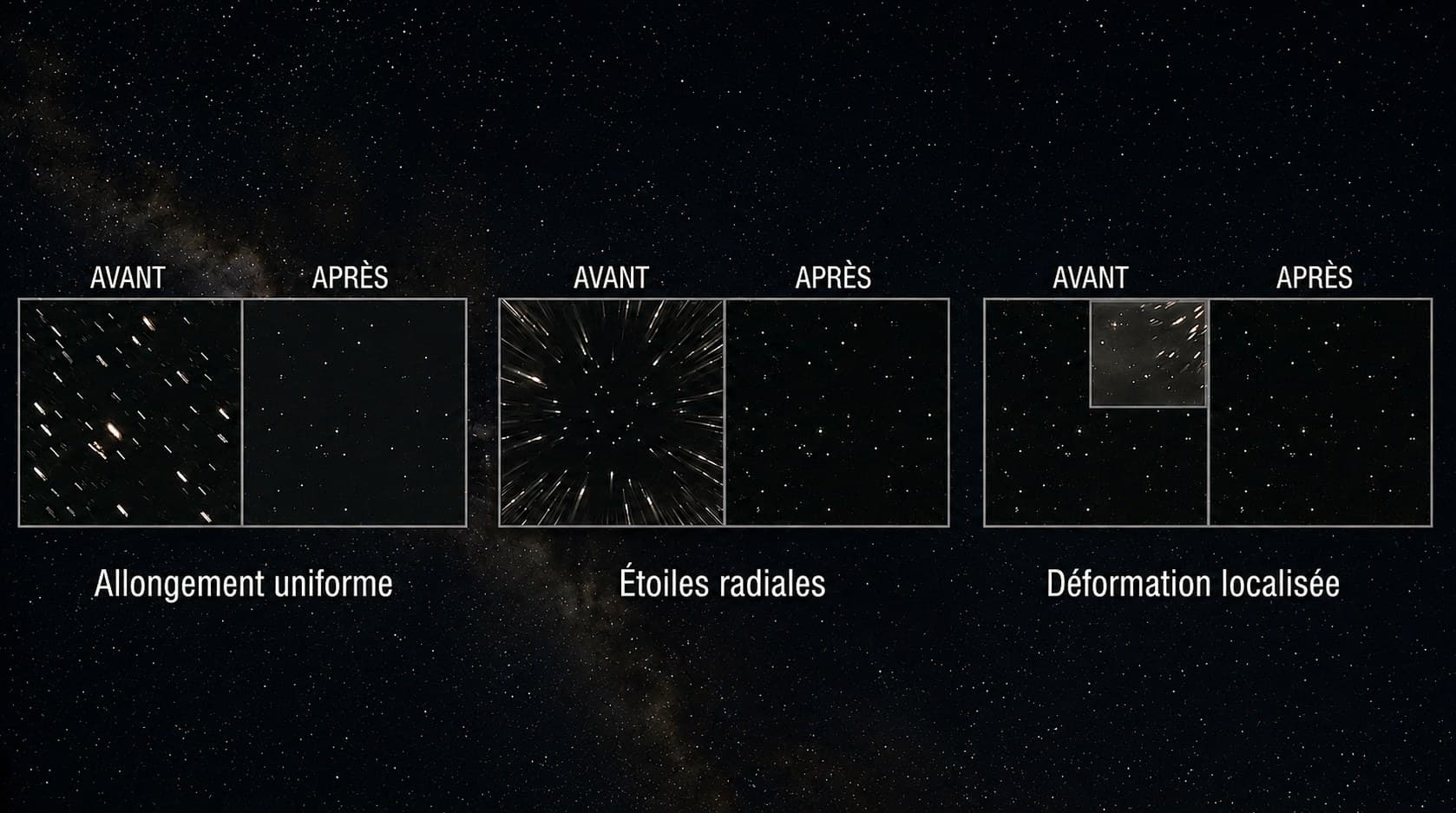
The sub is clean on the axes that matter most. The field center gives an elongation of 1.06 against a measured floor of 1.03: the CEM40 tracking over 180s leaves no directional trace, and the 23 deg PA dispersion between zones confirms there is no coherent field-wide elongation. In other words, no drift, no periodic error, no guiding oscillation to fix.
What remains happens at the periphery and belongs to field optics. Two signatures coexist and are in fact linked: elongation rising on the left and bottom edges without an FWHM increase, typical of field astigmatism, and a symmetric FWHM rise toward the four corners (ratio 1.117) that points to residual field curvature, meaning the R66 reducer spacing is slightly off. On a reduced RC8 these two effects move together with spacing: a fine backfocus adjustment often eases both at once. The amplitudes stay modest, and on a single noisy sub the Moffat fit in star-poor zones is fragile, hence measured confidences rather than certainties.
At this level the image is perfectly usable in a stack. The priority is not to rescue this sub but to gain a few percent of corner sharpness across the rest of the series.
Priority actions
- Fine tune the R66 reducer spacing in 1 mm steps and compare the corner/center FWHM ratio at each trial
- Check for mechanical stress in the optical train (spacers and filter holder tight but not forced)
- Consider 300s Ha exposures to lift the background further above read noise under this Bortle 3 sky
- Plan on binning 2 in processing, since 0.544"/px sampling is far beyond the actual seeing