Astrophotography diagnosis of M 16: Light pollution gradient
RawHalpha27 juil. 2026
The Doc examined this image of M 16 (raw, Halpha). Estimated overall technical quality: 8/10. 1 defect found: Light pollution gradient (severity 2/5).
&w=1920&q=75)
Info
- Cible
- M 16
- Date
- 27 juil. 2026, 21:14
- Lune
- Croissant décroissant 2.9% (15.9° d'alt., 17.7° de la cible)
- Site
- Bortle 3 · rural peu pollué (VIIRS)
- Position
- 18h18m52s · -13°50'21"
Excellent conditions. Bortle 3 on an emission target shot in Ha means sky background is almost a non-issue, and the Moon, a mere 2.9% crescent at 15.9 deg altitude, contributes nothing measurable even at 17.7 deg from the target. The measured gradient is therefore not lunar in origin: it points to a large-scale background tied to observing altitude or to stray light. In this context you can comfortably lengthen Ha exposures and aim for a long total integration, the background noise budget is very favorable.
Setup
- Type d'image
- Brut
- Télescope
- CDK 12,5"
- Caméra
- Moravian USB Camera 1 (64 bit)
- Filtre
- Halpha
- Phase de lune
- Gibbeuse croissante (97 %)
- FOV
- 48.2'
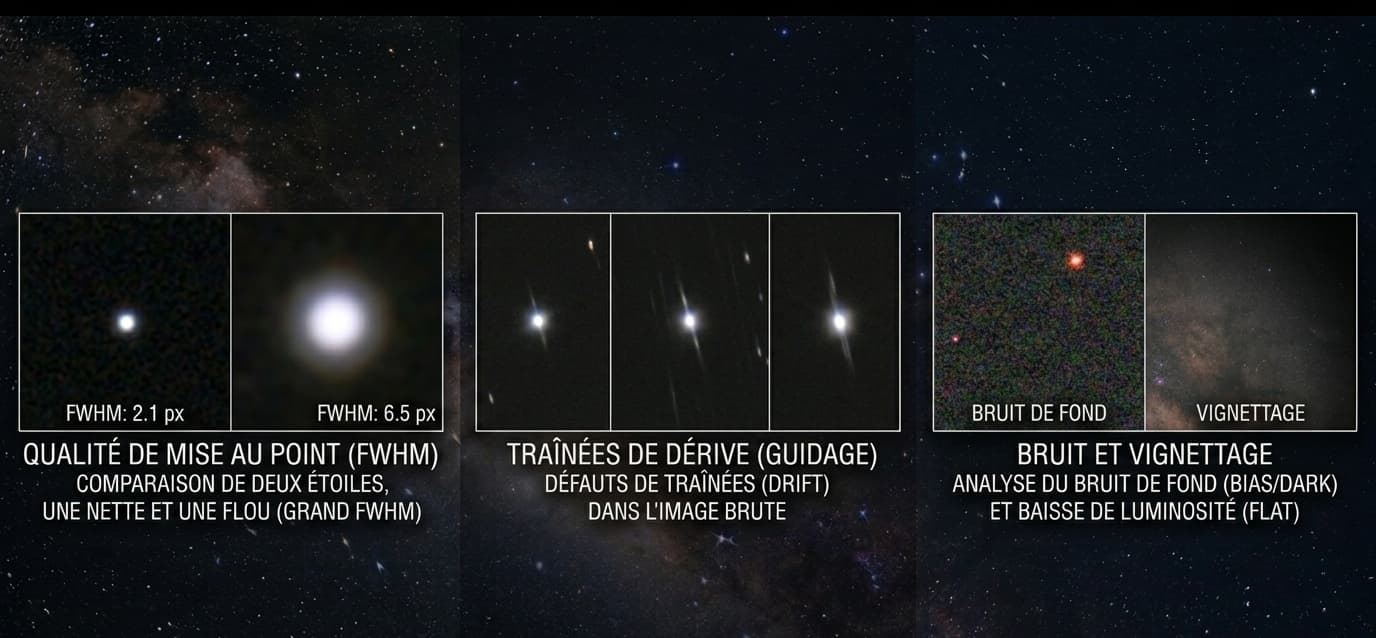
Coherent but tight setup. The CDK 12.5in at 2541 mm gives a 0.80 deg field for M16, whose nebular envelope slightly overflows: the useful part (pillars, NGC 6611 cluster) is well contained, but the outer Ha halo is cut off. Sampling at 0.731 arcsec/px is oversampled for typical seeing, confirmed by the measured FWHM of 5.5 px, roughly 4 arcsec: binning 2 in processing would cost no detail and would double the signal-to-noise ratio. The Ha filter is the right call here. The background-to-black-point margin e_margin=3.26 is low, but that is normal in narrowband with this filter, not a sign of underexposure.
The diagnosis in detail
Star shape is the strong point of this frame. Elongation at center is 1.10, exactly at the field floor for a monochrome camera, and the corners peak at 1.15 (BR) with a corner/center FWHM ratio of just 1.091. In other words, edge-of-field degradation is under 10%, which rules out tilt, backfocus error, coma and astigmatism. The 11.5 deg PA scatter combined with floor-level elongation means round stars, not drift: tracking held over this exposure. The PSF panel visually confirms these numbers, the cyan ellipses hug regular cores across all nine zones.
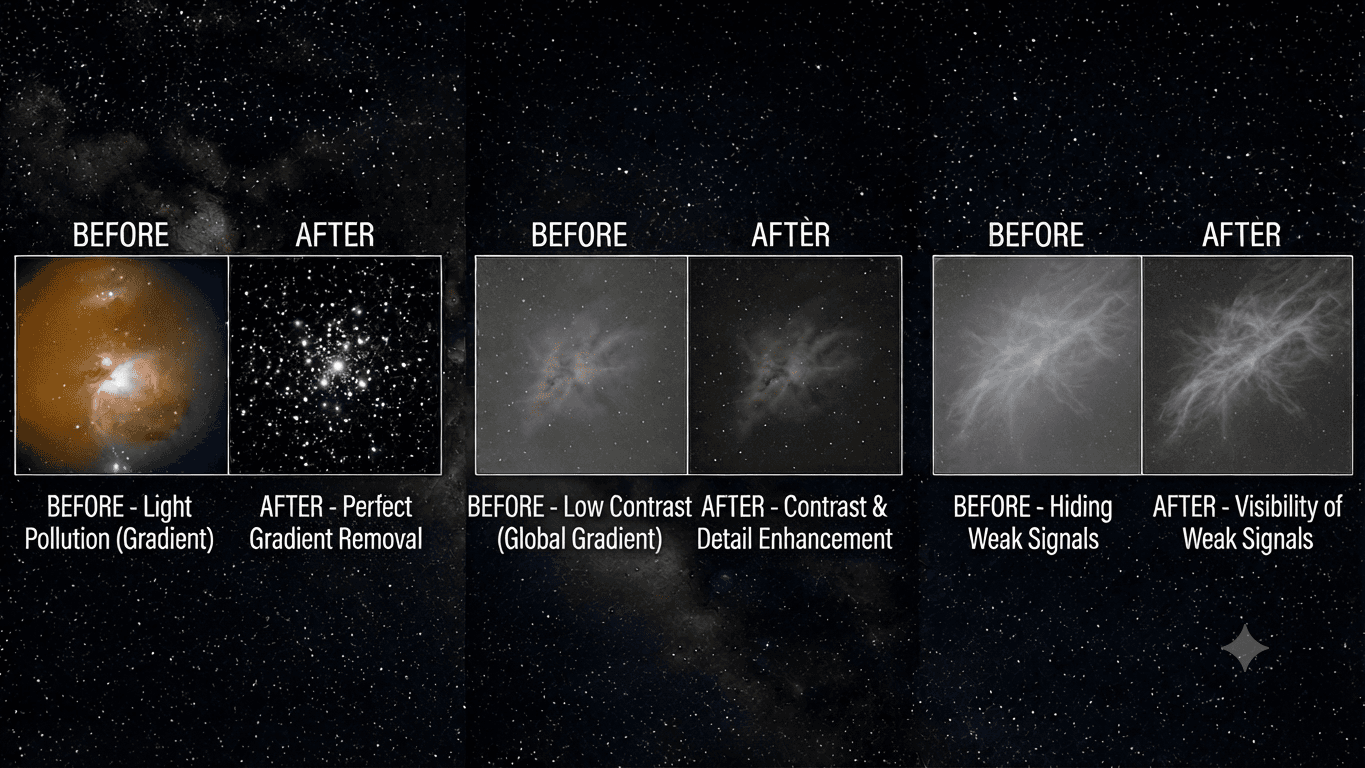
The only measured instrumental defect is a background gradient oriented at 100 deg with 27% amplitude, with a plane/radial dominance of 3.79 that rules out vignetting: this is not a radial falloff but an oriented ramp, darker toward the top-right corner. On a Bortle 3 site with a negligible Moon, the most likely explanation is a large-scale background tied to altitude or stray light rather than outright urban pollution. It is fully correctable after stacking.
At this uncalibrated raw stage, the readout band on the sensor's first rows and the absence of darks are expected. The 5.5 px FWHM reflects heavy oversampling more than a focus issue: at 0.731 arcsec/px it corresponds to about 4 arcsec of seeing, consistent with an ordinary night at this focal length.
Priority actions
- Remove the oriented gradient after stacking (GraXpert or DBE with samples placed off the nebula)
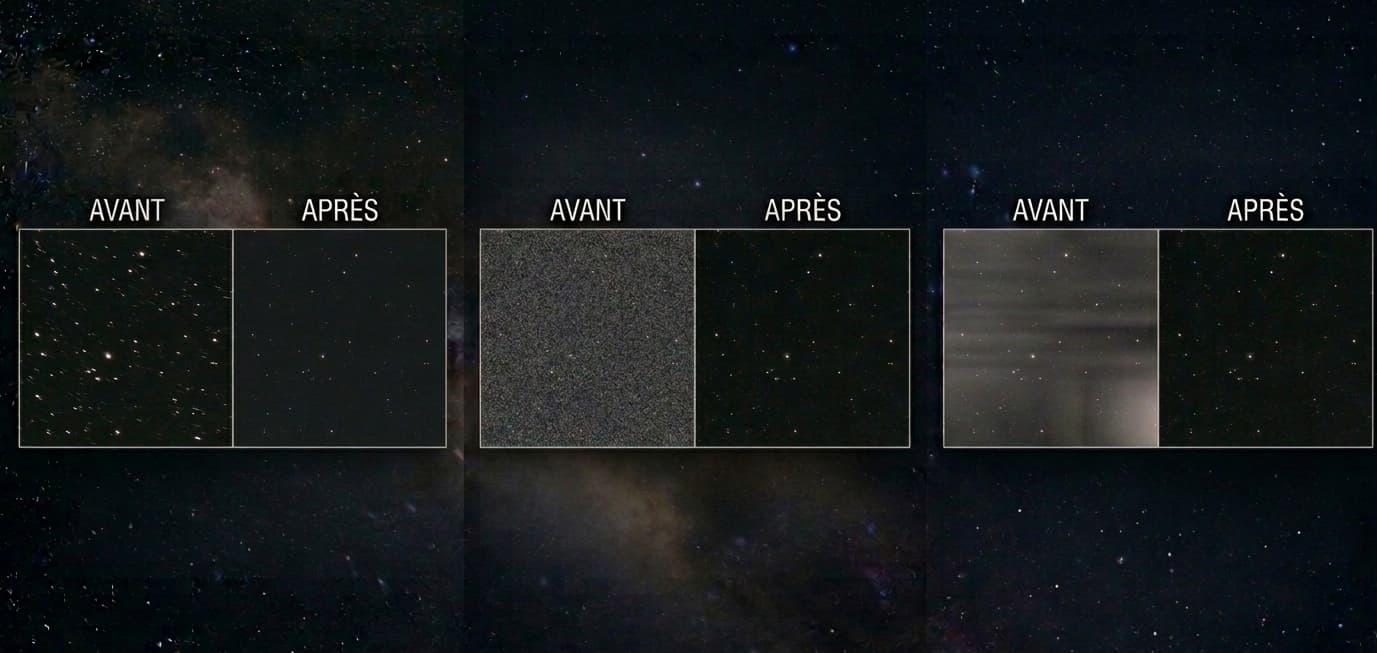
- Calibrate with darks and bias at matching gain and temperature to erase the top readout band
- Consider binning 2 in processing, since 0.731 arcsec/px sits well below the measured seeing
- Check for oblique stray light in the CDK optical train
- Extend total Ha integration, Bortle 3 conditions and the absent Moon allow it