Astrophotography diagnosis of M16: Residual vignetting and focus miss
Processed258x50s
The Doc examined this image of M16 (processed, 258x50s). Estimated overall technical quality: 7/10. 2 defects found: Residual vignetting (severity 2/5), Focus miss (severity 2/5).
&w=1920&q=75)
Info
- Cible
- M16
- Position
- 18h18m48s · -13°48'00"
Moon at 4% (near new moon): ideal conditions for an emission target like M16, no lunar pollution to worry about. The measured background stays clean, with no significant oriented gradient (plane R²=0.14, negligible). You made the most of the window: 258x50s, about 3h35 of integration, coherent to pull out the detail of the Pillars of Creation. No sky concerns to flag.
Setup
- Type d'image
- Traitée
- Télescope
- Askar FRA400
- Caméra
- ZWO ASI585MC Pro
- Monture
- ZWO AM5-N
- Exposition
- 258x50s
- Phase de lune
- 4%
- Notes
- Pas d'autofocus, pas de guidage
- FOV
- 54.0'
The Askar FRA400 (400mm) and ASI585MC on the AM5-N gives a 0.90° wide field, framing M16 comfortably with its peripheral nebulosity well included and no clipping. Sampling is fine and well matched to this focal length. The choice of short 50s subs without guiding is wise on the AM5-N: the measurement confirms it, perfectly round stars everywhere. The background/black-point margin (e_margin 1.23) is low but that's normal in narrowband, don't penalize it. The only truly actionable gap: autofocus, to tighten the stars.
The diagnosis in detail
The PSF panel is reassuring: elong between 1.00 and 1.03 across the nine zones, with no coherent elongation direction, validating flawless tracking from the unguided AM5-N on 50s subs. No signature of tilt, backfocus, coma or astigmatism: corners do not degrade significantly relative to the edges, the optics are healthy.
The only real caveat on star shape is size: FWHM from 5.7 to 7.4 px, somewhat soft disks. This is the expected signature of a session without autofocus, where focus is set manually and drifts thermally through the night. Nothing catastrophic, but autofocus or regular refocusing would noticeably tighten the stars and improve sharpness on the pillars.
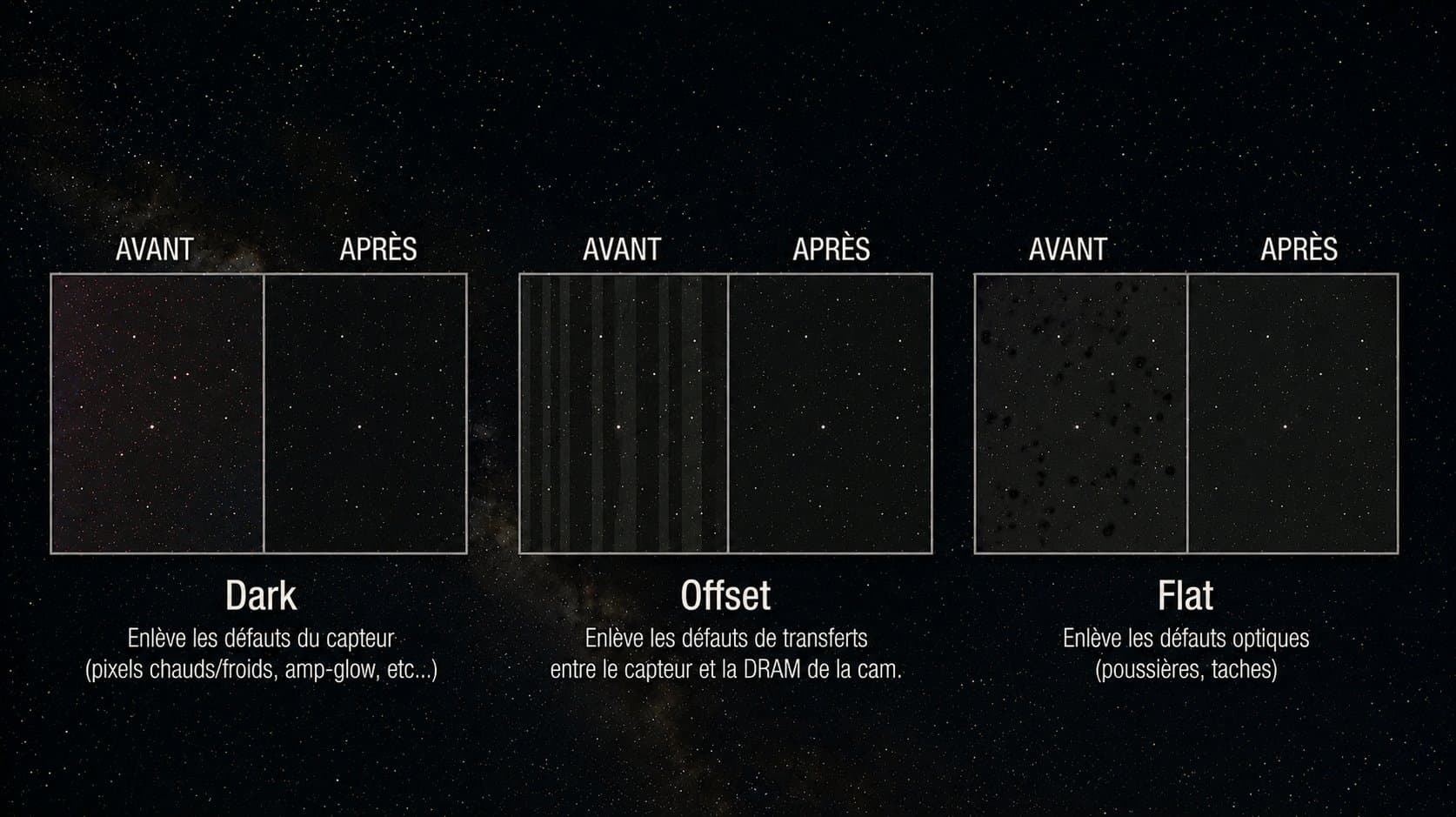
On the background, the measurement isolates a 36% radial falloff with rotational symmetry (plane/radial dominance 0.2), a classic residual vignetting from a missing or mismatched flat. Easy to fix in post-processing or to eliminate permanently with proper flats. Overall a solid result.
Priority actions
- Add an autofocus routine (or regular manual Bahtinov refocus) to tighten the FWHM
- Shoot flats on the exact optical train to remove the residual vignetting
- In the meantime, correct the background residual with GraXpert or DBE