Astrophotography diagnosis of M16: Backfocus error and clipped stars
ProcessedHa, OIII, SIISII 12×300s · Ha 12×300s · OIII 9×300s (total ~2.8 h)29 juil. 2025
The Doc examined this image of M16 (processed, Ha, OIII, SII, SII 12×300s · Ha 12×300s · OIII 9×300s (total ~2.8 h)). Estimated overall technical quality: 7/10. 2 defects found: Backfocus error (severity 2/5), Clipped stars (severity 2/5).
&w=1920&q=75)
Info
- Cible
- M16
- Date
- 29 juil. 2025, 00:00
- Position
- 18h18m48s · -13°48'00"
Moon at only 23%, which is favorable, and above all with no real impact in narrowband (Ha/OIII/SII) where spectral selectivity makes the image nearly insensitive to moonlight. For an emission nebula like M16 these conditions are ideal: narrowband lets you image even under Moon or urban pollution with no notable SNR loss. The 2.8h total stays modest for SII and OIII (weak signal); adding integration on those two channels would boost the signal-to-noise and allow a deeper process without raising chroma noise.
Setup
- Type d'image
- Traitée
- Télescope
- Sky-Watcher Quattro 150P
- Caméra
- ZWO ASI585MM Pro
- Filtre
- Ha, OIII, SII
- Monture
- Sky-Watcher EQ6-R Pro
- Exposition
- SII 12×300s · Ha 12×300s · OIII 9×300s (total ~2.8 h)
- Phase de lune
- 23%
- Notes
- Logiciels : PHD2, PixInsight, Nighttime Imaging 'N' Astronomy (N.I.N.A. / NINA)
- FOV
- 42.0'
The Quattro 150P (600mm focal, f/4) with the ASI585MM Pro yields a 0.70 degree field that frames M16 well: the Eagle Nebula and its cluster fit in the frame with some breathing room. The 585 sampling (2.9um pixels) at 600mm gives about 1 arcsec/px, slightly oversampled for current seeing but consistent with the tight measured FWHM (~1.5px). The triple narrowband filter on an emission target is the optimal choice. The coma corrector is mandatory on this f/4 Newtonian: the slight residual corner curvature simply indicates backfocus to fine tune by a few tenths of a mm.
The diagnosis in detail
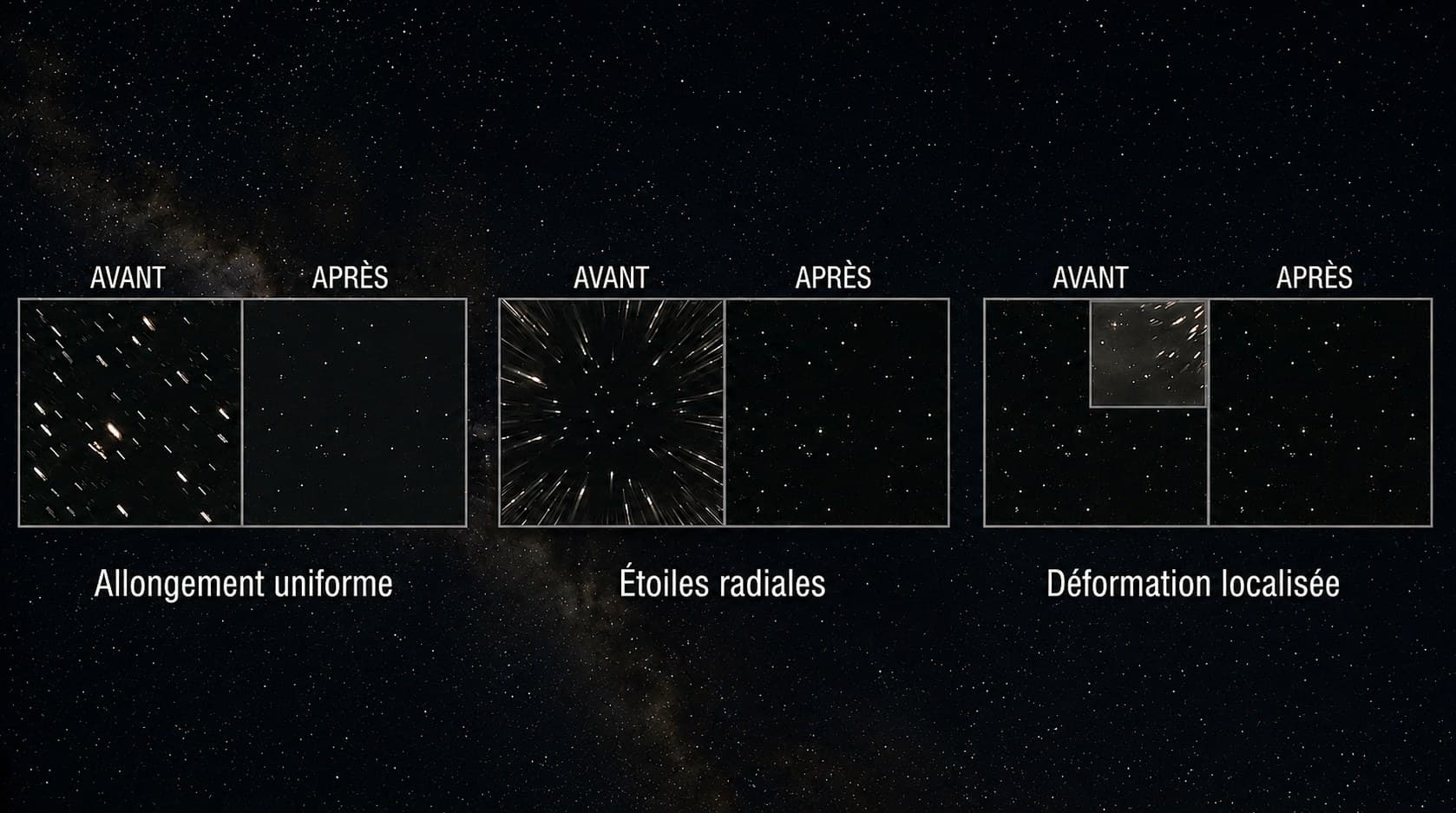
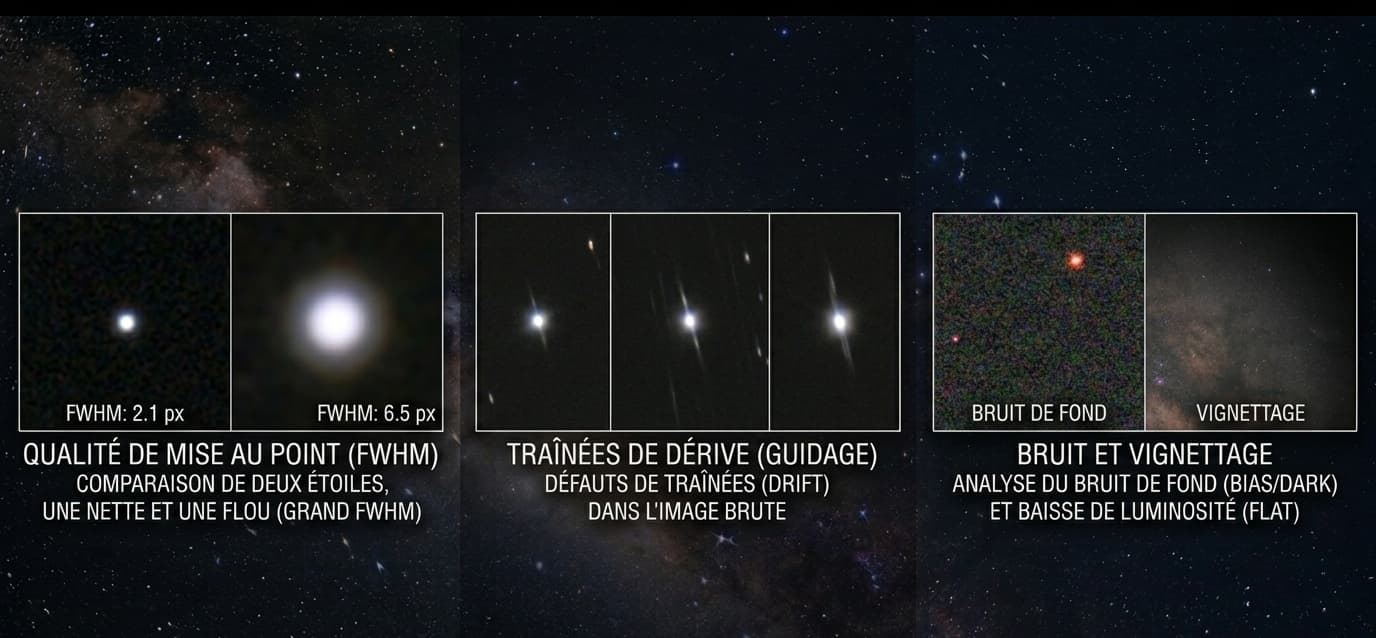
This SHO palette image of M16 is overall well made. The PSF plate confirms excellent tracking and clean optics at center: FWHM stays around 1.4-1.6 px across the whole field, and the high elongation measured at center (1.68) is a measurement artifact (the reference star sits in bright nebulosity, the Moffat ellipse is poorly constrained), not a real tracking flaw. The 37 degree PA dispersion and corner consistency confirm the stars are essentially round.
The only real optical point is a smooth symmetric FWHM rise toward the corners (corner/center ratio 1.32), with slightly oval stars and no clear radial coma: the classic signature of residual field curvature / coma corrector backfocus slightly out of tolerance on this f/4 Newtonian. It is minor and easily corrected by a spacing adjustment.
On the processing side, a few bright stars in the NGC 6611 cluster core are clipped (white cores with no nuance), recoverable via HDR or highlight protection. The measured background variation (+47%) corresponds to real nebulosity confirmed by the DSS, not an instrumental gradient. The background stays clean. The whole is a good amateur result that simply deserves more integration on SII/OIII.
Priority actions
- Fine tune the coma corrector backfocus by a few tenths of a mm to make the corner stars perfectly round
- Increase integration time on SII and OIII (weak channels) to improve SNR
- Protect highlights during stretch or add short exposures to recover clipped star cores