Astrophotography diagnosis of M16: Sensor tilt, clipped stars and 1 other
ProcessedHa / SII / OIII - 3nm3x20x600"
The Doc examined this image of M16 (processed, Ha / SII / OIII - 3nm, 3x20x600"). Estimated overall technical quality: 8/10. 3 defects found: Sensor tilt (severity 2/5), Clipped stars (severity 2/5), Background chroma noise (severity 2/5).
&w=1920&q=75)
Info
- Cible
- M16
- Site
- Bortle 4 · transition rural/banlieue (VIIRS)
- Position
- 18h18m50s · -13°52'44"
Comfortable conditions for this target. Bortle 4 with a 30 percent moon in 3 nm narrowband is almost a non-issue: 3 nm filters reject most lunar scatter and residual light pollution, which the background map confirms since no instrumental gradient was detected (the measured background variation matches the nebula itself). M16 is a strong emission target, exactly the case where moonlight costs almost nothing. The only notable effect is a background barely lifted off the black point (margin 1.01), normal in narrowband at 600 s and not a sign of underexposure. You can keep shooting this target even with a rising moon, prioritizing the OIII and SII channels which remain the limiting ones.
Setup
- Type d'image
- Traitée
- Télescope
- Planewave CDK 12,5"
- Caméra
- Moravian C4 monochrome
- Filtre
- Ha / SII / OIII - 3nm
- Monture
- Paramount MX+
- Exposition
- 3x20x600"
- Phase de lune
- 30%
- FOV
- 49.5'
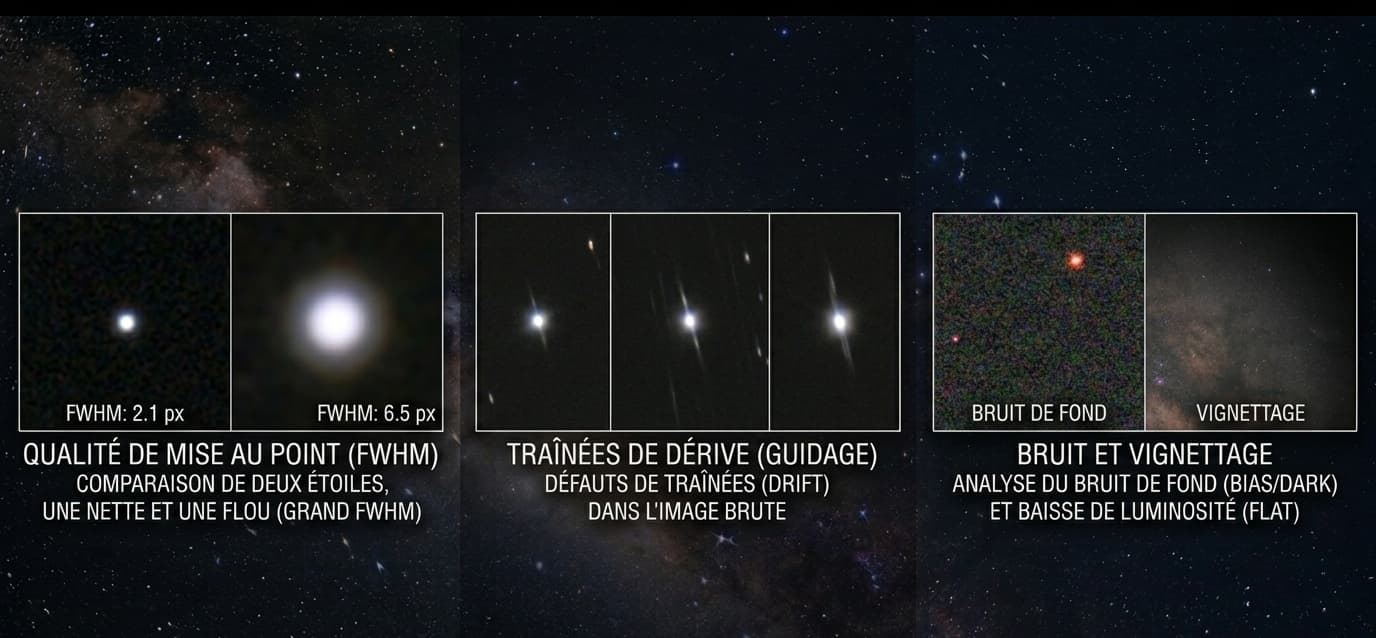
Coherent, high end setup for M16. The 12.5 inch CDK with the C4 gives a 0.83 degree field, framing the whole nebula with room for the faint extensions: the right compromise, neither too tight on the Pillars nor lost in empty sky. Measured FWHM around 6.5 px at center suggests fairly fine sampling relative to the seeing, typical of this kind of long focal length rig; 2x2 binning on the SII and OIII channels would buy SNR without losing real detail. The 3 nm filters are the right call here. The point to watch is mechanical: with a heavy imaging train on a CDK, sensor flatness needs regular checking, and that is exactly what the measurement is flagging.
The diagnosis in detail
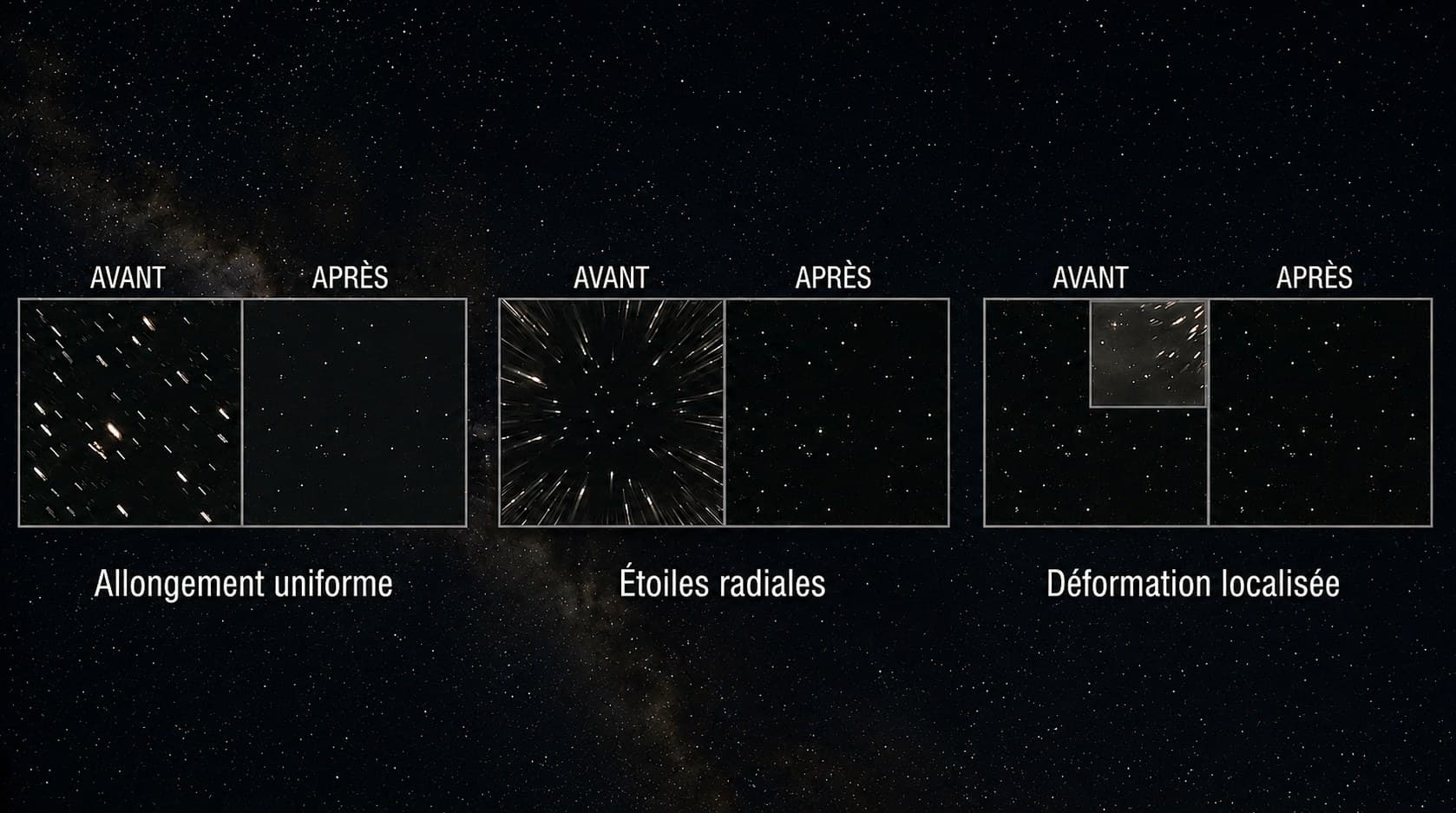
The image is of a very high standard and the remaining issues are all second order. The PSF measurement is unambiguous about tracking: elongation of 1.01 to 1.03 everywhere, PA dispersion of 31 degrees (so no preferred direction), which rules out drift, periodic error and guiding oscillation. The Paramount MX+ lets nothing slip at 600 s.
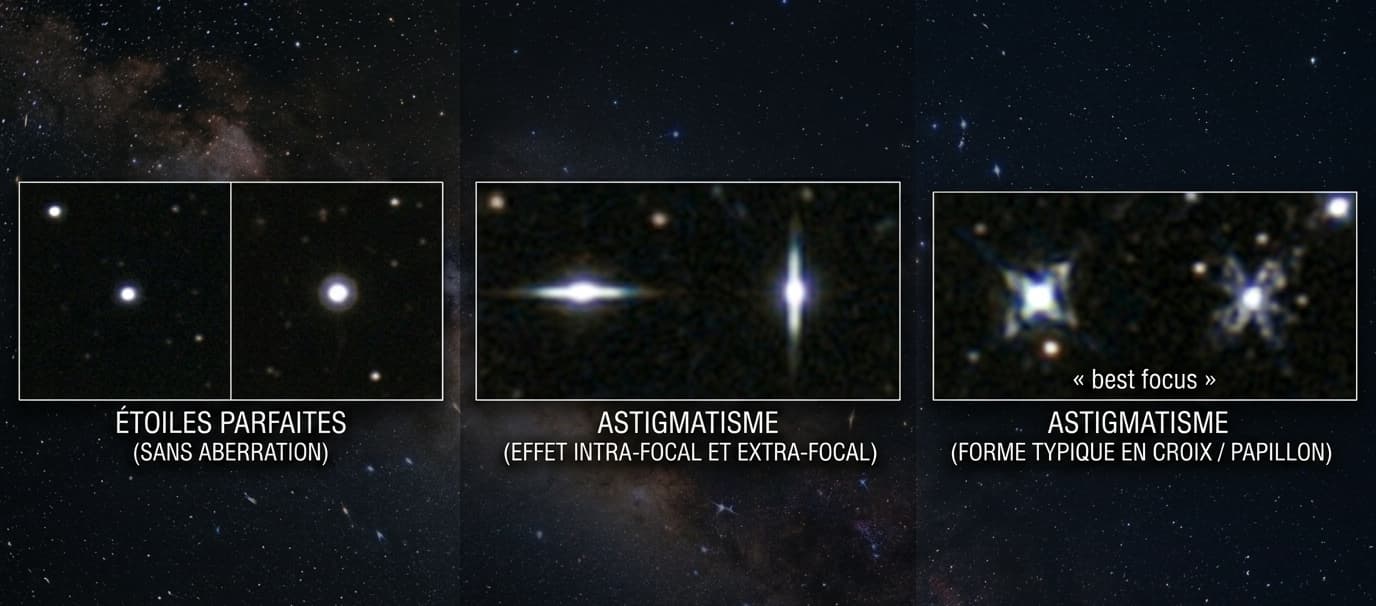
The only instrumental defect is a flatness problem. FWHM stays steady at 6.5 to 7.1 px across the entire top half and center, but climbs to 8.2 px at the bottom right corner and 14.2 px on the bottom edge. Vertical asymmetry (0.347) is five times the horizontal figure (0.063), and the stars stay perfectly round: this is neither coma nor astigmatism, but progressive defocus along a single axis, the signature of a tilted sensor plane. The extreme bottom edge value deserves a check since it may be inflated by a saturated star in the measurement window.
The rest is post processing: clipped star cores in NGC 6611 from the lack of a short exposure layer, and chroma noise in the lower left background revealing OIII/SII SNR below Ha. Both are recoverable in reprocessing, with no new acquisition needed except for the short subs.
Priority actions
- Correct the sensor tilt along the vertical axis, checking per-zone FWHM after each adjustment
- Rerun an aberration measurement on a single sub to validate the real tilt amplitude, since the bottom edge zone may be biased
- Add a short exposure set per filter to rebuild the cluster star cores in HDR
- Strengthen the OIII and SII channels, possibly with 2x2 binning, to cut background chroma noise
- Apply targeted chroma noise reduction on the background during reprocessing