Astrophotography diagnosis of M16: Sensor tilt, clipped stars and 1 other
ProcessedHa / SII / OIII - 3 nanomètres3x20x600"
The Doc examined this image of M16 (processed, Ha / SII / OIII - 3 nanomètres, 3x20x600"). Estimated overall technical quality: 8/10. 3 defects found: Sensor tilt (severity 2/5), Clipped stars (severity 2/5), Background chroma noise (severity 2/5).
&w=1920&q=75)
Info
- Cible
- M16
- Site
- Bortle 4 · transition rural/banlieue (VIIRS)
- Position
- 18h18m50s · -13°52'45"
Solid conditions for this target. Under Bortle 4 with 3 nm filters, a 30 percent moon is almost irrelevant: a 3 nm passband rejects most of the scattered continuum, and this is exactly the case where you can image without waiting for new moon. M16 being a very bright emission nebula in Ha, the signal to noise is comfortable. The weak link is therefore not the sky but the channel balance: SII and OIII on M16 are markedly fainter than Ha, and 20 subs of 600 s per filter do not quite bring them up to the Ha level, which the background chroma noise confirms. Next session, give SII and OIII extra time.
Setup
- Type d'image
- Traitée
- Télescope
- Planewave CDK 12,5"
- Caméra
- Moravian C4 monochrome
- Filtre
- Ha / SII / OIII - 3 nanomètres
- Monture
- Paramount MX +
- Exposition
- 3x20x600"
- Phase de lune
- 30%
- FOV
- 49.3'
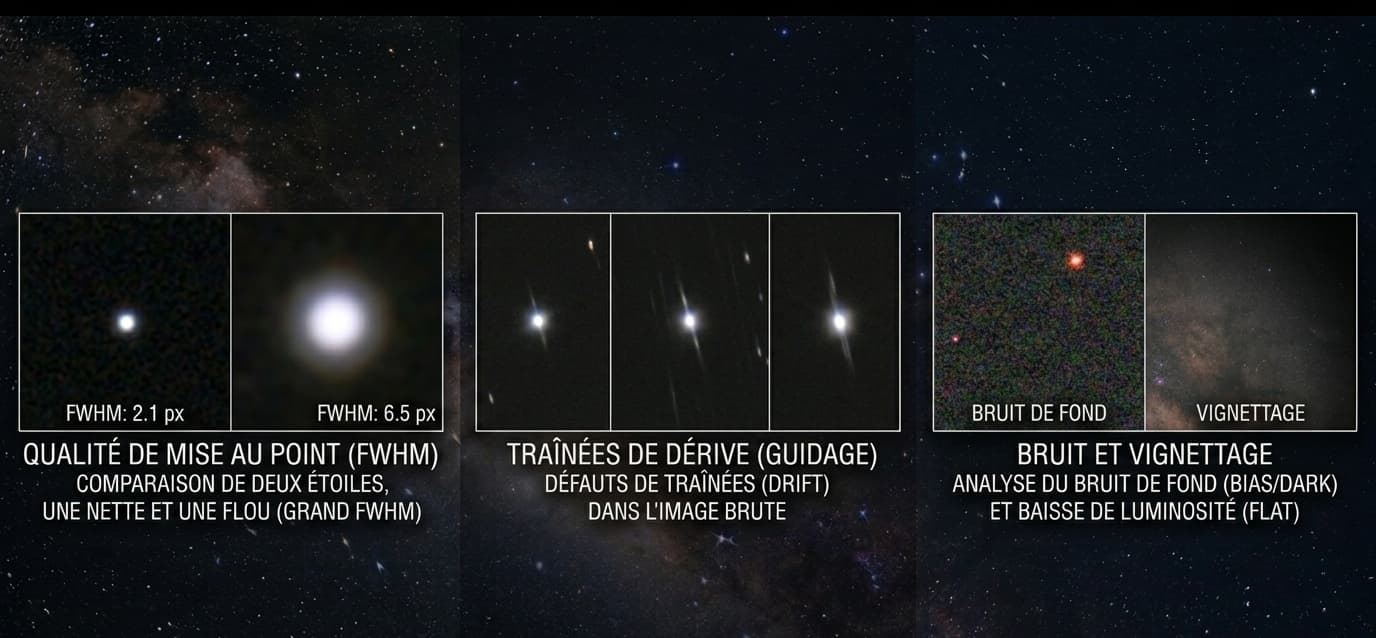
Very coherent setup for M16. The 12.5 inch CDK yields 0.82 degree of field, framing the whole nebula with room around the Pillars: generous, well centered framing. The 5.2 px FWHM at center suggests fairly fine sampling relative to the seeing, typical of this long focal length combination; that is the regime where any field flatness error shows immediately, hence the measured spread on the bottom edge. The Paramount MX+ does its job perfectly over 600 s, with no trace of drift or guiding oscillation. The 3 nm filters are the right choice here and introduce no visible halo on the bright field stars.
The diagnosis in detail
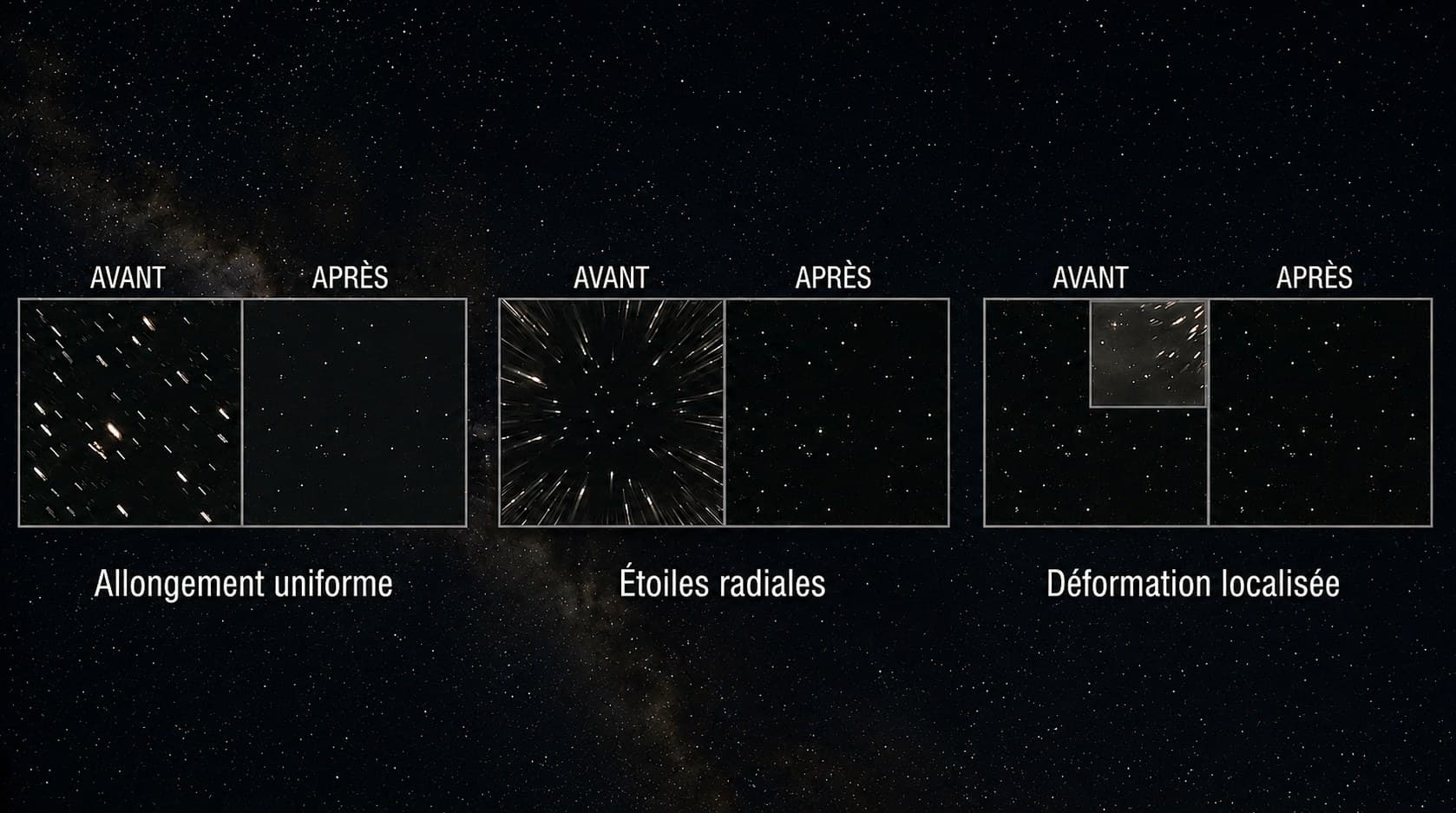
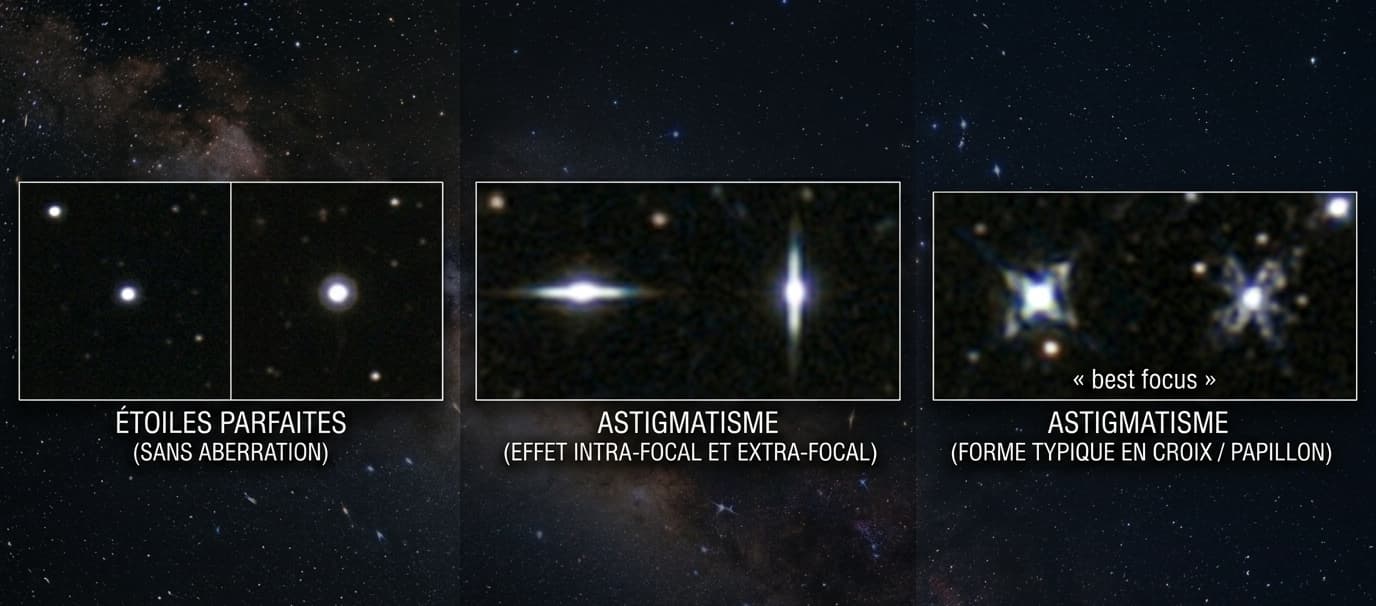
The verdict is clear: a very high quality image, and the three points raised are finishing touches, not fundamental problems. The acquisition chain is healthy, as the PSF measurement shows: elongation between 1.01 and 1.06 across the nine zones, PA dispersion of 30 degrees, in other words round stars everywhere. There is therefore no tracking, guiding or astigmatism component.
The only instrumental defect is a focus asymmetry along the vertical axis: the bottom edge rises to 11.5 px FWHM while the center and top corners stay between 5.2 and 5.6 px, whereas the horizontal axis varies by only 0.05. That single-axis profile, with stars staying round, points to a tilted focal plane rather than field curvature. At this focal length a few hundredths of a millimeter of tilt is enough. It is mechanical and fixable without touching the acquisition.
The other two points come down to processing and channel balance. The cores of the NGC 6611 stars are clipped to neutral white, an expected consequence of 600 s subs with no companion short set. And the background in the dark lower-left areas shows patchy colored mottling: the SII and OIII channels, intrinsically weak on M16, are pushed to the same level as Ha, which lifts their noise. More integration on those two channels would settle two thirds of the issue.
Priority actions
- Correct the imaging train tilt: restore flatness between the CDK and the Moravian C4, then verify with a per-zone FWHM map
- Extend integration on SII and OIII to balance the channels and bring down background chroma noise
- Add a short exposure set of 30 to 60 s per filter to rebuild the clipped stellar cores in HDR
- Apply purely chromatic noise reduction to the background, under a mask, leaving luminance untouched